
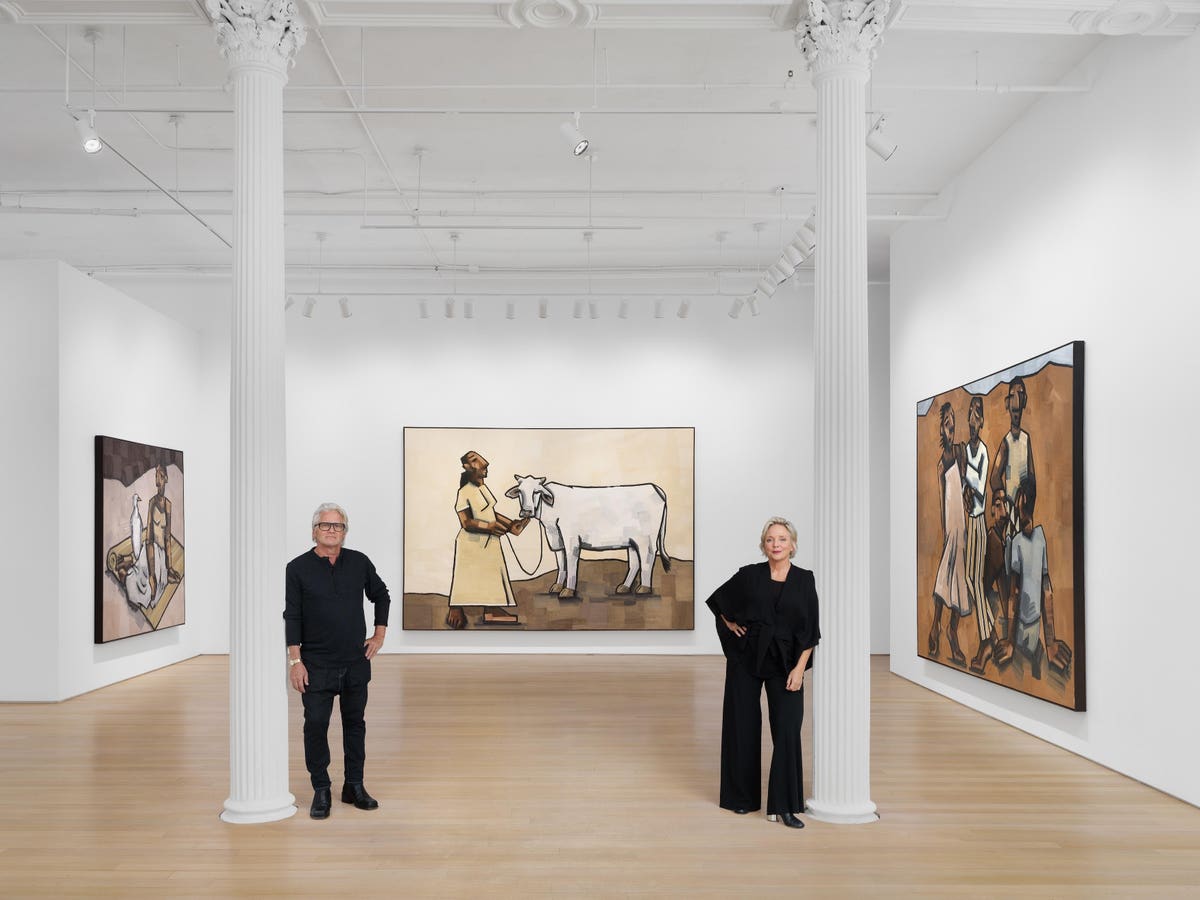
Julian & Trevyn McGowan
Erin Brady for Dan Bradica Studio & SGuild
Cape Town’s Silo District carries a particular kind of industrial quiet. Wind off the harbor moves between the old grain silos and the buildings that now occupy them: museums, galleries, hotels. Inside one of these converted structures, Southern Guild works across a cadence shaped less by exhibition dates than by production cycles that stretch across months and sometimes years.
Founded in 2008 by Trevyn McGowan and Julian McGowan, the gallery began in South Africa, working with collectible design and contemporary art. Today it operates between Cape Town and New York, following the transition of its Los Angeles space to 75 Leonard Street in Tribeca, opening on April 24 with two solo exhibitions by South African artists, Mmangaliso Nzuza and Usha Seejarim.
Table Mountain covered by its typical cloud table cloth and the twelve Apostles. Below on the left you can see Cape Town and the beautiful Camps Bay on the right. Taken right after sunset.
getty
The gallery’s work is built around a question that appears in different forms across continents: what happens to artistic authorship when visibility expands across systems that were not built around it?
“True representation means giving artists the tools, time and platform to tell their own stories on their own terms, and guiding how those stories travel,” says Trevyn McGowan.
She expands the point in full, without breaking rhythm.
“As African artists gain much-deserved visibility, that agency must deepen; not only should more voices be seen, but the terms of encounter must evolve. That means shifting curatorial power, commissioning new work rather than re-packaging existing narratives, investing in the long-term nurturing of practices, and protecting the cultural contexts that make the work meaningful. Visibility without agency can be extractive. Our role is to make sure visibility is a vehicle for creative risk and cultural sovereignty.”
Art, Always Art
Inside Southern Guild, that thinking is embedded in the structure of how work is made and moved. The word guild is used internally to describe a way of operating that privileges shared responsibility across artists, fabricators and curators.
“We’ve always been committed to preserving the collaborative, inclusive essence of who we are,” she says. “Day-to-day, that often looks like listening; long conversations about an idea, considering diverse perspectives in our decision-making, and sometimes simply offering a steady, patient sounding board.”
That extends into how artists are supported across time.
“Artists know we’ll advocate for them with museums, collectors, curators and cultural workers, protecting the alignment of all opportunities,” she says. “That collaborative constancy is in everything we do: shared responsibility and shared joy.”
Cape Town is where most of that infrastructure sits. Ceramic studios, bronze foundries, woodworking workshops and fabrication spaces form a production ecosystem that allows artists to scale technically without losing proximity to process.
Art Examples
One of the most visible examples of that system is the long-term development of Zizipho Poswa’s practice.
“Working with her over the last decade has allowed both the technical language and the conceptual scale of her work to expand from smaller-scale vessels to monumental forms that operate in some of the most significant collections and institutions in the world,” McGowan says.
The shift has been materially specific. Bronze fabrication, ceramic residency work and kiln-based production have all played a role.
“We facilitated her entry into bronze fabrication, which welcomed a transformative material development in her practice,” she says. “Her 2023 residency at the Centre for Contemporary Ceramics at California State University gave her access to kilns that saw her produce a series of forms reaching heights of about 9 feet tall.”
Those works were not separated from exhibition context. They became central to Southern Guild’s Los Angeles presentation.
“We chose to open our LA gallery with these works, honoring the most technically ambitious body of work she had produced,” she says.
Poswa’s work is now held in institutional collections including the Metropolitan Museum of Art, LACMA, the Philadelphia Museum of Art, the Art Institute of Chicago and Princeton University Art Museum among others.
New York, USA. May 5 , 2019. The New York Public Library entrance against blue sky background, sunny spring day
getty
“These production conversations don’t just change trajectories, they create new possibilities,” she says.
Los Angeles entered the system later, becoming a site where Southern Guild’s production-led model encountered a different audience structure and set of expectations.
“What surprised me most was the immediacy of curiosity and the willingness to learn,” McGowan says. “In LA, we found audiences who came with specific questions – about technique, lineage, concept and materiality – and who wanted to sit within complexity rather than reductive categorisation.”
The exchange did not remain contained within the city.
“I also learned how reciprocal the exchange can be,” she says. “Encounters in Los Angeles have informed programming back in Cape Town and sparked collaborations we wouldn’t have been able to conceive from afar.”
Over time, LA became part of a feedback loop between continents.
“The warmth and practical support from our LA community, from local institutions, curators and neighbors, was more generative than we expected,” she adds. “Having a permanent foothold in the US allowed us a space to cultivate and sustain this two-way conversation.”
Across this system, artists often draw from inherited cultural and material frameworks that sit outside Western classification structures.
“Our artists are drawing from deep wells of ancestral knowledge, spiritual practice and personal mythologies,” she says. “Those lineages demand care, time and trust.”
The market context around this work shifts constantly, but McGowan describes a slower internal rhythm that has remained consistent.
“Even as the global art market contracts, our programme has continued to grow,” she says. “I don’t take that for granted. I think we’ve built a model that is slow, resonant and embedded in sustaining the authenticity of our artists’ individual practices.”
That model is tied directly to production infrastructure rather than exhibition output alone.
“We are in the studios, at the kilns, in the foundries; we invest in fabrication, mentorship and are unafraid of experimentation,” she says.
New York Art
New York is the next layer in that system. The Tribeca space adds institutional proximity to an already distributed structure.
“This isn’t just about placing work in a new city,” McGowan says. “It’s about creating a foundation where artists from Africa and the diaspora can engage with institutional partners, curators and collectors year-round, from a place of strength and agency.”
The gallery describes its broader operation as a collaborative environment that facilitates artistic development through long-term engagement with material, process and production.
That structure now spans Cape Town and New York, each location contributing differently to a shared system of making, exhibiting and circulating work. Production, exchange and institutional engagement move continuously between them, depending on the needs of each artist and each project.
“We are able to give artists the confidence and infrastructure to go deeper into their practices, even when the market is unsure of itself,” she says. “That stability is a form of stewardship, and it’s central to how we honor the knowledge they carry.” What emerges from that art system is not growth in the usual sense but a way of working that keeps production relationships and circulation in play over time. That’s exactly why it’s worth your next free afternoon.