
by Michelle Mullen
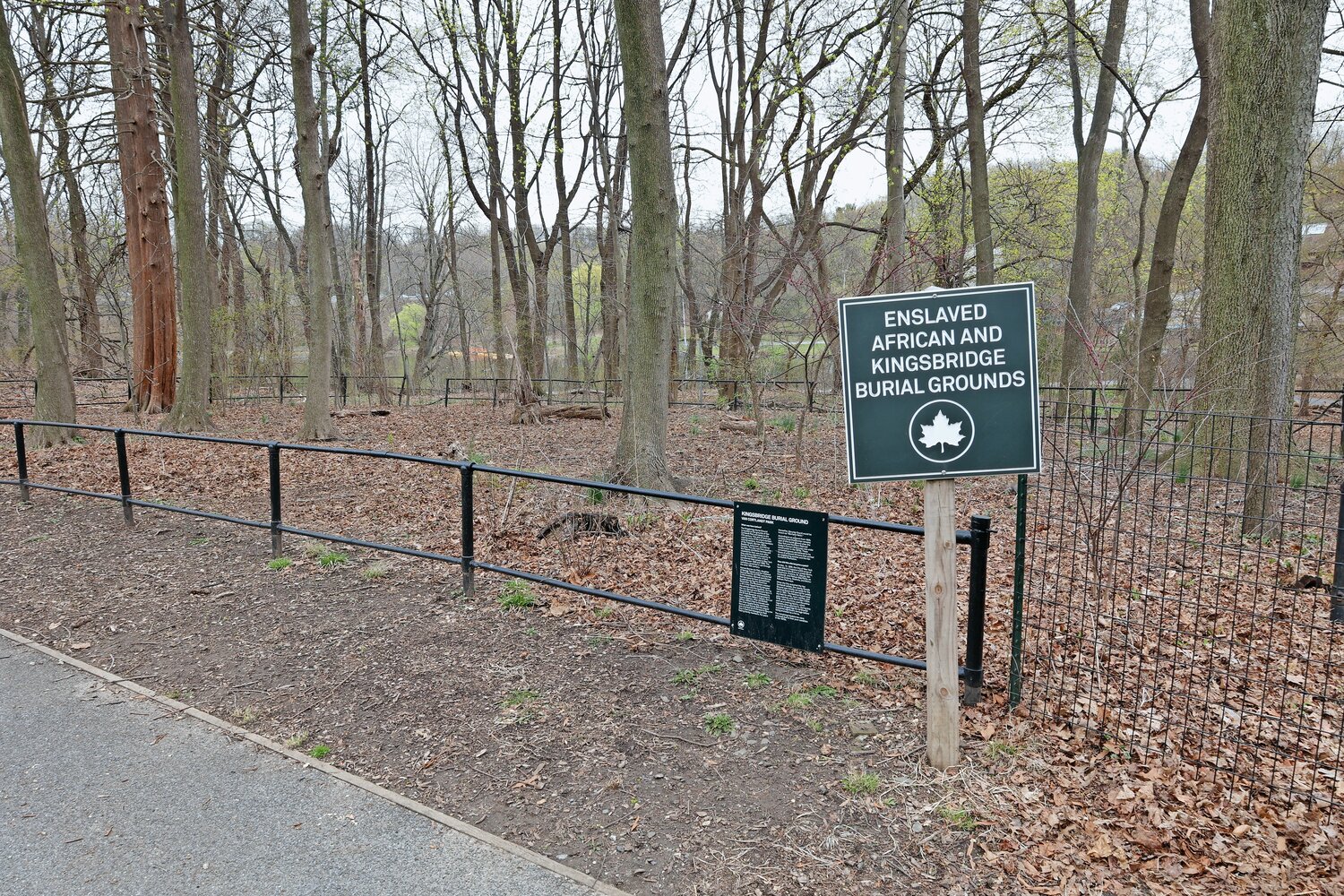
Three design teams, the Pinkster Azalea Collaborative, JIMA Studio and the Sunsum Collective, have been selected to help shape the future of a historic site, a major step forward in an initiative known as “Reimagining an African Burial Ground in Van Cortlandt Park.”
Until now, much of the work has been grounded in research and public programming, with community surveys launched last year, gradually bringing attention to a site that for generations remained largely unmarked within one of the city’s most heavily used parks.
That groundwork is what made this phase possible, said Stephanie Ehrlich, executive director of the Van Cortlandt Park Alliance, which is leading the project alongside the Design Trust for Public Space and Immanuel Oni of Liminal sp.
“This is to generate possible concepts and ideas for what might happen there in the future,” said Ehrlich. “It’s important to remember to frame it as a design ideas lab. The idea of this phase is that there is not going to be a design that will be implemented as a result of this.”
The burial ground lies within land that once formed part of a colonial estate, where enslaved Africans and their descendants worked fields, operated a grist mill and contributed to the development of the surrounding area. Although those histories shaped the terrain, they were rarely acknowledged in how the park was presented to the public for decades.
In recent years, that has begun to shift. Guided tours and educational programs have introduced visitors to the site’s past, tracing connections between present-day features and the labor that defined them.
A Legacy Council of residents, historians and educators played a central role in reviewing the 60 proposals submitted and setting priorities for the project. Their involvement ensured the selection process considered not only design experience, but also cultural awareness, collaboration and sensitivity to the site’s significance.
“Everybody who we selected is from the descendant community,” Oni said. “So these are all Black-owned businesses, which is very important to tell this story.”
Rather than focusing solely on the burial ground, each team has been asked to design a pathway leading to it. The intent is to shape how visitors encounter the site through movement, allowing context to build gradually across the park rather than being concentrated in a single point.
That approach reflects changes already taking place.
A section of the park once associated with the estate’s mill has been renamed to honor Hester and Piero, an enslaved couple, shifting attention away from the Van Cortlandt family. The change offers a new way of understanding a familiar space, and points toward how design might continue that shift.
For the selected teams, the site’s history serves as the starting point.
The Pinkster Azalea Collaborative is led by Rodney Leon, whose work includes the African Burial Ground National Monument in Lower Manhattan. In the Bronx, Leon said the focus is on revealing what has long been embedded in the landscape.
“How do we bring to life a lot of those histories that have been hidden, have been suppressed, have been erased,” he said. “And then re-manifest them so they become more part of our urban spaces.”
Working alongside him are Ifeoma Ebo and Elgin Cleckley, both part of the Pinkster team. Ebo’s approach draws on ecological systems, including plant species tied to Indigenous and African traditions, to express memory through the land itself.
“We’re diving into the landscape and understanding the different conditions,” Ebo said. “We’re exploring the kinds of plants that the Lenape people used and the plants that were brought or cultivated by enslaved Africans.”
Cleckley, a professor at the University of Virginia whose work focuses on race, memory and the built environment, explained the project also opens the door to a broader understanding of New York’s past, particularly the way slavery has been historically framed.
“We have an assumption that there was very little slavery in the North,” he said. “But it was an American institution.”
He added, the effort in Van Cortlandt Park is as much about perception as it is about design, using space to make that history visible within a setting people already know. By situating the burial ground within a public park, he noted, the project could challenge assumptions in a direct and lasting way.
Detroit-based JIMA Studio, led by Uijji Davis Williams, focuses on culturally grounded public spaces and works on projects that center on underrepresented histories and community-driven design.
“I think politically, right now, we are in a moment of erasure and rewriting,” she said. “Particularly the stories of Black contribution to this country.”
That approach is essential to a site like this, she added, where meaning is shaped not only by history, but by how people continue to engage with the land.
The Sunsum Collective, led by Will Jones, often examines how design can reveal connections between past and present, particularly in sites shaped by labor and displacement. In Van Cortlandt Park, Jones said that perspective means looking beyond the burial ground itself to the systems that continue to define the landscape.
“What we really want to do is be able to honor ancestors while linking the history of labor and infrastructure on the site,” he said. “And show how that legacy continues into the present day.”
In the coming months, the teams will present early concepts and continue working with the Legacy Council before sharing their proposals publicly, likely around Juneteenth. The process is designed to remain open, with multiple perspectives shaping the outcome.
Keywords
Van Cortlandt Park,
African Burial Ground Bronx,
Pinkster Azalea Collaborative,
JIMA Studio,
Sunsum Collective,
public space design