
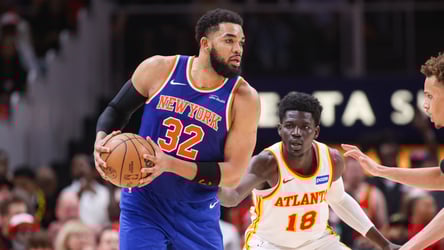
After suffering another loss that came down to a final possession, the Knicks trail the Atlanta Hawks, 2-1, in the first round.
In New York’s 109-108 loss to the Hawks, there were several moments to note. OG Anunoby emerged with 29 points. The Knicks outscored Atlanta, 56-40, in the paint. But the Hawks shot better from the three-point line (39 percent).
Advertisement
As New York tries to even the series on Saturday night, here are three keys to Game 4…
Absent starters need to come through
New York’s starters scored 78 points on Thursday night, but 76 of those points came from the trio of Anunoby, Jalen Brunson (26 points), and Karl-Anthony Towns (21 points). The other two starters — Mikal Bridges and Josh Hart –combined for just two points in 61 minutes.
Bridges was scoreless in 21 minutes, attempting just three shots. He was also a -26 and had four turnovers, leading to him being benched for much of the second half in favor of Deuce McBride. That turned out to be the right decision as McBride was instrumental in New York’s comeback attempt.
Advertisement
The absent offensive performance was another notable moment in an uneven two-year stretch for Bridges. The external noise around the Knicks trading five first-round picks for Bridges only grows louder after performances like this. Hart had two points on 1-for-9 from the field and he missed all four of his attempts from the three-point line.
Hart and Bridges have made significant contributions defensively in this series, and Hart did have nine rebounds and six assists on Thursday. But both players have played a part in New York’s substandard offensive play. New York will need more from both Bridges and Hart on the offensive end in Game 4.
The next logical step is head coach Mike Brown possibly making a change to the starting lineup. As SNY’s Ian Begley noted, one of the burning questions for Game 4 is if McBride will replace Bridges.
Limiting miscues
Creating turnovers on defense is crucial to the Hawks’ strategy. Not a great halfcourt offense, the Hawks have been able to thrive off playing fast and creating transition scoring opportunities.
Advertisement
As this series has worn on, miscues have become a concern for the Knicks. New York had 11 giveaways in the series opener, followed by 14 in the second game. In Game 3, the Hawks forced a series-high 18 Knicks turnovers and scored 21 points off those errors.
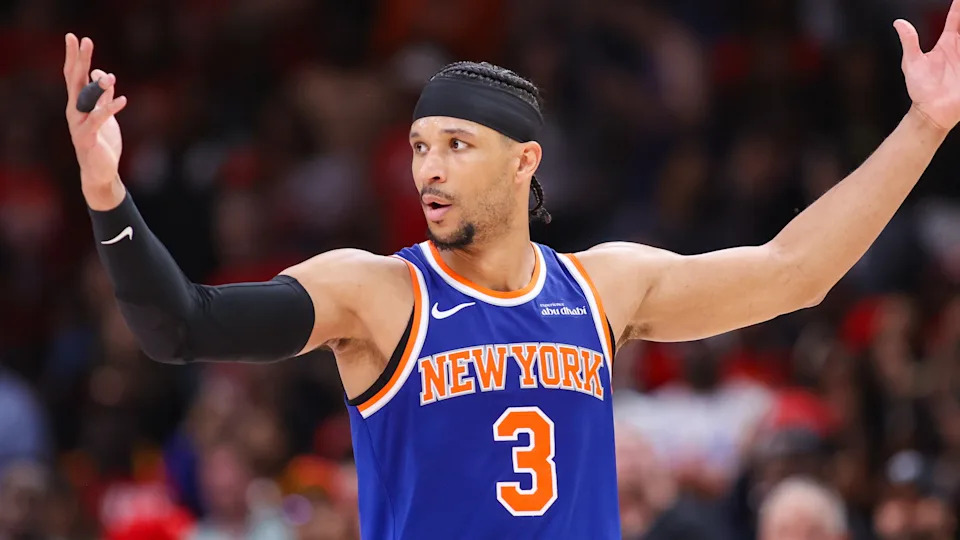
New York Knicks guard Josh Hart (3) reacts to a call against the Atlanta Hawks in the fourth quarter during game three of the first round of the 2026 NBA Playoffs at State Farm Arena / Brett Davis – Imagn Images
Atlanta has athletic finishers like Jalen Johnson and Jonathan Kuminga, who benefited from easy baskets that came from either turnovers or long rebounds. Johnson broke out for his best performance in the series on Thursday with 24 points, 10 rebounds, and eight assists. Kuminga had 21 points off the bench.
Keeping those two players in the halfcourt will be crucial for Game 4. Taking care of the rock is of significant importance, especially when thinking of how each of the last two games have gone.
Advertisement
The plan for Mitchell Robinson
The series was supposed to be made for Robinson. With Atlanta’s diminutive roster, Robinson was expected to dominate off the bench. But so far we’ve seen scant minutes for the seven-footer. Over three games, Robinson is averaging 14.7 minutes.
Two factors seem to be weighing on Robinson’s limited minutes. One is the potential for the Hawks to intentionally foul the notoriously poor free-throw shooter. Brown has also noted that lineups with both Towns and Robinson on the court haven’t been as effective.
When Robinson has played, he hasn’t dominated the offensive glass. Despite Robinson not seeing increased minutes, the Knicks have actually rebounded well on both ends of the floor. New York is sixth among the 16 playoff teams in offensive rebound rate, recovering 33.1 percent of misses, per NBA Stats.