
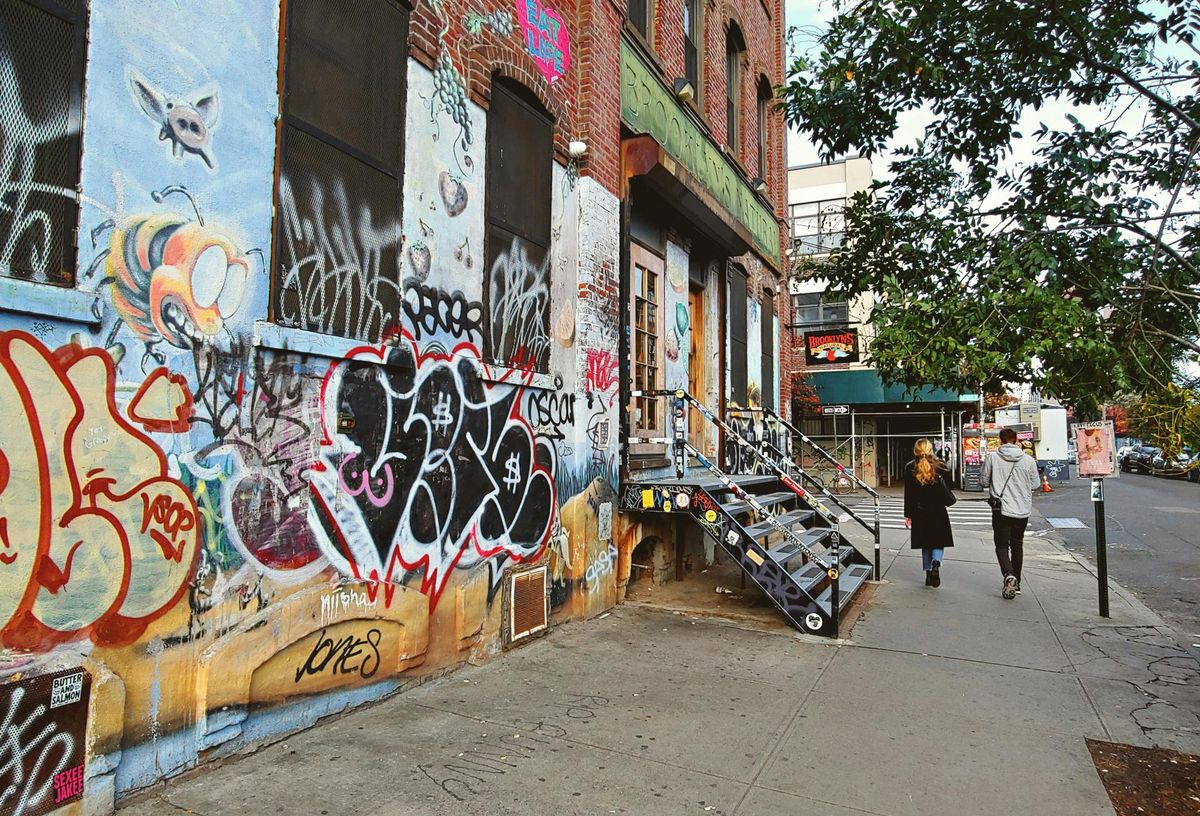
Living in any of Bedford-Stuyvesant, Bushwick or Sunset Park comes with a distinct but equally trendy reputation for Brooklyn’s young professionals — one that brands, in theory, would love to latch onto.
Yet, securing the right retail remains a challenge in many parts of the borough, brokers and developers said Thursday at Bisnow’s Brooklyn State of the Market.

“Retail seems to be, in some places, slow to catch on,” Herrick partner Mitch Korbey said onstage at the event, held at Global Holdings’ 25 Kent Ave. in Williamsburg. “There are some challenges even in Downtown Brooklyn, around Fulton Mall, where we have 50,000, 60,000 people living — bigger than the population of Lower Manhattan.”
Already the largest of the five boroughs, Brooklyn’s population surged by over 9% in the decade leading up to 2020. Despite registering a decline during the pandemic, it has continued to grow in recent years, with an estimated 2.7 million residents as of 2025.
Coming out of the pandemic, it had the city’s fastest economic recovery. Over 40% of households make more than six figures as of 2023, according to the Furman Center.
“Ten, 12 years ago, people started to show up, new to the city, only looking at Brooklyn intentionally,” Alloy Development President AJ Pires said.
When most people think of Brooklyn’s affluent shoppers, they think of Williamsburg. The 2005 rezoning of Williamsburg and Greenpoint brought new high-rises to the area. Today, the average rent for a one-bedroom apartment in the adjoining neighborhoods is just under $4,600, according to a report by MNS Real Estate.
Parts of Williamsburg have become akin to SoHo and Fifth Avenue. Retail rents on North Sixth Street peaked at $400 per SF last year, with prime storefronts demanding as much as $600 per SF, according to a report by the Real Estate Board of New York.
But those storefronts aren’t necessarily the ones with the most activity, according to panelists at the event.
“The traditional Brooklyn narrative, from a retailer’s standpoint, is: We are in New York City and have decided we want to go to Brooklyn. Williamsburg is the first reaction, which is usually a brand response,” Pires said. “Anybody that then has two stores appreciates that they do twice the amount of volume in Downtown Brooklyn than they do in Williamsburg because of the transportation and number of people.”
Bisnow/Sasha Jones
MNS’ Andrew Barrocas and daughter Zoe, Tri State Commercial Realty’s Shlomi Bagdadi, Gotham’s Bryan Kelly, Alloy Development’s AJ Pires, Brooklyn Navy Yard’s Lindsay Greene and Herrick’s Mitch Korbey
Downtown Brooklyn was rezoned in 2004, but it took some time for developers to rush in. Last year, the neighborhood produced a record amount of housing with a total of 4,421 new residential units. Rents there surpass Williamsburg, with an average of $4,611 for a one-bedroom, according to MNS.
Still, the retail sector is in a transitional phase. Banks and other essential services may be easy to find, but cafés and small boutiques are less common. The same could be said for Gowanus, which was rezoned more recently in 2021.
“Yes, we all need beds, and we all need grocery stores and so on,” Brooklyn Navy Yard President and CEO Lindsay Greene said. “They’re essential, but they don’t really make the neighborhood. They don’t provide character.”
Mom-and-pops build character, but they tend to be less creditworthy. Even if they are likely to drive foot traffic, that can deter landlords from working with them, especially since they require more of an investment.
“It’s much easier to move volume and attract very successful smaller businesses, if they can move into a space that’s more or less turnkey,” Greene said. “They can’t see a white box, where they can’t envision a counter and a seating area, or whatever it is. They’re just not going to see it as a real actionable opportunity.”
Tri State Commercial Realty founder and President Shlomi Bagdadi emphasized that developers can build off the momentum of existing stores, which define a neighborhood’s character before the inpouring of new development.
“Developers are not coming to develop something in a vacuum,” Bagdadi said. “There are normally businesses there. There are already local versions.”
Still, there’s naturally “a lag” between when residents move in and the hottest new restaurant sees the area as profitable, Bagdadi said.
Bisnow/Sasha Jones
Ariel Property Advisors’ Sean Kelly, Naftali Group’s David Hochfelder, Dansker Capital Group’s Andrew Dansker, Charney Cos.’ Brandon Tajfel and Windels Marx’s Andrew Stoecker
MNS is currently leasing several buildings near the stretch of Crown Heights and Bed-Stuy’s Atlantic Avenue that was rezoned last year. The 2,000 units, across a handful of buildings, have had no problem finding residents. The retail, however, remains empty, CEO Andrew Barrocas said onstage.
It’s “definitely a challenge,” he said, but it’s also expected.
“Ninety-nine percent of the time we’re leasing out buildings, the retail is empty,” Barrocas said. “What comes first? It’s always the tenants. The residential tenants come, and then the retail fills in.”
Pricey indie brands have begun to scout Brooklyn’s neighborhoods in recent years. Anthropologie made its entry into the borough in Cobble Hill. Asheville, North Carolina, cult favorite East Fork Pottery ventured farther down Atlantic Avenue for its first store outside of the South. British lifestyle brand Toast chose Boerum Hill as the location for its U.S. debut.
The presence of such brands can then build an ecosystem that entices their more-established luxury peers to open up shop.
The evolution can be seen by following Fourth Avenue, which runs from Downtown Brooklyn to Bay Ridge, Bagdadi said. The area closest to its intersection with Atlantic and Flatbush avenues has already started to buzz with retail activity — approximately five years after its first residential towers sprang up.
“Then, it’s Gowanus after that,” Bagdadi said. “If you keep going, you’re going to hit Sunset Park. So, Sunset Park is going to take a little bit of time.”