
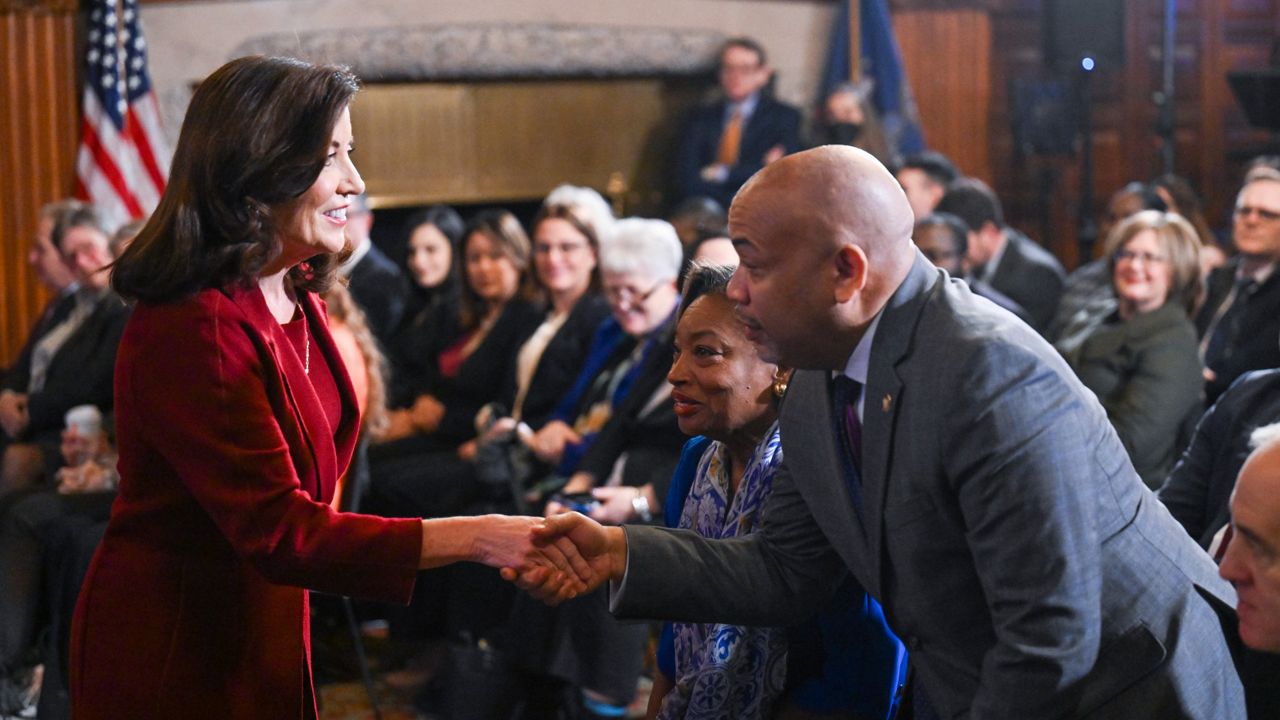
This week, Assembly Speaker Carl Heastie chastised the media for not adequately covering the legislative fallout stemming from the lengthy policy debates commonplace in New York’s budget process, where the governor has the power to make policy changes tied to the state’s spending plan and state lawmakers negotiate objections or desired tweaks to those policy proposals behind closed doors.
As the budget surpassed three weeks late, Heastie argued those negotiations push a three-way deal between the state’s Democratic trifecta of himself, Gov. Kathy Hochul and Senate Majority Leader Andrea Stewart-Cousins weeks further than if budget talks focused only on money, and drastically cut down on the time the Legislature has to focus solely on passing bills. The budget is due April 1.
Hochul has fired back against criticism from lawmakers and good-government groups over her use of the budget process by insisting that she “prefers an on-time budget” and that her priorities have been open for legislative digestion since her State of the State address at the start of the year providing plenty of time for parsing and public budget hearings, though this is not true when it comes to her push to change the state’s climate law.
Blair Horner, senior policy adviser for NYPIRG, and John Kaehny, executive director of Reinvent Albany, spoke with Capital Tonight about what Heastie and state lawmakers could realistically do if they do indeed want to change the process to focus less on policy.
“Is it a good public process? We believe the answer is no, and it’s up to the Legislature to do something about it because that’s their job,” Horner said.
The good-government watchdogs said those options include things that state lawmakers have so far been steadfastly unwilling to do, like intense political pressure and grandstanding, including veto overrides, hearings and legislative initiatives, or introducing a constitutional amendment following the 2004 Court of Appeals decision in Silver v. Pataki and a related case that solidified aspects of the governor’s power over the process and the Legislature’s lack thereof.
“An amendment could be put before voters that the governor cannot introduce policy bills in Article VII of the Constitution, only budget bills,” Kaehny said.
Plus, Horner added that the current status quo of mild irritation and complaining is far from the limit of either side’s power in an active budget negotiation, with nuclear options exercised by both parties at different times during the late budgets of the 1990s and 2000s.
“They can add things to her budget subject to her line-item veto, and they can override those vetoes if they have a two-thirds majority, and the governor can continue to put things as much as she can into extenders in terms of policy initiatives,” he said.
He cautioned that a good-government solution is in order because swinging the pendulum the other way toward the Legislature would do little, pointing out that prior to the post-Silver v. Pataki understanding, legislative leaders could more easily be the source of the logjam themselves, such as former Assembly Speaker Sheldon Silver’s budget holdups over rent control.
While tension has built slowly over the past few weeks, it has so far not been as palpable as last year’s budget season, when the spending plan was the latest in 15 years, with Hochul signing the bills into law on May 9. While many Albany watchers have doubted for months that this year’s budget could eclipse that, it is becoming a distinct possibility, resulting in anxiety for school districts planning their own budgets.
Heastie has been clear that he holds no animosity toward Hochul and is wary of the political realities of the Democrat-led Legislature waging a war over a constitutional amendment challenging a Democratic governor’s power.