
The New York Jets immediately put a target on their back for the 2026 and 2027 NFL Drafts when they decided to conduct a fire sale at the trade deadline.
They sent away two of their best players (Sauce Gardner, Quinnen Williams) for a draft-pick haul last November. The 2026 draft class became particularly important after the Jets lost seven of their final eight games, finishing the season 3-14. That increased the need for general manager Darren Mougey and coach Aaron Glenn to nail this draft class if they hope to stick around long-term.
Well, the draft is over, and while it’s far too early to determine whether the Jets made the right moves with their eight picks, it’s hard to argue they didn’t get better this weekend. The consensus seems to be that Mougey and Glenn did a good job, for the most part.
“I think we did a really good job of identifying the guys that we love and we brought them here to this team to be able to help us move in the direction we want to move,” Glenn said Saturday.
Who were the best picks? What was the biggest surprise?
Let’s dive into the Jets’ 2026 draft class.
Best value pickCB D’Angelo Ponds
Ponds is a diminutive cornerback who doesn’t play like he’s small. We all should have seen this coming. Just about every line of his scouting report makes him sound like Glenn, who was an undersized Pro Bowl cornerback for the Jets long before he became their head coach. Similarities aside, snagging Ponds in the second round — after trading back six picks to No. 50 and picking up an additional fourth-round pick, no less — was a smart move and a great value at that spot.
There really aren’t many knocks against Ponds … other than his size. Many inside the league believe he would have been a first-round pick if not for his height (5 feet, 8 inches). The Jets believe he has that potential and can get it out of him. Despite his size, Ponds made impressive plays in college on the ball in coverage, was an aggressive tackler and solid against the run. Jets fans who went to watch Oregon quarterback Dante Moore in the College Football Playoffs last season were treated to him throwing an interception — to Ponds, who also had a huge hit on Ty Simpson in another playoff game that knocked the Alabama quarterback out of the contest.
“I would say I’m an aggressive, scrappy corner,” Ponds said.
He plays with the same sort of swagger, scrappiness and mindset as another recent undersized Jets outside cornerback: D.J. Reed, who is 5-9. The Jets plan on cross-training Ponds as both an outside and inside cornerback, and it wouldn’t be surprising if he starts at one of those spots as a rookie.
Veteran Brandon Stephens is the only cornerback on the Jets’ current roster who can safely be described as a starter. Azareye’h Thomas and free-agent signee Nahshon Wright will push to start on the outside, while Jarvis Brownlee will provide competition at the nickel.
Also considered here: Kansas State safety VJ Payne, whom the Jets snagged in the seventh round after he fell off his fourth-/fifth-round projection. Payne brings an intriguing combination of size, length and athleticism and should push for a depth role in the secondary.
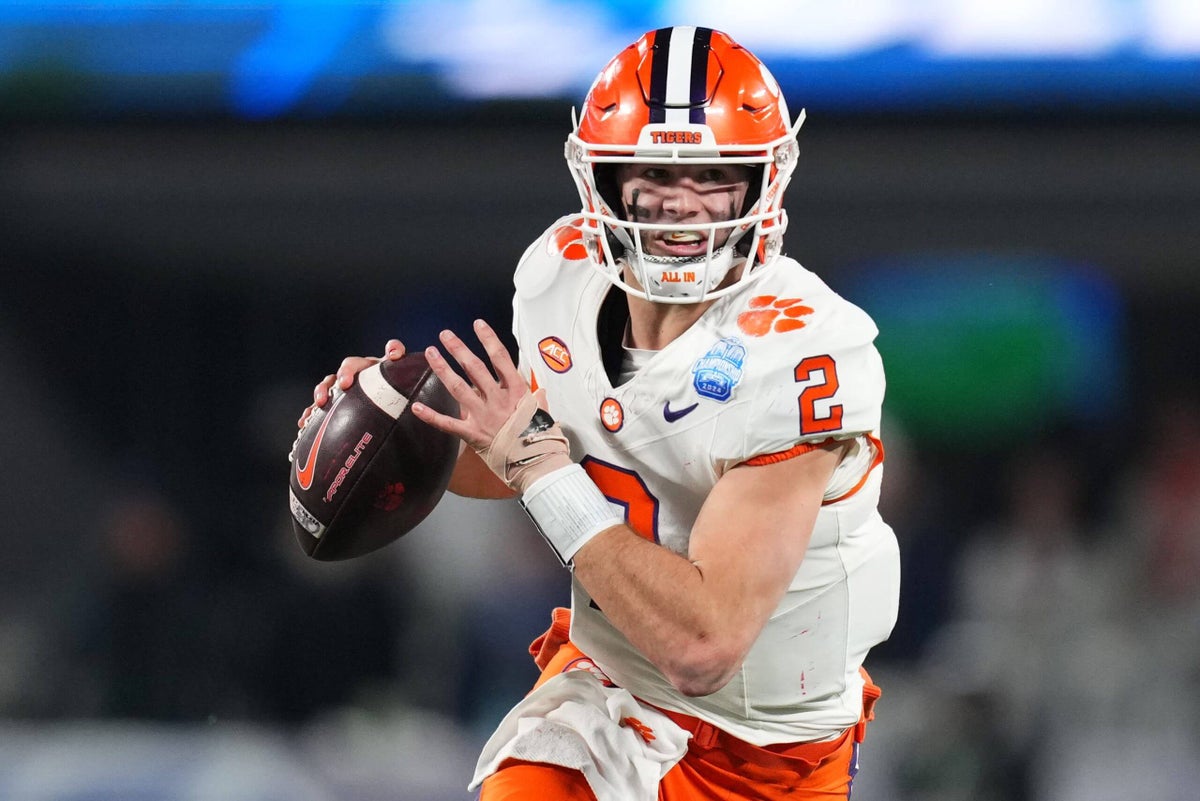
Most surprising pickQB Cade Klubnik
This was an easy choice, because the rest of the Jets’ choices made varying degrees of sense. (Even if a case could be made that choosing David Bailey at No. 2 over Arvell Reese was at least somewhat surprising.)
Still, the Klubnik pick and what led to it came as a surprise. The Jets were always expected to draft a quarterback, someone to develop as a backup more than a serious competitor to be a starter at any point. There were rumblings the Jets were interested in Miami’s Carson Beck, but they ultimately passed on him in the second round, and the Arizona Cardinals picked him at the top of the third. The Steelers picked Penn State quarterback Drew Allar later in the third round.
Heading into Day 3, there was a feeling the Jets might be interested in one of LSU’s Garrett Nussmeier, Arkansas’ Taylen Green or North Dakota State’s Cole Payton. But when they traded two fourth-round picks (Nos. 128 and 140) to move up to No. 110, they selected Klubnik.
A year ago, many projected Klubnik as a potential first-round pick, but after a bad season — for him and for Clemson, which went 7-6 — many experts viewed him as a late Day 3 option. The Athletic’s Dane Brugler ranked him the No. 202 prospect and as the eighth-best quarterback in this class.
Mougey said Saturday the Jets had “good grades” on Klubnik heading into the 2025 season, adding that he was dealing with injuries that led to some of his struggles last season. Mougey said Klubnik impressed the Jets during his interview at the combine, which led to them setting up a visit with him in Clemson. From there, they were sold.
“He’s still young, athletic, with some upside, and we feel really good about being able to get him,” Mougey said.
Ultimately, there are traits to like: Klubnik had a dominant 2024 campaign, with 3,639 yards, 36 touchdowns, six interceptions, 463 rushing yards and seven rushing touchdowns. He has impressive athleticism, solid arm strength, and he’s lauded for his maturity and competitiveness.
But he’s not especially big (6-2, 207), and Brugler wrote that he has “inconsistent pocket presence” and that his “urgency reading the field needs to be addressed.” It’s also hard to ignore how much he fell off as a senior, with 2,943 yards, 16 touchdowns, six interceptions and only 94 rushing yards. Klubnik described it as “a lot of little things that were going wrong.”
“For me, I figured out how to take a team that’s not winning and transform and go win games to finish with four straight wins at the end of the year,” Klubnik said. “So, I’m all about pushing the guys around me, and I’m a winner, and I’m a competitor, and I hate to lose. So, if we’re not winning, we’re going to find a way to win.”
Klubnik said he hit it off with Jets coaches, especially offensive coordinator Frank Reich, during the pre-draft process.
“I woke up this morning thinking: I hope the Jets pick me,” he said.
Biggest question markWho will be the Jets’ No. 2 quarterback?
This, of course, ties directly to the conversation around Klubnik. The Jets have, thus far, not added any veteran quarterbacks as a potential backup for Geno Smith. Tyrod Taylor is still available, but it seems unlikely at this juncture that he’ll return. Veteran Cooper Rush is an option, as are others on the trade market, like the Titans’ Will Levis.
Mougey said the free-agent quarterback landscape hasn’t changed much over the last month and that the Jets will now revisit the idea of adding one.
For now, the Jets’ quarterback room consists of Smith, Klubnik, Brady Cook and Bailey Zappe. Zappe would make the most sense as a potential backup: He has shown flashes of productivity in the NFL, mostly with the Patriots in 2022. He’s started one game (for the Browns) since 2023. Cook started the last four games for the Jets last season and … it wasn’t pretty.
Would the Jets really roll into training camp with Zappe and Klubnik competing to be the No. 2? That feels unlikely.
Remaining needs
The Jets still lack depth at wide receiver, though they at least have a solid trio at the top with Garrett Wilson, Adonai Mitchell and 2026 first-round pick Omar Cooper Jr.
Returner Isaiah Williams showed flashes in the slot, but the Jets need more help on the outside, where 2025 fourth-round pick Arian Smith was a disappointment as a rookie.
The Jets also could use an upgrade at kicker. They let Nick Folk walk in free agency, so their current roster options are Cade York (who has a 73.3 career field-goal percentage) and Lenny Krieg, a kicker from Germany without any NFL experience.
Post-draft outlook
The goal for the Jets was to raise the floor for a team that was often a disaster last season, especially on defense. It was clear Mougey and Glenn had to add stability after the Jets bottomed out in such a significant way at season’s end. The GM and coach did that in free agency by prioritizing proven veterans and leadership at positions of need, namely adding Wright, linebacker Demario Davis, defensive tackle David Onyemata, safety Minkah Fitzpatrick, safety Dane Belton and edge rushers Joseph Ossai and Kingsley Enagbare. On offense, they added Smith and left guard Dylan Parham.
Really, the way they went about the draft felt similar, especially at the top. The Jets ultimately went with Bailey over Reese because they believe Bailey is more ready to contribute immediately as a pass rusher. He is the kind of player who — if all goes according to plan — can get 10 sacks as a rookie for a team that was one of the NFL’s worst at pass rushing last season. Reese was viewed as a bigger swing and project, true or not. Ponds will add depth and playmaking ability at cornerback that was lacking last year, too.
Cooper will step into a significant offensive role right away, and tight end Kenyon Sadiq — a mildly surprising pick at No. 16 — should push for a big role too because of his unique athleticism at tight end. By adding Cooper and Sadiq to an offense that already has Wilson, Mitchell, tight end Mason Taylor, running back Breece Hall and a solid offensive line, the Jets are trying to cultivate the best possible supporting cast for their quarterback. That’s Smith now and a rookie later, in 2027.
The Jets still feel far away from the playoffs, but the goal for 2026 is about a simple C-word: competence. That’s what this offseason was about — even if that might feel like a low bar.