
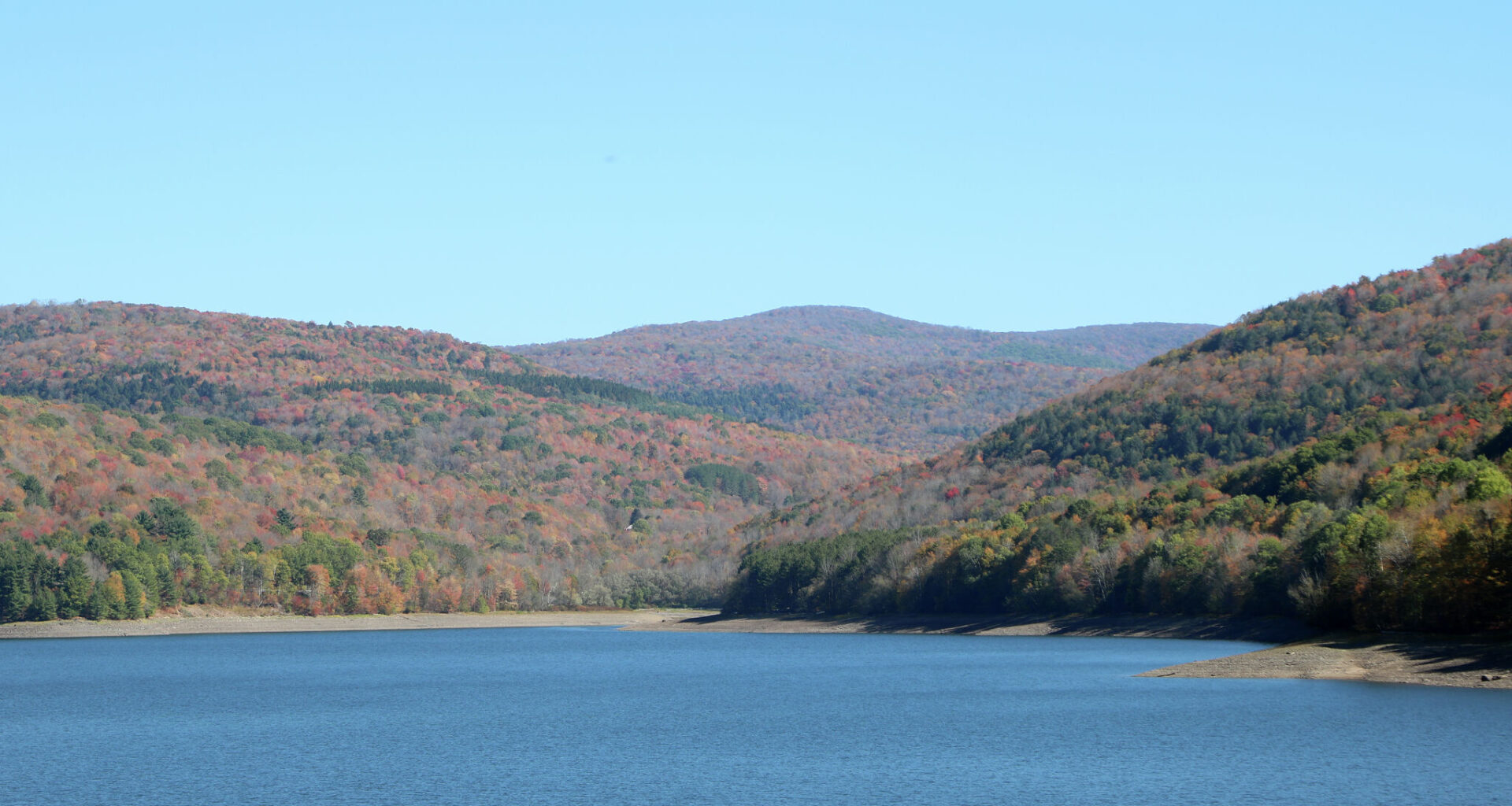
Pepacton Reservoir in the Catskill Mountains, one of the water bodies that feeds New York City. Riverkeeper filed a lawsuit this month seeking to invalidate an agreement between New York City and Catskills towns about how the former will purchase land around the reservoirs after the environmental organization was excluded from the final round of negotiations.
Tyler A. McNeil/Times Union
The Hudson Valley’s preeminent environmental group is suing New York City over its agreement with Catskill Mountain towns that loosens restrictions on nearly 150 square miles of city-owned land in the mountain formation, including allowing the construction of renewable energy infrastructure and utilities.

The agreement at hand, referred to as “the bridge agreement,” alters what can be done with the city-owned land and limits future purchases. It is acting as a two-year bridge as the city begins negotiations to maintain its Filtration Avoidance Determination, a regulatory waiver with the state Department of Health that allows the city to continue using its upstate reservoir system without filtering the water. Building a filtration system would cost the city billions of dollars.
Article continues below this ad
New York City has purchased more than 220 square miles in the Catskills since a 1997 agreement meant to keep the Catskill reservoirs’ water potable by buying land in the region and keeping it undeveloped. Local Catskill leaders have chaffed under the agreement, arguing it depresses their tax base and undercuts local control. Catskill leaders were overjoyed with the bridge agreement they negotiated with the city last year, which also necessitated their approval for any future land purchases between the city and private landowners.
In the lawsuit, the nonprofit Riverkeeper argues the plan did not go through the environmental review process and violated previous agreements about the land.
The city “failed to complete or even commence a review of the potential environmental impacts of these actions,” according to the lawsuit, referring to the state Environmental Quality Review Act, the law that requires developments and changes in laws that could affect the environment to go through an often-lengthy review of potential impacts.
Make the Times Union a Preferred Source on Google to see more of our journalism when you search.
Add Preferred Source
The lawsuit also takes issue with the bridge agreement allowing some development on the city-owned lands.
Article continues below this ad
Under the bridge agreement, “the extraction of sand, stone, soil, and gravel,” is permitted in some areas, with the materials used onsite for “maintenance and construction of access roads, and parking areas,” or offsite for “purposes of water quality protection in any area of the watershed.” Any mining would need to get normal state approvals.
The agreement also allows renewable energy infrastructure, such as solar panels, and utilities, such as fiber optic cables. Riverkeeper opposes both, according to the lawsuit.
Catskills towns have long taken issue with traditional utilities being barred from the city’s Department of Environmental Protection lands, which has led to a lack of cell phone service and high-speed internet in the region.
Riverkeeper Legal Program Director Mike DuLong had formerly said the organization long supported allowing traditional utility infrastructure on DEP land, but his view was different when interviewed Friday.
Article continues below this ad
“This is a change to the easement; (it) hasn’t undergone SEQRA, which opens up a lot of different things that haven’t been evaluated,” he said.
“Our stance has not changed,” he added when pressed.
Riverkeeper cites the 1997 agreement that kicked off the land purchases in its argument, which states conservation easements would be placed on the land “to ensure that such land is held in perpetuity in an undeveloped state in order to protect the Watershed and the New York City drinking water supply.” Riverkeeper was a signatory to the 1997 agreement.
Riverkeeper was also a party to the bridge agreement negotiations, but, along with the National Resources Defense Council and the Catskill Center, was not invited back to the table after negotiations resumed in October 2025, after falling apart the previous summer.
Article continues below this ad
Jeff Baker, the attorney for the Coalition of Watershed towns, a group of local leaders representing Catskills towns during the bridge negotiating agreement, called it “a curious lawsuit” without merit.
“We were disappointed in (the lawsuit), because Riverkeeper has been involved in all the substantive negotiations about conservation easements and land acquisition, and they had agreed to everything,” he said.
“I understood that they weren’t happy that they weren’t involved in the final agreement, that wasn’t the coalition’s call,” but instead the city’s, Baker said. He added that the only thing that was discussed in the last few months of negotiations was the city’s continued financial support for programs in the watershed. These programs are meant to benefit both the reservoirs and local residents, such as a program that pays for septic system replacements.
Eric Goldstein, senior attorney for the National Resources Defense Council, which was one of the environmental groups excluded from the final rounds of negotiation, said the lawsuit “was a direct outgrowth of the events last summer when the negotiations among the parties were upended by the city.”
Article continues below this ad
“When you exclude parties with legitimate interests from the conversation, by golly, they find another way of getting a seat at the table,” he said.
The environmental groups “had not been in full agreement” with such things as the scope of the conservation easements and “the scuttling” of a land-purchasing method called the Streamside Acquisition Program.
New York City made most of its purchases in the Catskills through a program focusing on large land purchases in any part of the Catskills watershed. The city announced it would discontinue that program in October 2024 in favor of the Streamside Acquisition Program, which began in the 2010s and targets small land purchases on the banks of streams feeding the reservoirs. The National Resources Defense Council was supportive of this move.
But under the bridge agreement, any purchases would have to be approved by working groups that include town leaders before a landowner is even solicited by the city.
Article continues below this ad
In a statement, Dulong said Riverkeeper’s goal “is to maintain protections that keep drinking water safe for 9.5 million New Yorkers.”
“We’re working to repair and restore relationships that were cast aside by a rushed agreement that didn’t include all the groups and communities involved in the decades-long collaboration to preserve the source waters,” Dulong said. “Riverkeeper has taken legal action to ensure that the independent voice of the environmental community remains at the table throughout current and future planning for this critically important natural resource — the system of reservoirs that provide drinking water for half the residents of New York state.”
Upstate reservoirs, mostly in the Catskill Mountains, provide potable water to 1 million people in the mid- and lower-Hudson Valley, as well as nearly all of New York City.
The New York City Law Department, which handles lawsuits against the city, declined to comment while the case is under review.
Article continues below this ad
The final negotiations of the bridge agreement happened under DEP Commissioner Rohit T. Aggarwala, who was replaced by Lisa F. Garcia in February after Mayor Zohran Mamdani took office. Garcia will be at the helm during negotiations for a longer agreement dictating land purchases that begin this year.
“Ultimately, the hope is, with a new administration at city hall, productive dialogue and discussions will ensue,” Goldstein said.