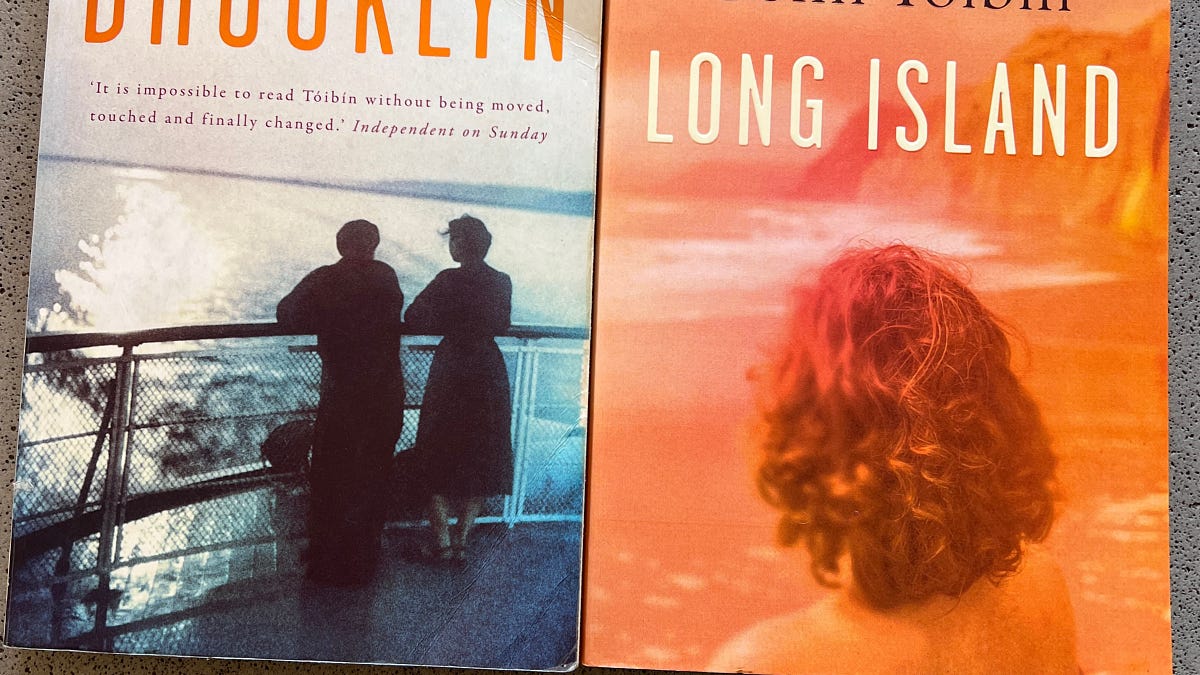
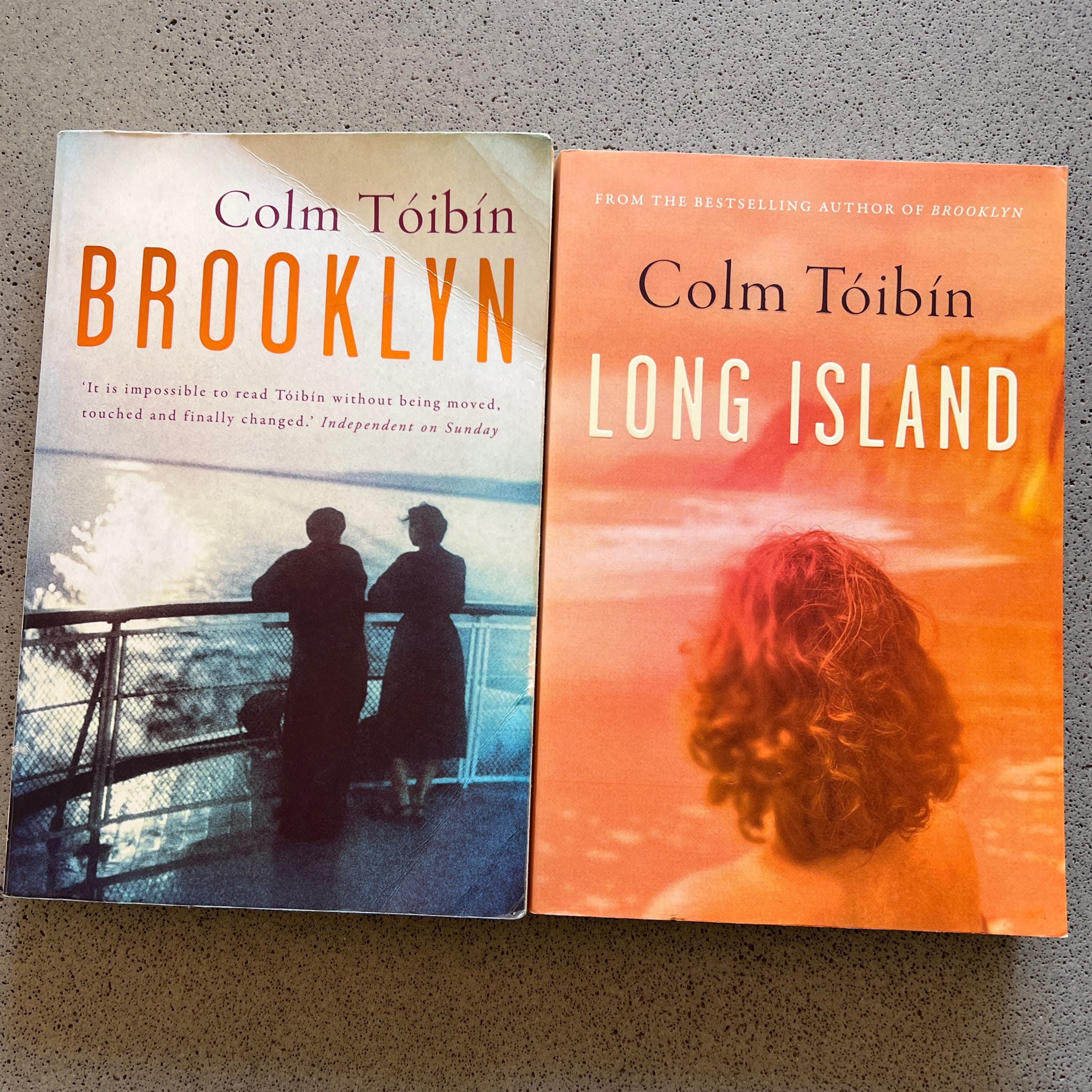
Colm Tóibín was first published in 1990, with his novel The South. He published five novels thereafter, to great praise and awards buzz – but it wasn’t until his 2009 novel Brooklyn – that he reached global and resounding success;
Young Eilis Lacey dreams of life beyond the confines of her tiny Irish village, but unlike her beautiful sister, Rose, Eilis’ gifts are of a more practical nature: she has a head for numbers, and is a loving and dutiful daughter. Yet her ambition cannot be hidden and soon is noted by the Parish Priest, Father Flood. Via a church contact, he arranges for Eilis to travel to America where a job opportunity has arisen in New York with a reputable ‘merchant of Italian origin’.
Eilis finds lodgings in an eccentric boarding house and ekes out an existence in the cosmopolitan melting pot that is 1950s Brooklyn, impressing her employer, outwitting her landlady, and even falling in love. It seems her dream is truly becoming a reality. But then fate intervenes: a family crisis back home forces Eilis to make a choice between the past and the future, the old world and the new.
Told with a masterful and elegant simplicity, Brooklyn is a sublime Trans-Atlantic coming-of-age story by one of the UK’s greatest living writers.
The book was long-listed for the Booker Prize and won the Costa Novel Award 2009 – it was also an Oprah Book Club pick that helped send it into the stratosphere.
In 2015, the film was adapted by producers Finola Dwyer and Amanda Posey of Wildgaze Films, with bestselling English author Nick Hornby adapting the screenplay. And the movie did extremely well according to Wikipedia;
Brooklyn received many nominations for industry and critics awards, including three nominations at the 88th Academy Awards: Best Picture, Best Adapted Screenplay, and Best Actress. Saoirse Ronan’s performance was particularly praised, and, in addition to her Oscar nod, she garnered BAFTA, Critics’ Choice, Golden Globe, and SAG nominations for Best Actress.

I first read the book, because of the film – which I love so much. And it’s a very faithful adaptation too, except for the ending … Nick Hornby gave the film a much more conventionally happy and romantic ending; of Eilis Lacey choosing her husband Tony in Brooklyn and a beautiful, light-filled closing scene and reunion between the two of them. There’s a voiceover of Eilis speaking to another young Irish immigrant girl on the boat to Ellis Island, her voiceover carries us through the final, light-filled and romantic scene too;
You have to think like an American. You’ll feel so homesick that you’ll want to die, and there’s nothing you can do about it apart from endure it. But you will, and it won’t kill you. And one day the sun will come out – you might not even notice straight away, it’ll be that faint. And then you’ll catch yourself thinking about something or someone who has no connection with the past. Someone who’s only yours. And you’ll realize… that this is where your life is.
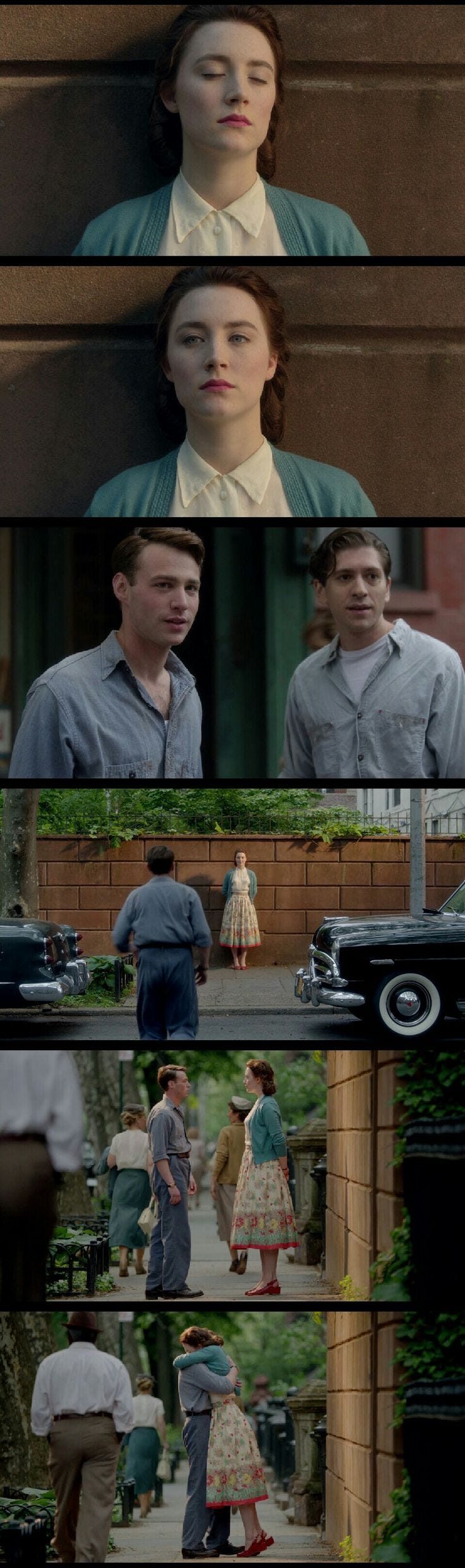
It’s really beautiful, and part of the reason Brooklyn was one of those adaptations, that – for a long time – I’d say I slightly preferred the film to the book, precisely for that lovely finality.
But truth be told; the ending is more Nick Hornby than Colm Tóibín. And recently in revisiting Brooklyn – and its 15-years in the making sequel, Long Island – by listening to the audiobooks, I’ve decided that I prefer Tóibín endings and ambiguities, that I in fact believe they are intrinsic to his themes and messages.
Which is not to say I don’t still love Brooklyn, the movie. And I am a fan of screenwriter (and author), Nick Hornby (Funny Girl is one of my recent faves, of his). He’s had a wonderful career script-writing alongside book-writing, and with a particular talent blending his careers; adapting books to film (An Education based on Lynn Barber’s book, and the year before Brooklyn came out – in 2014 – he wrote the screenplay adaptation of Cheryl Strayed’s Wild).
In 2015 as part of promotion for the film, Hornby was interviewed by The Guardian and partly revealed why he tweaked the ending;
Is adapting from a novel you did not write like picking up a foreign language – do you try to catch the tone of the book?
Brooklyn and Wild spoke to a readership. There is no point alienating that readership just because you have seen something in the book that could make a movie. It is too disappointing for people. Brooklyn is a beautiful, literary novel but we had to amplify it because its feelings and gestures are so understated. Colm Tóibín sees to it that the reader has to make up his or her own mind about what happened.
That’s exactly it … in Colm Tóibín’s Brooklyn we never see Eilis return to America. We get the scene of Miss Kelly telling her she knows of her Italian husband back in Brooklyn, and how she intends to tell Jim Farrell and his mother what she’s done in trapping and manipulating him. The choice is made for Eilis, and while she comes clean to her own mother – and writes a letter of goodbye for Jim – Eilis merely slips out in the middle of the night, into a waiting taxi to begin her long journey back to America. Not because she’s chosen this path for herself with gusto and heart – the way Saoirse Ronan plays it in the film – but because someone else chose for her, Miss Kelly’s scheming forces her hand. It is very much up to the reader if Eilis is happy or compromised in her choice.
It’s an ending indicative and full-circle to Eilis’s entire journey … in which her mother and her older sister Rose, begin the book by already deciding that she is the one to leave their small Irish town of Enniscorthy, and try for a bigger and better life in New York.
To some extent, Eilis doesn’t even really choose Tony – her husband – he picks her out at an Irish dance that he’s infiltrated as a young Italian-American man because he has a thing for Irish girls. For a lot of their courtship Tony just makes himself available and in proximity to Eilis who eventually relents and finds some comfort from her homesickness in the distraction he presents … when Rose dies and Eilis plans to return home, it’s Tony cajoling her into marriage before she leaves to ensure she returns to him.
Even when Eilis is back in Enniscorthy and has the beginnings of a romance with local man Jim Farrell, it’s him assuming that they’re engaged-to-be-engaged as opposed to Eilis throwing herself bodily and wholly into the relationship … he doesn’t consult her, just begins talking so as to make clear he assumes they’re on their way to engagement.
It makes sense for a filmic adaptation that Eilis finally make her own decisions in the finale – and chooses Tony and America. But the book has no such need or desire to appease movie-goers, and Tóibín’s leaving Eilis still unable to choose the path that is already laid out for her, is profound and feels true of the 1950s era.
I decided to revisit Tóibín’s Eilis Lacey series, precisely because in 2024 he decided to – after 15-years – revisit the world and character that made him a superstar author, by writing his first ever sequel.
But I decided to revisit via audiobook listening;
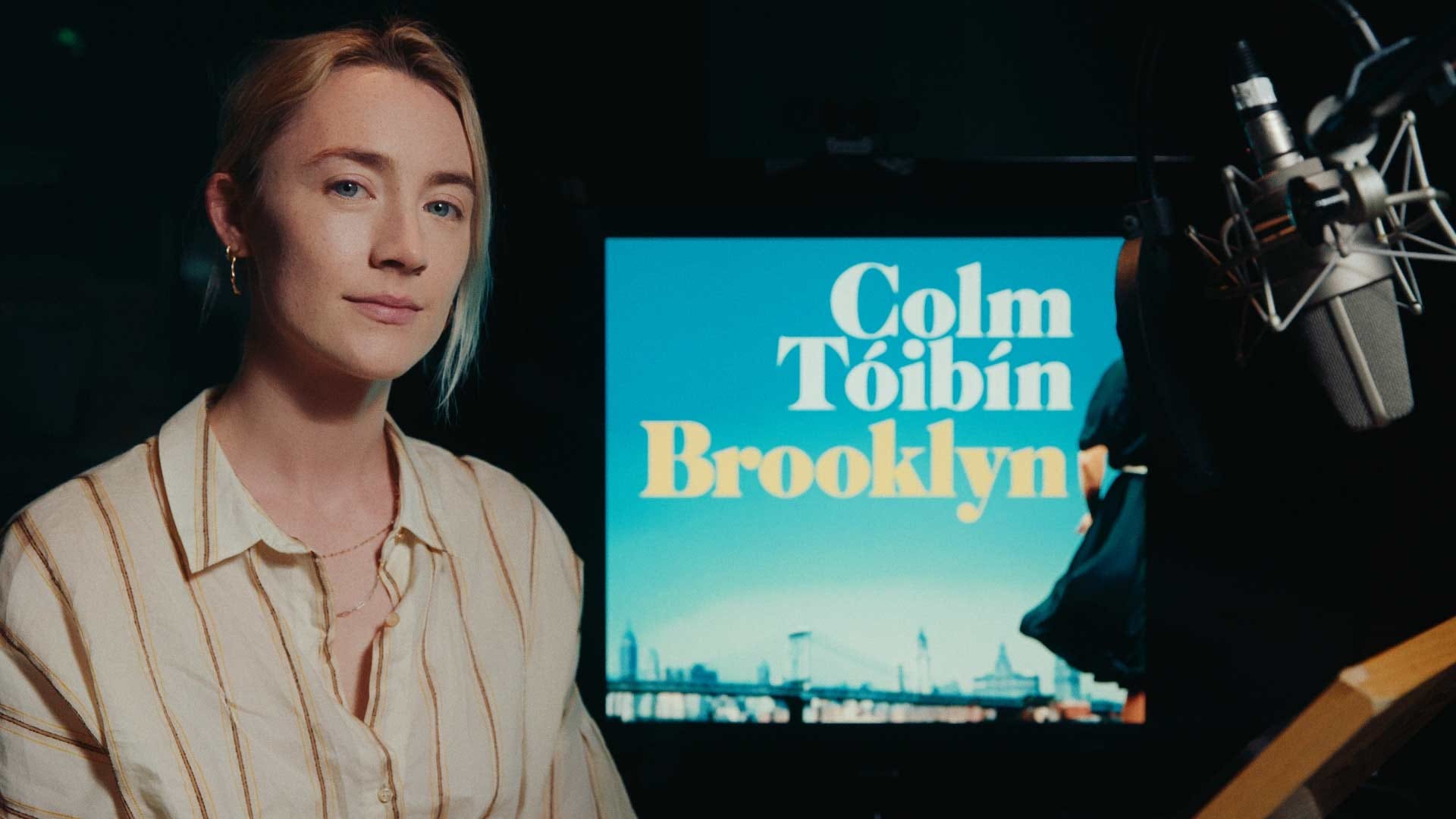
In 2024 Saoirse Ronan came back to the character and recorded the new audiobook of Brooklyn
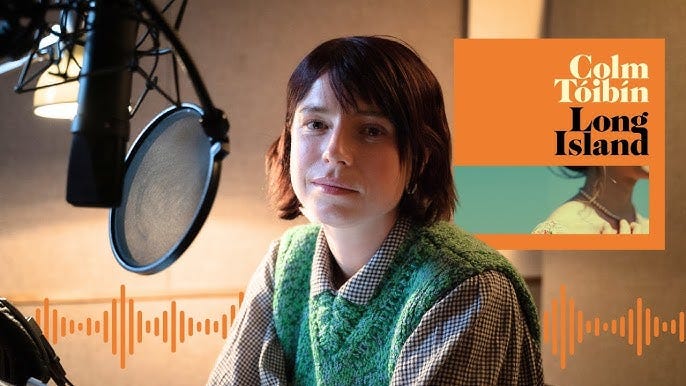
Also in 2024, Jessie Buckley was announced as the narrator of Long Island audiobook
It’s interesting that Ronan wasn’t tapped to narrate both audiobooks – but I actually think it’s genius casting, to signal that 20-years have past. Ronan is 32 to Buckley’s 36 – but where Ronan’s Irish lilt is light and perfectly suits Eilis at 19 (and is intrinsically tied to the movie adaptation too, of course), Buckley’s voice is deeper and brings that sense of age and wisdom to a woman now in her 40s. There’s a grit and growl to Buckley, that perfectly suits the narrative leap between the two stories also …
I know of so many people (myself included) who were totally blindsided by the premise of Long Island;
Eilis Lacey is Irish, married to Tony Fiorello, a plumber and one of four Italian American brothers, all of whom live in neighbouring houses on a cul-de-sac in Lindenhurst, Long Island, with their wives and children and Tony’s parents. It is the spring of 1976 and Eilis, now in her forties with two teenage children, has no-one to rely on in this still-new country.
One day, an Irishman comes to the door asking for Eilis by name. He tells her that his wife is pregnant with Tony’s child and that when the baby is born, he will not raise it but will leave it with her. Eilis has choices to make, and what she does in the wake of this shattering news is at the heart of one of Tóibín’s most riveting and emotional novels to date.
Yes, the catalyst for the novel – right there in the blurb and opening chapter – is that Tony cheats on Eilis, and gets a married woman pregnant … this woman’s husband comes to the door and tells Eilis that when the baby is born, he will bring it to Tony’s house to deal with.
It’s a big and cataclysmic thunderclap start to the novel, and maybe especially because of Hornby’s romantic ending to Brooklyn, the film – one that shook fans.
But Tóibín was asked about this plot-device, and gives a very brilliant answer in a 2024 interview with America Magazine;
Do you feel any of the characters have changed in significant ways since Brooklyn? If so, which ones?
With Tony, a lot of readers have come up with one way of looking at this. They believe the novel makes clear what a beast Tony is. This is not how I see things. These things happen and they’re not ideal, but it’s not as if Eilis is suddenly living with this monstrous figure. Some readers don’t buy this. Some readers think it’s horrible, it’s disappointing, and how could you do this?
The flippant answer is that God made adultery so we could have novels. This is one of the things the world knows, and if it’s in the world, it’s part of creation. It’s not as though I have decided to bring this into the world.
I don’t think Tony changes. This is one of those things that gives rise to the drama of the novel. Without it, there is no novel. I get quite a lot of emails about this through my website. Readers are so upset.
“God made adultery so we could have novels,” is a perfect answer and if it has indeed elicited such a reaction from readers then it worked as a cataclysm in Eilis’s life – and one that sends her back to Ireland for the first time in two-decades.
It’s also worth noting – again – that had Hornby not tinkered so romantically with the ending of Brooklyn, it’s a development that actually perfectly fits with the arch to Eilis’s life … once again; actions of other people are dictating her future and path, and all she can do is react and move.
The other departure in Long Island is that we get multiple POVs – from Eilis, Jim Farrell, and her old friend (now widowed, and in a secret relationship with Jim) Nancy Sheridan. Again, Buckley’s timbre perfectly suits and swaps between these two women and one man.
I loved Long Island maybe even more than Brooklyn, and specifically for the things that other people hated about the novel.
For one thing; I love that all these people are in their 40s, but messier than ever. Far more than they were in Brooklyn – with their adultery, love-affairs, heartbreaks and reignited passions. I love reading literature that affirms that; the older you get does not necessarily guarantee the getting of wisdom. Just the opposite.
I also loved Long Island because I think it’s Colm Tóibín revealing this deep understanding he has, that your life can begin again at any age. Either because you will it so – choosing to leave your philandering husband – or because it’s deeply unfair, and death makes a widow of you far too soon. I think Tóibín knows this – given that he is a prominent gay author, who has been in a relationship with Hedi El Kholti, a Moroccan-born editor and literary press publisher – and the relationship seems to have started around 2012, when Tóibín was 57-years-old.
I also found Long Island to be a very funny novel – there were times when the Enniscorthy gossips had my toes-curling for their unintentional wrecking of secrets and relationships, and there was an Irish wedding scene in particular that had me in giggles, as I listened – equal parts mortifying and hilarious.
I know the ending is highly controversial – maybe especially for those who cling to Hornby’s decided finality interpretation of Brooklyn. But the ambiguity is actually in keeping with Brooklyn the book, and makes it a true duology book-ended.
I also loved the ending of Long Island that has this feeling of … plates spinning in the air; that as we turn that final page, these characters have a propulsive nature to them – that their lives will continue, there is so much mess and heartache to unpick and while we won’t be privy to it, it continues somewhere off the page.
Yes, it does feel like we’re missing two or ten more chapters. But in that open-end, these characters feel more alive than ever – even as all of them find themselves stuck in that thematic web that Tóibín loves to weave; that none of them are really getting much of a say in their lives. They’re still reacting, and having paths chosen for them.
Do I think there will be a third book in the Eilis Lacey series, concluding it as a trilogy? I don’t know. I hope so! But part of me also hopes it takes years, just as it did between Brooklyn and Long Island. I see Colm Tóibín is now in his 70s and not slowing down; and I’d love him to leap ahead another 20-years and show that’s as true for his characters as it is for him.
And I think of that question that Jim asks Eilis, and never gets an answer to at the end of Long Island;
‘There’s one question I want to ask you,’ he began.
She looked up.
‘Just one?’
‘If the phone rang in your garage on Long Island one morning, or one day, and it was me and I was in New York, or was even closer, and I had come to see you, what would you do?’
Indeed; what would Eilis Lacey do? A fascinating question across two books already, I’d love it if Tóibín made it a hat-trick.