
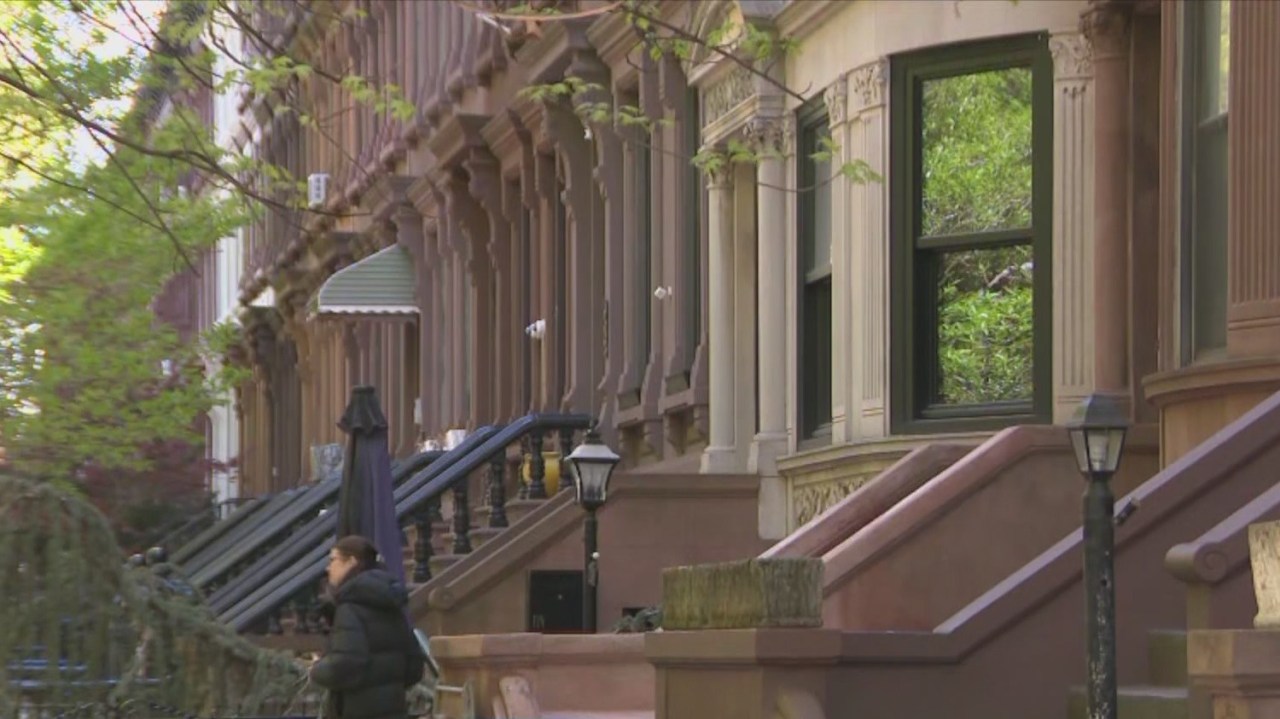
NEW YORK CITY (PIX11) — A woman fighting eviction from the home her family has lived in for 60 years has drawn community support and outrage in Brooklyn.
Carmella Charrington and her family say they’ve been victims of attempted deed theft to take their family’s brownstone at 200 Jefferson Ave. in Bedford-Stuyvesant. However, the state says that may not be the case.
Stay connected with community stories that matter: Visit our homepage
The Charrington family’s case
Charrington has been in a two-year fight against brownstone developer 227 Group LLC to maintain the home’s deed. The family says Charrington holds the power of attorney for her father’s estate and that he granted her the property. However, her father is under conservatorship. The developer argues that because of the conservatorship, it “legally purchased the property in 2024 via the Fulton County Probate Court.”
“The transaction was a lengthy process that involved extensive negotiations with attorneys of all parties, including Mr. Charrington’s conservatorship attorney, and approval by the Probate Court, which also denied the current occupant’s claim challenging its authorization of the sale,” a spokesperson for 227 Group LLC said.
A representative for the New York Attorney General’s Office told PIX11 News that it reviewed Charrington’s case in 2025 and determined it was a property dispute between heirs and relatives of the former co-owners, not a deed theft.
However, New York City Council Member Chi Ossé, who was recently arrested during a protest against Charrington’s eviction, has maintained that her case is an instance of deed theft and that not all of her legal measures have been exhausted.
For more on what’s happening in your area, head to our homepage
“Black displacement is happening right now in Bed-Stuy and Carmella is one of many Black homeowners battling deed theft in Brooklyn,” Ossé’s office said in a statement. “Not another Black homeowner should have their home stolen.”
What is deed theft in New York City?
Deed theft is when a “thief takes the title to a home without the homeowner’s knowledge or approval,” according to the New York State Attorney General’s Office.
It can happen through forgery when someone fakes a homeowner’s signature on a deed and files it with the county clerk, or when a homeowner signs their deed over without realizing what they’re signing.
Those most at risk of deed theft include seniors, immigrants, and people of color, especially when the situation involves:
abandoned or empty properties
properties in foreclosure
properties that have tax or utility liens
properties where the homeowner is deceased
heirs who do not legally transfer the title to the property
The non-profit New York Legal Assistance Group also defines deed theft as “the unintentional or unwilling transfer of a property from the rightful owner to another person or entity.”
Supervising Attorney Julie Howe says scammers will often prey on people who purchased their homes in previously undesirable neighborhoods that are now being gentrified and have increasing property value, such as Bed-Stuy, Williamsburg, Harlem, or the South Bronx.
Howe says some other scenarios of deed theft can include:
Homeowners who were induced by purported mortgage brokers or real estate agents (sometimes with valid licenses, sometimes without) to sign their homes over to an LLC or shell corporation. Sometimes these homeowners were then saddled with “commercial mortgages” on their properties that were now under the ownership of the shell LLC
Heirs to a property upon the death of the homeowner who unwittingly found that another heir of a portion of the property was induced to sell their portion, usually at an unreasonably low price, to a legitimate or illegitimate investor, LLC, or hedge fund. These heirs can find themselves in partition proceedings to fight either for the right to remain in their family home or at least to retain the lawful equity in the property
Poor end-of-life planning that can unfairly displace minority homeowners
Individuals who outright forge the signature of the homeowner on a Quitclaim or Bargain-and-Sale Deed. We often see this form of deed theft among family members, friends, or romantic partners.
Homeowners who are elderly and suffering from cognitive loss who are directed to sign over their property to the scammer (or their LLC, or to take out a reverse mortgage or home equity investment) allegedly as part of end-of-life planning
Councilman Ossé has said that speculators can target homeownership heirs in predominantly Black neighborhoods and try to use “legitimate-looking paperwork” to take ownership of their housing.
Discover more stories shaping your neighborhood on our homepage
“Sometimes their methods are technically legal…everything that is legal isn’t always right or just,” Ossé said in a social media video. “I’ve seen enough Black displacement in my life, and I refuse to abdicate my responsibility to ensure Black families can remain in their homes.”
Black homeowner displacement in Bed-Stuy
Black homeowners and renters have lost more of their share of property in rapidly gentrifying neighborhoods like Bed-Stuy, elected officials have said.
In 2018, then-Brooklyn Borough President Eric Adams sounded the alarm about the Third Party Transfer program, which took homes from owners who were in debt. The program, formed by the city’s Department of Housing Preservation and Development in 1999, had the biggest impact on Black and Latino homeowners in neighborhoods like Bed-Stuy, NBC News previously reported.
More: Latest News from Around the Tri-State
“There’s something going on here where Black and Brown long-term property owners were receiving an onslaught of individuals taking their houses away through the TPT program, through deed fraud, through foreclosures that are being expeditiously moved through the system. There is something that is larger than our bandwidth to do this investigation,” said Adams in 2018.
Data from the NYU Furman Center shows that the Black population in Bed-Stuy dropped from 74.9% in 2000 to 40.7% in 2023. Meanwhile, the white population rose from 2.4% in 2000 to 26.5% in 2023. The Asian population in the area also grew from 0.8% in 2000 to 4.1% in 2023, while the Latino population went up from 19% in 2000 to 22% in 2023.
What’s being done to stop deed theft
Councilman Ossé is pushing for New York Gov. Kathy Hochul to pass an eviction moratorium to prevent homeowners, like Charrington, from being removed from their homes while their cases are still going through the legal process.
For now, Charrington and her family remain in the Bed-Stuy brownstone.