
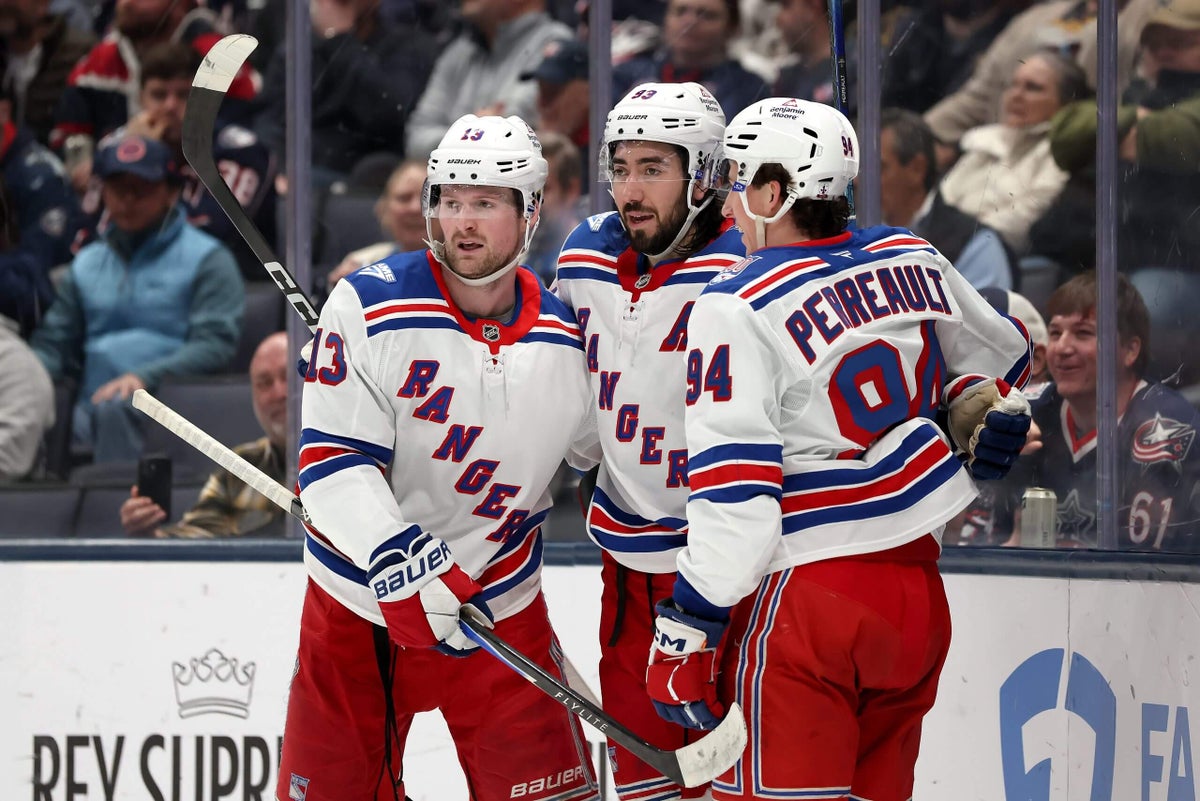
Last week, we examined the 10 biggest questions facing the New York Rangers this summer. Now we’ll shift to analyzing the state of the lineup.
This exercise is intended to not only show where the Rangers have players in place for 2026-27, and which spots those players are likely to occupy, but also to highlight the most glaring holes. The quality of available talent is suspect given the NHL’s diluted free-agent class, but team president Chris Drury is expected to be active in trade conversations with the hope of accelerating his self-proclaimed retool. Whether he can pull it off remains to be seen, but if New York plans to be competitive next season, it will probably require four to six impact additions.
We’re proceeding with the assumption that veteran center Vincent Trocheck will be aggressively shopped in the name of getting younger and restocking a depleted asset pool, which is why you won’t see him in our projected forward lines. By my count, that would leave the Rangers searching for three forwards and two defensemen, plus a new backup goalie. Some will contend that they need even more, but I’m trying to work within realistic parameters. (And even these might not be that realistic.)
We’ll do multiple looks this offseason — an updated one after free agency, another during training camp — but it’s helpful to have a starting point. With that, let’s go position-by-position and line-by-line for version 1.0 of our Rangers lineup projection.
Projected Rangers forwards, 2026-27
Left wingCenterRight wing
Gabe Perreault
Mika Zibanejad
Alexis Lafrenière
Will Cuylle
J.T. Miller
?
Tye Kartye
Noah Laba
?
Adam Sýkora*
?
Jaroslav Chmelař
Depth options: LW Anton Blidh, LW Adam Edström, C Justin Dowling, C Juuso Pärssinen, C Dylan Roobroeck*, RW Liam Greentree*, RW Brody Lamb*, RW Taylor Raddysh, RW Matt Rempe.
Unrestricted free agents: C/RW Jonny Brodzinski, LW/RW Conor Sheary
Restricted free agents: LW/RW Brett Berard, LW/RW Brendan Brisson
*rookie status in 2026-27
An argument can be made that the Rangers would be better off with Gabe Perreault-Mika Zibanejad-Alexis Lafrenière as their second line and J.T. Miller centering a checking third unit, and you wouldn’t get any pushback from me. But pragmatically, I don’t think we can expect New York to obtain an entirely new top line in one offseason. That’s more of a long-term goal, with the expectation that the Rangers will aim to nab one piece with their top-five pick in the upcoming NHL Draft and keep an eye out for any others who hit the market either this summer or down the road.
In the meantime, I could see the Rangers penciling in the Mika-and-Friends line again for 2026-27. Its underlying metrics tailed off at the end of the season, with a final expected goals-for rate at only 48.57 percent, according to Natural Stat Trick. But it still outscored opponents 14-10 and generated more high-danger scoring chances (51-47) across 265:06 together at five-on-five. Most importantly, playing prominent roles alongside a respected veteran and thoughtful mentor in Zibanejad really seemed to propel the young wingers, who finished the season by combining for 43 points (24 for Lafrenière and 19 for Perreault) in the final 23 games.
Miller finished on an upswing, as well, while skating on a line with Tye Kartye and Sheary. It’s possible Sullivan will want to continue that chemistry — at least with Kartye, who’s under contract for one more year at $1.25 million. But Will Cuylle offers better offensive potential and remains higher on the LW pecking order. Maybe all three will play together, though that would require one of the wingers to switch to their off-hand side. The likelihood is that Drury will be seeking a scoring RW (or center, in which case Miller could shift to wing) to upgrade at least one position in the top six.
Ample competition has emerged in the bottom six, where Jaroslav Chmelař, Adam Sýkora, Edström, Raddysh and Rempe will be vying for roles while prospects-turned-pro such as Greentree and Lamb could push for in-season recalls. Both Edström and Rempe would have to clear waivers to be assigned to AHL Hartford, which is a risk New York would rather not take, but their places in the lineup seem to be in jeopardy after Chmelař and Sýkora seized their fourth-line spots late in the season.
It will get even more crowded if the Rangers follow through on coach Mike Sullivan’s comments about improving the team’s forward depth. Third-line winger and fourth-line center seem like logical targets, particularly if Trocheck is traded. That, along with the March trade that sent Sam Carrick to the Buffalo Sabres, would leave them painfully thin down the middle, with little center help coming up through the system.
Projected Rangers defense, 2026-27
Left defenseRight defense
Vladislav Gavrikov
Adam Fox
?
Will Borgen
Matthew Robertson
?
Depth options: LD Jackson Dorrington*, LD Drew Fortescue*, LD Urho Vaakanainen
UFAs: LD Connor Mackey, LD Brandon Scanlin, RD Casey Fitzgerald
RFAs: RD Vincent Iorio, RD Scott Morrow, RD Braden Schneider
*rookie status in 2026-27
Barring something unforeseen, the top duo is set. Among the 70 NHL D pairs that logged at least 400 minutes together at five-on-five this season, Gavrikov and Fox ranked third with a 58.49 percent xGF and fourth with 1.72 goals allowed per 60 minutes.
It’s the other two pairs where the problems lie.
The Rangers essentially have four or five defensemen you’d feel okay about as the Nos. 5-7 in your organization, but it’s Nos. 3-4 where they must look to upgrade. Sullivan didn’t say that exactly, but when asked about offseason priorities, the first area he pointed to was “puck-moving ability on our blue line.”
Drury will continue to explore trade options for Schneider, with the idea of using him to fill one of their holes at forward, but he could also keep the 24-year-old and move on from Will Borgen instead once the latter’s full no-trade clause turns into a 15-team no-trade list on July 1. Whichever one remains will likely slot in as the 2RD, but it’s unclear whether New York would be willing to trust either Iorio or Morrow — both of whom will be RFAs seeking new contracts — in the third spot. Chances are, competition will be brought in via trade or free agency.
An even bigger priority should be 2LD. Matthew Robertson was an uplifting story as an overlooked rookie who bided his time and finally settled in as an NHL regular, but there are limitations in his game. He was fine on the third pair but looked overmatched on the second. Is Fortescue ready for that assignment? That’s a lot to ask of a player who will turn 21 on Tuesday and would benefit from some development time with Hartford.
Regardless of who lines up on which pair, the Rangers likely need to acquire two defensemen — and they must heed Sullivan’s words by making sure those players can efficiently advance pucks and contribute offensively. As it stands, Fox is the only New York D who rates as above-average in those key facets of the game.
Projected Rangers goalies, 2026-27
StarterBackup
Igor Shesterkin
?
Depth options: Spencer Martin, Callum Tung*
RFAs: Talyn Boyko*, Dylan Garand*, Hugo Ollas*
*rookie status in 2026-27
The Rangers have an internal solution for the backup role that makes a lot of sense. Garand has been champing at the bit and looked ready for the assignment during his brief end-of-season cameo, going 2-0-1 with a .948 save percentage and 1.62 goals-against average in his first three NHL starts. With all of the other problems Drury has to solve, he can make his life easier by giving a homegrown netminder the initial crack at replacing future Hall of Famer Jonathan Quick as Shesterkin’s No. 2.
There’s a good chance Drury will, but I’d expect some level of veteran competition at camp. Martin, who is already signed for next season, will be part of it, but don’t be surprised if New York signs someone else either on a cheap, short-term deal or a professional tryout contract.