
The New York Jets completely revamped their roster this offseason — to the point that there could be somewhere in the range of 11 to 13 new starters on offense and defense.
General manager Darren Mougey and head coach Aaron Glenn remade the defense in free agency and added eight new players in the NFL Draft, many of whom should be expected to play significant roles in 2026.
Now that the roster is completely reset, this felt like the right time to dive in and look at what the 53-man roster might look like. This doesn’t include the impending undrafted free agent class nor the possibility that Mougey adds other veterans — quarterback and wide receiver would be the positions to watch — at some point ahead of training camp.
(Note: “FA” for free agent addition, “T” for trade addition, “R” for rookie)
Quarterback (3)
In: Geno Smith (T), Cade Klubnik (R), Bailey Zappe
Out: Brady Cook
Mougey said at the NFL owners meetings in March that the Jets would look into potentially adding a veteran backup quarterback before the draft. Ultimately, they opted to go into the draft without any new additions and instead see how things played out before pursuing any new additions.
“That (veteran) landscape hasn’t really moved much,” Mougey said. “We felt good about it and didn’t anticipate it moving. So it felt like, ‘OK, let’s go into the Draft, let’s see where we come out, we will reconvene, and say OK, now let’s look at the landscape.’”
The Jets then went and not only added a backup quarterback to their roster in the draft, but traded up to get him, taking Clemson quarterback Cade Klubnik in the fourth round. He’s an interesting prospect with some mobility, decent arm strength and accuracy, but he’s coming off a down final collegiate season. He was viewed as a potential first-round pick at this time last year, though, and the Jets did a lot of work on him during the pre-draft process. Offensive coordinator Frank Reich was a fan.
It’s still possible the Jets add another quarterback at some point. Maybe Tyrod Taylor would come back, though that feels unlikely as of now. In free agency, the only viable options still out there are Cooper Rush and Joshua Dobbs. Maybe the Titans would part with Will Levis in a trade since he’s tumbled down their depth chart.
Or, the Jets will roll with Smith and Klubnik, and let Zappe and Cook duke it out for the third quarterback spot — either on the active roster or practice squad.
Running back (5)
In: Breece Hall, Braelon Allen, Isaiah Davis, Andrew Beck (fullback), Kene Nwangwu
Out: none
The Jets are bringing back almost the identical running back room they had last year — at least before Allen suffered a season-ending injury. Glenn is high on this group, clearly, otherwise they would have added a running back of some sort during free agency or the draft. Hall is on the franchise tag and was not in attendance at OTAs.
On Saturday, Mougey said this about contract negotiations with Hall: “I mean, I got a list of things we got to turn the page from on the draft and address next week. That being one of them. We’ll internally discuss and see where that goes.”
After a follow-up, he said: “I anticipate addressing the Breece Hall contract stuff. I’ve got a list of things to get to next week, that being one of them. I want to have discussions internally, have discussions with Breece’s party before saying much more. But I anticipate kind of turning my attention to Breece and that contract situation.”
Mougey also added that he hasn’t spoken with Hall’s representatives since the Jets placed the tag on him ahead of free agency. The deadline for a new contract is July 15, otherwise Hall will either have to play on the tag or hold out.
Wide Receiver (5)
In: Garrett Wilson, Adonai Mitchell, Omar Cooper Jr. (R), Isaiah Williams, Arian Smith
Out: Irvin Charles, Quentin Skinner, Jamaal Pritchett, Mac Dalena
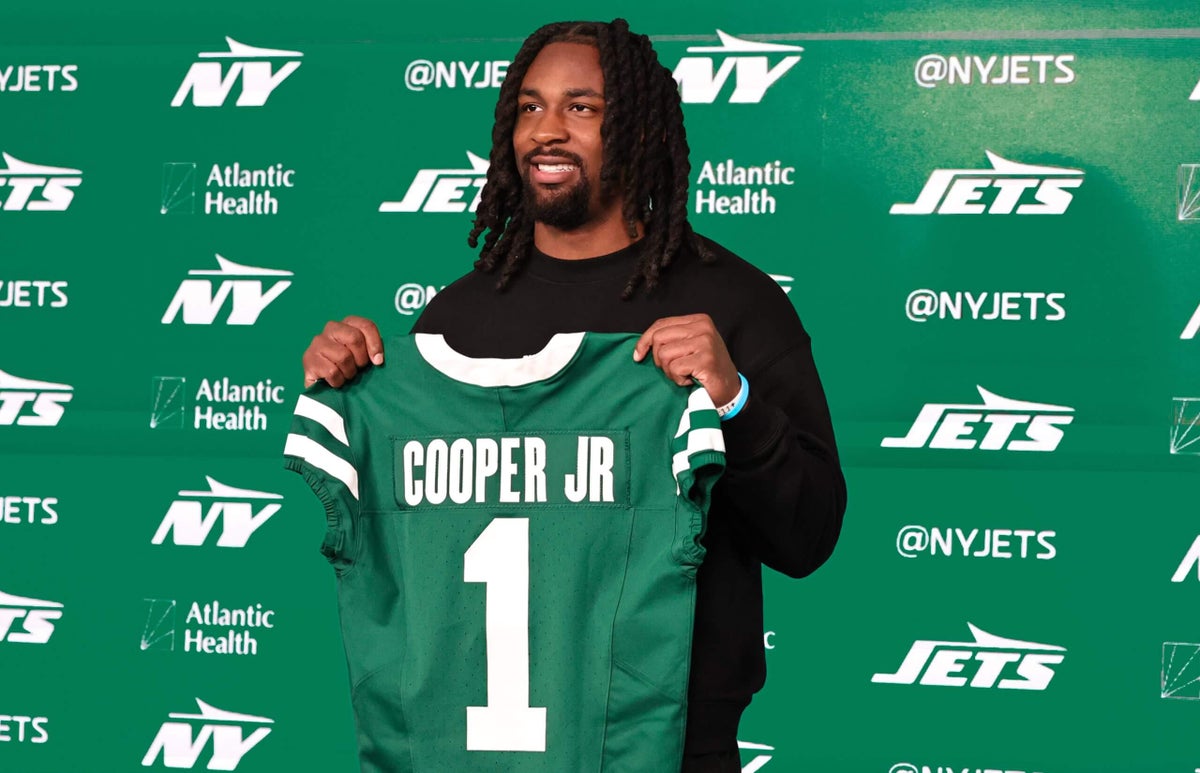
Mougey didn’t add a single new wide receiver in free agency, so it was a foregone conclusion that they’d add at least one in the draft. That’s exactly what they did, trading back into the first round to snag Cooper at pick No. 30. The Jets are high on Mitchell’s potential after he flashed an impressive ability to get open and make plays down the field after they acquired him in the Sauce Gardner trade in November. Barring another surprising addition, they’ll roll into 2026 with a talented trio of Wilson, Mitchell and Cooper at the top of the depth chart.
Cooper presumably will act as the primary slot receiver, though he has the ability to play outside too — and Wilson also thrives in the slot, though he can produce from any part of the field.
“I feel like this is a really good group of receivers and we could do something special,” Cooper said.
Williams, the team MVP last season, played well in the slot late (though his primary role will be as the team’s punt returner). Smith was a disappointment after the Jets drafted him in the fourth round in 2025, so this will be a crucial offseason for him to prove he deserves to stick around. He did make some plays on special teams, which could be his best path to the roster. Though Smith might have to stave off Charles, an elite gunner prior to tearing his ACL in 2024, missing all of last season.
Depth is a concern here, so it’s fair to wonder if Mougey plans to add another veteran. The high-end veterans still available are highly unlikely — Tyreek Hill, Deebo Samuel, Jauan Jennings, Stefon Diggs, Keenan Allen — but perhaps some other potential depth pieces could be pursued.
Noah Brown, Tim Patrick, Zay Jones, Juju Smith-Schuster, Brandin Cooks, Tyler Lockett and Gabe Davis are among those still available.
Tight End (3)
In: Kenyon Sadiq (R), Mason Taylor, Jeremy Ruckert
Out: Jelani Woods
Sadiq is a freak athlete who should play an immediate role as a pass catcher and moveable weapon; his skill set complements Taylor’s well enough that it’s conceivable the two could be on the field together plenty. Ruckert will be the team’s primary blocking tight end, though it wouldn’t be surprising to see his snaps take a downturn now that the Jets added Sadiq. Taylor showed some flashes last season but should be in a better position to succeed with improved quarterback play in 2026.
Offensive Line (9)
In: Olu Fashanu, Armand Membou, Dylan Parham (FA), Joe Tippmann, Josh Myers, Chukwuma Okorafor, Max Mitchell, Anez Cooper (R), Xavier Newman
Out: Gus Hartwig, Liam Fornadel, Marquis Hayes, Kohl Levao
This looks like a solid offensive line if everyone stays healthy — maybe not a great one, but a solid one, and that’s more than the Jets have been able to say for much of the last decade. Membou looked like a potential star as a rookie, Fashanu had an up-and-down season but should be better in 2026, and Tippmann thrived once he moved to right guard. Parham had a down season with the Las Vegas Raiders but has played well in the past, while Myers can do a serviceable job.
Mitchell, Okorafor and Newman were all brought back to comprise the backup group, while Cooper is an intriguing developmental guard the Jets added in the sixth round. He’s a big (6-5, 334), strong lineman who might be a little flat-footed athletically, but he makes up for it with his strength and play demeanor. He allowed zero sacks and two QB hits in 434 pass-blocking snaps last season, per Pro Football Focus.
Defensive Line (5)
In: T’Vondre Sweat (T), David Onyemata (FA), Harrison Phillips, Jowon Briggs, Darrell Jackson (R)
Out: Jack Heflin, Eric Watts, Mazi Smith, Payton Page
This looks like one of the Jets’ strongest positions on the roster all of a sudden. There are no stars among this group, but it’s a collection of solid NFL players who fit well into the Jets’ new defense, plus a developmental rookie with tantalizing physical traits.
Sweat was acquired in the Jermaine Johnson trade with the Tennessee Titans, and he’s coming off two seasons in which he was one of the best run-stopping nose tackles in the NFL. The key for him will be staying in shape. Onyemata was one of the free-agent signings the Jets got the most praise for — a rock-solid veteran defensive tackle who can help in both the run and pass game.
Phillips became a leader for the Jets last season and is at his best against the run, while Briggs flashed some significant potential last year as a pass rusher.
The Jets grabbed Jackson early in the fourth round, and it’s easy to see why — he’s 6-foot-5, a unique height for any defensive tackle. He’s at his best against the run, and defensive line coach Karl Dunbar will work to develop him as a pass rusher, too.
Outside Linebacker (4)
In: Will McDonald, David Bailey (R), Joseph Ossai (FA), Kingsley Enagbare (FA)
Out: Tyler Baron, Braiden McGregor, Kingsley Jonathan, Paschal Ekeji
The Jets completely revamped their edge rusher room in free agency and the draft, bringing reinforcements for a group that struggled last year. McDonald had eight sacks, but six of them were over two games. The Jets are expected to exercise his fifth-year option for 2027 at some point before the May deadline, but he needs to bounce back after a down season — and he shouldn’t be expected to be anything more than a pass-rush specialist at this point.
Having Bailey flanking him on passing downs should help, as Bailey — while a flawed run stopper — is a ready-made pass-rusher, with the skills, talent and athleticism to make an impact right away as a rookie. It’s rare for rookies to get 10 sacks, but it wouldn’t be a shocker if Bailey got there.
The Jets should have a healthy rotation at edge rusher (like they used to in the prime of the Robert Saleh-Jeff Ulbrich defensive era), with Ossai and Enagbare offering much more in the run game than McDonald and Bailey. Ossai isn’t a bad pass rusher either, getting five sacks in each of the last two seasons, a total that somehow would’ve ranked second on the Jets last season.
Baron had a rough season after the Jets drafted him in the fifth round and then suffered a season-ending knee injury in Week 14.
Inside Linebacker (5)
In: Demario Davis (FA), Jamien Sherwood, Kiko Mauigoa, Marcelino McCrary-Ball, Mykal Walker
Out: Kobe King, Ochaun Mathis
If the Jets had drafted Arvell Reese at No. 2, he might have spent much of this season playing here. If the Jets were interested in Texas Tech’s Jacob Rodriguez, the Miami Dolphins jumped ahead of their original pick at No. 44 to snag him at No. 43. As such, the Jets are rolling with this group of linebackers — and sticking with Sherwood, coming off a poor season after a 2024 breakout campaign that got him a huge contract.
The key here is Davis — the Jets, and especially Sherwood, were desperately missing CJ Mosley’s leadership skills at linebacker last season; Davis will go a long way toward making sure his teammates have a better idea of what they’re doing and where they are supposed to be. Sherwood struggled in that role last year and should do better with fewer responsibilities. It also doesn’t hurt that, even at 37, Davis is still one of the best run-stopping linebackers in the NFL.
Mauigoa had some moments last year but mostly looked out of place as a starting linebacker. McCray-Ball was the special teams captain in 2025 and should be back.
Cornerback (6)
In: Brandon Stephens, D’Angelo Ponds (R), Azareye’h Thomas, Nahshon Wright (FA), Jarvis Brownlee, Qwan’Tez Stiggers
Out: Jordan Clark, Tre Brown, Samuel Womack
This is one of the deepest position groups on the roster, even if there’s not a no-doubt No. 1 corner among them (at least not yet). Stephens was a pleasant surprise, if a bit inconsistent, after the Jets signed him in free agency last season, and he’ll be locked into one of the starting spots on the outside.
Ponds is only 5-foot-8, but don’t rule him out as a potential starter on the outside right away. He was stellar at Indiana and is a playmaker on the back end, which the Jets were severely lacking last season. He’ll also cross-train at nickel corner and could potentially start at either spot. On the outside, he’ll be pushed by Thomas, a third-round pick last year who showed some flashes but also was banged up and didn’t play as much as the Jets would’ve liked in a developmental year. Wright had five interceptions and a touchdown for the Chicago Bears and has unique size at 6-foot-4.
At nickel, Brownlee is the primary option, though, as mentioned, Ponds could push him — and safety Minkah Fitzpatrick might wind up getting the bulk of the snaps at nickel anyway.
Safety (5)
In: Minkah Fitzpatrick (T), Dane Belton (FA), Malachi Moore, Andre Cisco, VJ Payne (R)
Out: Dean Clark, Keidron Smith, Jarius Monroe, Chris Smith
There is an argument that this group got the biggest upgrade from last season of any position on the roster. Last year, Cisco was signed to be the No. 1 safety, and now he’ll have to fight to even get on the field. Fitzpatrick should be a major upgrade, even if he’s not quite at the level he was in his prime, when he was a takeaway machine. Belton is a versatile safety and sure tackler with a history of forcing turnovers. Moore should be better with a year under his belt, though he was inconsistent as a rookie.
And the Jets got a steal with Payne in the seventh round, a 6-foot-3 safety who was projected as a fourth- or fifth-round pick by most experts. He’s at his best covering tight ends, which is something the Jets have struggled with over the years.
Special Teams (3)
In: K Cade York (FA), P Austin McNamara, LS Thomas Hennessy
Out: K Lenny Krieg (FA)
The Jets are expected to sign BYU kicker Will Ferrin as an undrafted rookie, so it looks like they’ll have another full-scale kicking competition this summer. Last summer, the Jets went into it with Harrison Mevis and undrafted rookie Caden Davis in competition. When both struggled, they signed Nick Folk, who went on to have a stellar season (and parlayed it into a contract with the Atlanta Falcons).
It’s down to York (career 73.3 percent made), Krieg (a German kicker without NFL experience) and, potentially, Ferrin — who made 23 of 30 field goals last season but only 2 of 7 from 40-49 yards (though he was 4 of 6 from 50-plus).