
I grew up on a cul-de-sac in Arkansas, in a suburban house with a basketball hoop, a trampoline and a few years’ worth of food stored in the garage. My parents built industrial shelves and lined them with gleaming canisters of freeze-dried potatoes and green beans, boxes of stabilized milk and Ziplocs of beef jerky. They also stored hundreds of pouches of mac n’ cheese for me, the family’s pickiest eater.
My parents believed that the apocalypse loomed. They weren’t alone.
About 40 percent of American adults said in a 2022 poll that we are living in the “end times.” For much of the country, it’s an idea that’s almost mundane. The rapture is spliced into their Sunday sermons and enchants their world with a fearsome possibility. I’d hear bad news on television as a kid and think, is this it? Has the time come?
It’s an idea that’s now bouncing around, too, at the highest levels of the U.S. government.
The Trump administration has framed its campaign in Iran as a biblically-prophesied holy war. Paula White-Cain, the head of the White House Faith Office, asked Prime Minister Benjamin Netanyahu whether the conflict was a sign of the “End of Days.”
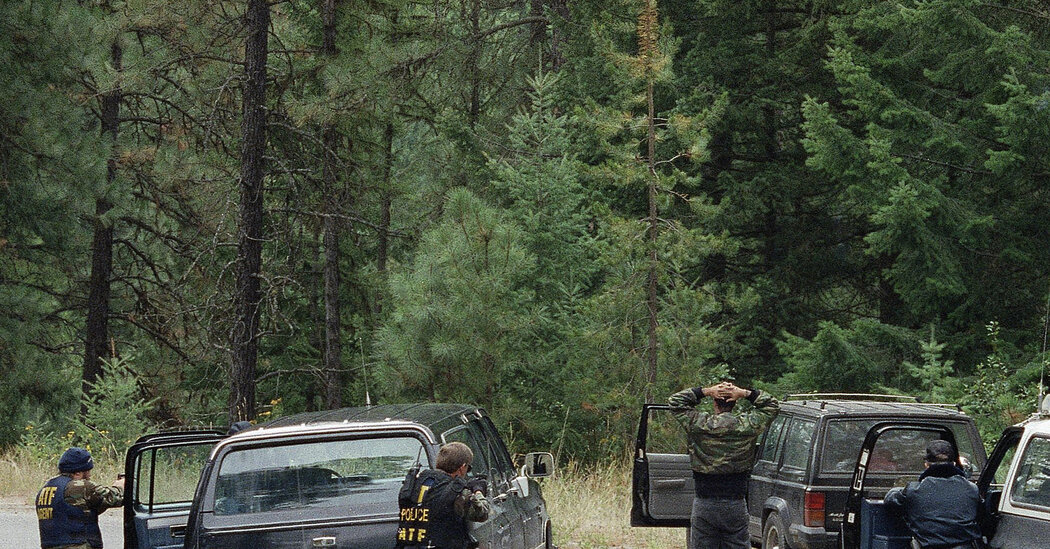
That’s also the title of a new book by Chris Jennings, a journalist who used to work at The New Yorker. The book looks back at Ruby Ridge, the violent 1990s standoff between federal law enforcement and a survivalist family in Idaho. It also seeks to explain the emergence of apocalyptic rhetoric in the United States, and how it has shaped modern conspiracies like QAnon.
Ruby Ridge, Jennings writes, portended “a slow-moving ontological crack up, the fracturing of American reality itself.” I am fascinated by that, so I asked him how apocalyptic thinking became so prevalent and potent in American life.
This has been edited for clarity and brevity.
Lauren: Your first book was about an early American pursuit of utopia, and your second was about a modern American embrace of apocalyptic fear. Do those come from the same impulse?
Chris: Yeah, I would see them as two sides of the same coin. Both of them have the effect of reorienting your whole relationship to the material world and to your fellow citizens. If you think the world’s on the brink of perfection, it inspires a certain set of mostly positive impulses. But if you think that the world is on the brink of calamity, that makes you a very different kind of citizen.
You’ve said you’re not a believer, so what drew you to those themes?
I grew up on the West Side of Manhattan. My mom’s Jewish, but I wasn’t raised with any Judaism. My dad was Episcopalian, which I feel like is among the lighter Protestantisms. I think just people with really strong faith, or really strong belief about anything, have always fascinated me.
Was that because, raised in-between things, you weren’t sure what you believed in yourself?
Yeah, I think that might be part of it. Growing up in a big city, I was exposed to so many different intense beliefs. So I started researching them. I realized there was this era right before the Civil War when a lot of very reasonable people thought utopia was possible. Then the prevailing story that American Protestants had about how history ends inverted, and became much less hopeful after the Civil War.
Their utopian ideas sound crazy to anyone looking around now, but they’re also beautiful. The turn to the second book was lamenting: Where has this relationship to the future gone?
You write about that shift, and the spread of a doomsday interpretation of the Bible. What is “premillennial dispensationalism”? And why does it matter that tens of millions of Americans have been influenced by this way of thinking?
The premise, cooked up by the British Bible teacher John Nelson Darby in the middle of the 19th century, is that divine history is divided into separate dispensations. In each chapter, God’s relationship to his creation changes. We’re in the sixth of seven. What remains is the period of tribulation. Through some very convoluted prophetic math, many people believe there will be like a seven-year period that will precede Armageddon, which will be a literal earthly war. After that is when Jesus comes and reigns for 1,000 years in a millennial kingdom. But before that, all this bad stuff has to happen.
That sounds intense in this context. But this apocalyptic story could also be just that, another story. I’d hear it all the time in church as a kid, then class would break and we’d go eat the cinnamon rolls Sister Pierson baked for the choir.
Yes. This is sort of surprisingly threaded into ordinary religious life. But what surprised me was how much of this came not from pastors, but from pop prophecy texts. The most recent example being the “Left Behind” books. Kids went to ordinary evangelical churches and then read these highly literalized, fictionalized telling of end times prophecy. In the case of the Weaver family on Ruby Ridge, it was reading Hal Lindsey’s, “The Late Great Planet Earth.” This stuff is exciting in a way that the hymns are not exciting.
You write that it makes modern life into a sci-fi thriller.
It re-enchants the news in a way that I think is dangerous and interesting. American foreign policy is suddenly infused with prophetic elements. What’s a reasonable, rational relationship with Iran or with Israel? All of that can be set aside if it is plugged into the web of prophecy.
Pete Hegseth and others are invoking apocalyptic thinking in describing the war in Iran. What is the implication of that?
When Hegseth frames this in apocalyptic terms, for people who read books like “Left Behind” as teenagers the connection is immediate. It’s hooking something very real — bombs, death, civilians, war — to a fantasy. It would be just as wild to be interpreting American foreign affairs through the lens of the “Die Hard” movies or the Iliad.
You weren’t raised with these ideas. After going deep into the Weavers’ story on Ruby Ridge, have you developed a sympathy toward them and their survivalism?
I had a sympathy toward them throughout. We all live within stories about the world. I don’t think a lack of faith is an absence of a narrative. I just think my narrative is less consuming than theirs. They got so far into a particular tale about how the world would end and about their special role in it that it blotted out all other realities for them.
Read our good review of Jennings’ book. It says he “writes with vividness and precision, and occasionally soars into a panoramic lyricism.” Deal me in!
Religion in the News
Pope Leo wrapped up a tour of Africa. His comments about injustice there were interpreted as criticisms of President Trump.
An Orthodox monastery in southern Ukraine is caring for the abandoned and the ill. See these striking images.
The Supreme Court agreed to decide whether Catholic preschools in Colorado that reject children of queer parents are eligible for state funds.
Pilgrimage
In a remote corner of India, a few thousand people believe they are one of the Ten Lost Tribes of Israel — the descendants of the biblical Manasseh, who were said to have dispersed nearly three millenniums ago. They teach their children Hebrew, keep kosher and wait with their passports at the ready to make the move to the modern state of Israel.
Nearly half the community has already gone, and more than 250 flew to Tel Aviv this week. The remainder, a few thousand more, hope to follow by 2030.
“India is our birthplace,” one man said, “and Israel is our destiny.”
Trending
Loving, so much: Wisteria season in London. In Japanese folklore, wisteria is viewed as a powerful talisman against evil (!)
Eating: At Hot Saint Pizza.
Following: My former colleague Bianca Giaever is offering free help to strangers in New York. Her documentary about it is going to the Tribeca Film Festival.
Reading: “Yesteryear,” by Caro Claire Burke. It’s about a homesteading trad wife who actually has to go to 1855.
Also reading: “Perfecting Democracy,” in The Point magazine. “I once found the spirit of democracy at a church that met in a movie theater,” Paul Taylor wrote.
Watching: “Unchosen,” a Netflix series about a fictional religious sect that separates itself from modern society.