
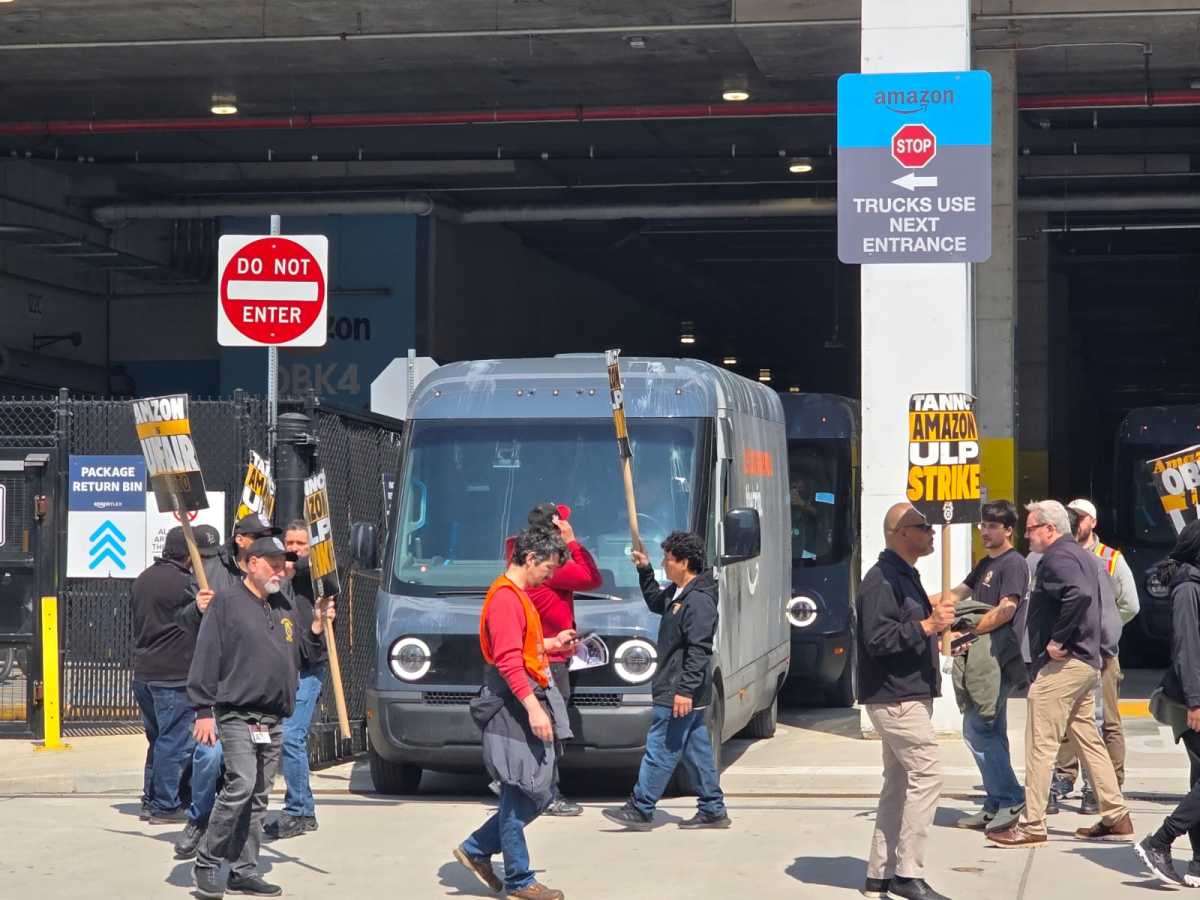
Amazon workers joined Council Member Tiffany Cabán and Teamsters representatives outside Amazon’s DBK4 last-mile delivery facility in Maspeth on April 24 as part of a protest against an alleged unfair labor practice at a separate delivery facility in Los Angeles.
Protesters said that they were also protesting against Amazon’s Delivery Service Partners (DSP) model, which sees the company work with more than 3,000 third-party entities to deliver packages around the world without recognizing drivers as Amazon employees.
Amazon workers and Teamsters said that they were extending the picket line from LA to New York after Amazon cancelled a contract with a third-party DSP after drivers at LA’s DAX7 delivery facility joined Teamsters Local 396 in LA.. Teamsters has described the cancellation of the contract as an illegal retaliation against workers who had organized with the union.
Cabán, Amazon workers and Teamsters representatives also accused the corporation of illegally cancelling a contract with DSP contractor Cornucopia Logistics at the DBK4 facility in Maspeth last August. Organizers said the move came as a direct result of drivers organizing with Teamsters, which Teamsters said resulted in more than 100 job losses.
Amazon officials pushed back strongly against the allegations, stating that it cancelled its contract with DSP provider Next Stop at its DAX7 facility because the company repeatedly failed to meet “basic operational standard,” including vehicle safety, performance expectations and internal communication.
A company spokesperson further alleged that the protest in Maspeth was attended “exclusively” by outside organizers and individuals, accusing Teamsters of intentionally spreading misinformation. The company further contended that DSP workers are not employed by Amazon.
“It’s just the latest example in a long pattern of dangerous, coercive behavior from the Teamsters,” an Amazon spokesperson said in a statement. “Despite the Teamsters’ misinformation, the truth is that there are multiple independent small businesses that deliver from this building, and those businesses – not Amazon – employ their workers.”
Several attendees, including Cabán, strongly disputed that statement, noting that drivers wear Amazon uniforms, drive company trucks and follow company rules, even if they are not directly employed by the company.
“It’s bullsh*t,” Cabán said.
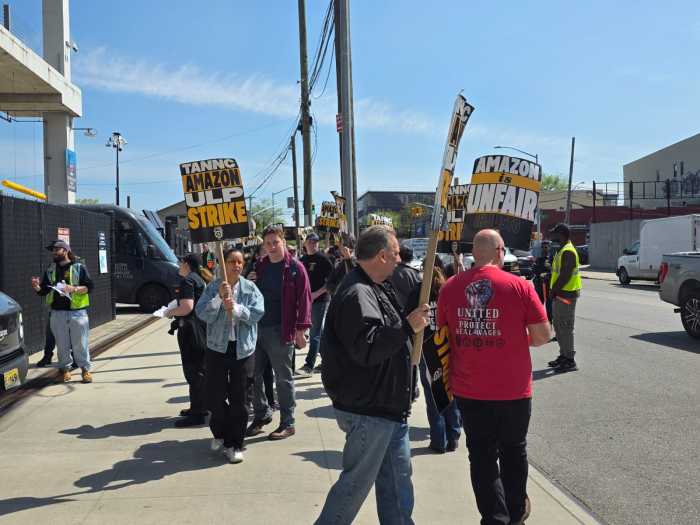 Cabán at Friday’s protest. Photo by Shane O’Brien.
Several Amazon workers and Teamsters representatives joined the April 24 protest to show solidarity with workers at the LA facility.
Latrice Johnson, a driver at the Maspeth location who lost her job when Amazon cancelled the Cornucopia contract last year, said she joined the protest because the DSP model leaves drivers vulnerable to termination.
“It happened to me. I’ve seen it happen to other people,” Johnson said. “I’m not going to back down. Amazon is not going to get away with what they do to people, including myself. People with families. It’s not okay.”
Sarah Venegas, a driver at the LA facility who joined the protest in Maspeth, said she traveled to the east coast to raise awareness about the issue.
“We’re here to bring awareness to other Amazon workers. If it happened in California, I’m sure it happens in New York, and talking to some of these drivers here, it has happened in New York,” she said.
Venegas also claimed that Amazon had cancelled the DSP contract as retaliation for the efforts.
“Amazon doesn’t want any type of organizing, so they’ll do whatever to kill any momentum going on with it,” Venegas said.
Venegas further accused Amazon of asking drivers to drive “over-packaged routes,” asking workers to meet high quotas.
Cabán has introduced the Delivery Protection Act in the City Council, which would end the DSP model in New York City if passed. The legislation, which has over 30 sponsors, would require delivery companies to directly hire their drivers.
Cabán said that the subcontracting model for major delivery firms “has to go,” adding that the Delivery Protection Act would help keep both workers and New Yorkers safe by reducing high daily quotas, which Teamsters says places drivers under pressure.
“We continue not to be able to hold Amazon accountable,” Cabán said. “That’s why we have to regulate it.”
Workers at Amazon’s DBK1 facility in Woodside previously told QNS that the DSP model “holds people hostage” by making it almost impossible for workers to fight for better conditions.
“Basically, it’s holding people hostage by saying, ‘if you want to fight for better conditions, then you’re going to risk us just wiping out the jobs of 100 or 200 people overnight,’” DBK1 driver Matt Multari told QNS in December.
Several workers reiterated that stance on Friday.
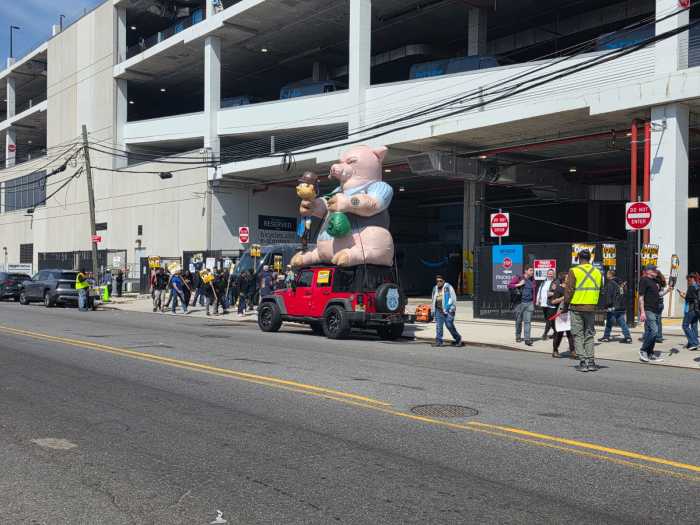 Photo by Shane O’Brien.
Johnson accused Amazon of retaliating against drivers with the third-party provider because union organizing was particularly strong among Cornucopia drivers.
“I feel like they saw how strong we were and didn’t want to see us progress,” Johnson said.
She further accused the company of cancelling contracts with certain DSPs to deter future union efforts.
“Amazon wants us to be afraid. They want us to back down,” Johnson said.
Amazon said at the time that the cancellation of the Cornucopia contract at DBK4 was part of a “recent change” that would allow DSPs to be “more hands-on with their teams and support their operations at one delivery station.”
“Our goal is to provide customers with fast delivery and great service – and we regularly review and make changes to the DSP program in support of this,” Amazon spokesperson Eileen Hards told the Guardian last year. “Changes like this not only benefit their employees, but also our customers.”
Vincent Perrone, president of Teamsters Local 804, accused Amazon of spreading misinformation about the issue. Perrone also called for passage of the Delivery Protection Act, stating that the legislation would help improve accountability mechanisms.
“It would make all of these people direct employees,” Perrone said. “It would hold Amazon accountable. It would drive up wages.
“It would also hold Amazon accountable for health and safety issues, which is vital not only to the employees, but to the residents of New York City.”
A California National Labor Relations Board (NLRB) official ruled in August 2024 that Amazon had engaged in unfair labor practices when it terminated its contract with Palmdale-based DSP Battle-Tested Strategies (BTS) after drivers had organized with Teamsters. The NLRB official said Amazon had “unlawfully failed and refused to bargain” with Teamsters over the decision to terminate the BTS contract, according to an NPR report.
The official said the move did not amount to a retaliation but ruled that Amazon is a joint employer of subcontracted drivers who delivered the company’s packages out of Palmdale.
However, several outlets reported in March that Amazon has reached a proposed settlement with the NLRB General Counsel that would require Amazon to provide a payout to the Palmdale drivers without admitting to any wrongdoing or being found liable as a joint employer.
Teamster is urging an NLRB judge to reject the proposed settlement, describing the agreement as an “ambush” that would allow Amazon to dodge any collective bargaining agreements with the union.
Perrone said Friday that the NLRB is moving as “slow as molasses” in relation to the ruling.