
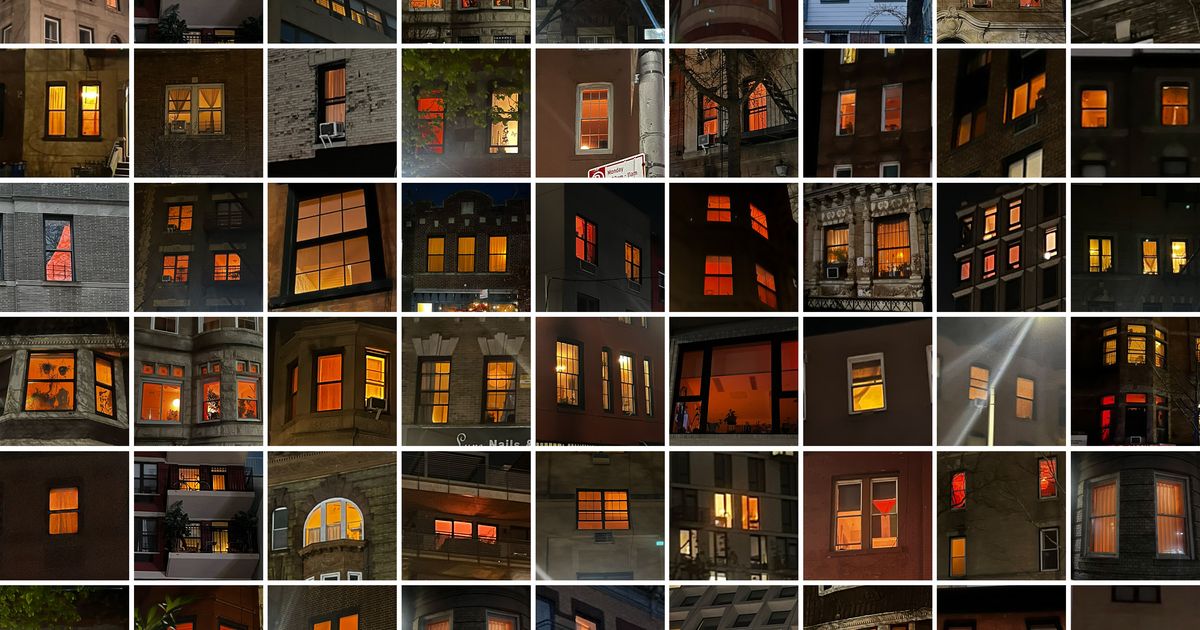
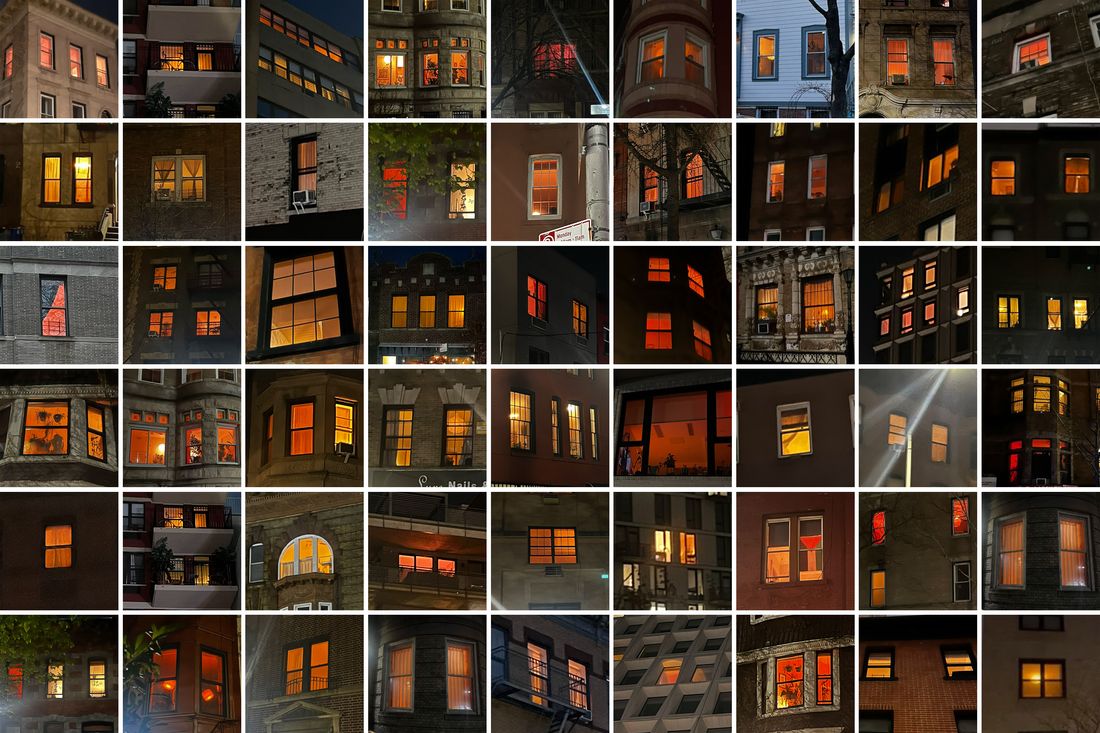
Windows glowing orange spotted across Brooklyn and Manhattan on evenings this year.
Photo-Illustration: Curbed; Photos: Adriane Quinlan
Sometime last year, my block in Crown Heights started turning orange. When the sun set, our windows burned in the apricot tones of the old sodium-vapour lamps. The shift began with one window (rental building, paper lantern), but the spread was swift — up and down the block, across the stately Queen Anne townhomes, and along the busy corridor where, on my nightly commutes home, I watched for shades of marigold and poppy, Werther’s Butterscotch and Gatorade. From the West Village to Williamsburg, I photographed windows of safety-vest orange. In Bed-Stuy, a friend reported that her entire walk home from Pilates had turned cantaloupe. Her own windows had too, long ago. “I’ve really been an evangelist,” she says.
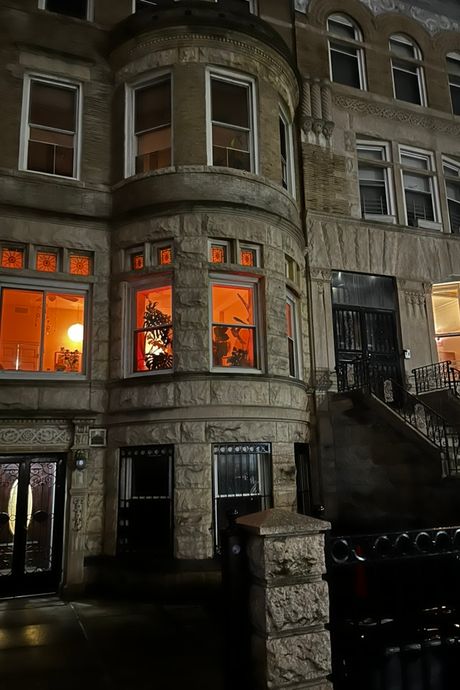
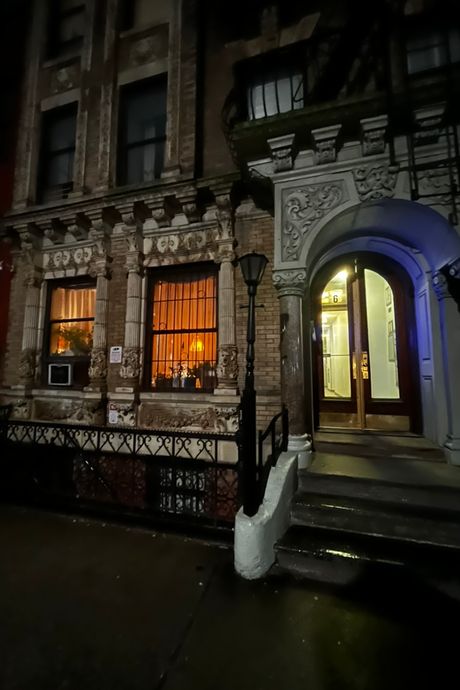
Orange adopters from Bedford-Stuyvesant (left) to the West Village (right). From left: Photo: Adriane QuinlanPhoto: Adriane Quinlan
Orange adopters from Bedford-Stuyvesant (left) to the West Village (right). From top: Photo: Adriane QuinlanPhoto: Adriane Quinlan
“I’ve been noticing the same thing,” says Paola Pietrantoni, a lighting consultant who lives in Bed-Stuy. She has picked bulbs for Madison Avenue jewelry stores and the TWA Hotel at JFK, and she calls me between fêtes at Milan Design Week to explain that home lighting has been trending warmer for years, but the move toward darker, deeper oranges is so recent and so local that she wonders aloud if it is due to our particularly “horrible winter” — snow and ice, storms upon storms. Her New York clients have been asking her for ruddier tones than she would have used a year ago, and she feels the same pull. “I, personally, am craving to go warmer,” she tells me. “Warmer light makes you slow down.”
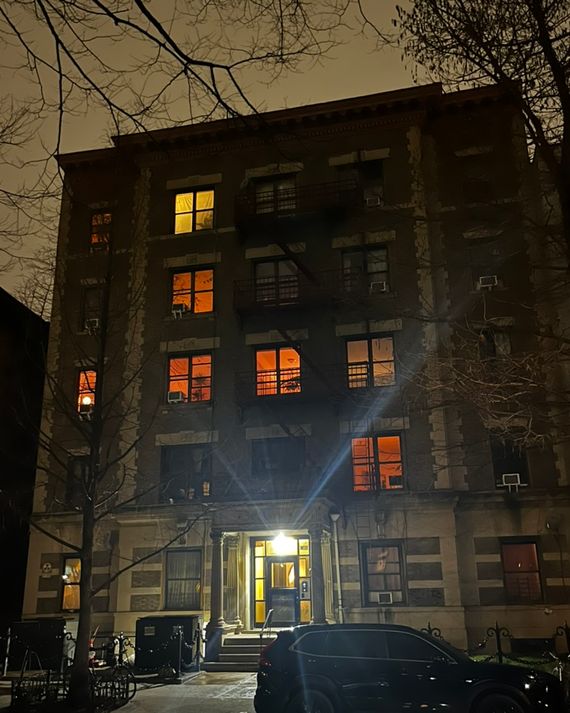
A building across from the Pratt campus.
Photo: Adriane Quinlan
“I bet there is a caveman-brain-related thing where it’s comforting to be in the glow of a fire,” says Dan Goedeker, a director of photography. I had called him to ask about the flattery of orange — did it really make people more attractive? (It does, and he’s used it to light on-camera interviews for television news.) That’s why we love candles on the table at date spots. “Orange is a resistance to the sterility of modern life,” speculates my neighbor Grace Ginsburg, who turns on her orange lamps when she’s done with a day’s work on backlit, bluish screens. (And then, she admits, she sometimes stares at her phone.) Another friend finds it actively hard to go back to work if she’s already turned on her orange lights. There’s actual science behind this claim. “You’re catching me as I just got back from a sleep doctor,” she says. The doctor had endorsed the shift.
Blue light jolts us awake, blocking our body’s impulse to produce melatonin when the sun fades. A hospital in Norway tried shifting lights toward orange at night in one psych ward and found the patients were less aggressive. Online, biohackers who cite these studies sell “circadian lights” as a return to nature. Some of their posts hawking these bulbs get millions of views, which might have more to do with how orange pops on a blue screen than with the health benefits. And online, orange lights are intersecting with the trend to paper lanterns. But people who buy the off-brand Noguchi will quickly find the rice paper isn’t as warm, Pietrantoni, the lighting consultant, tells me. To fix the problem, some may be going orange — which fits how the trend spread on my block from a window with a paper orb as big as a beachball.
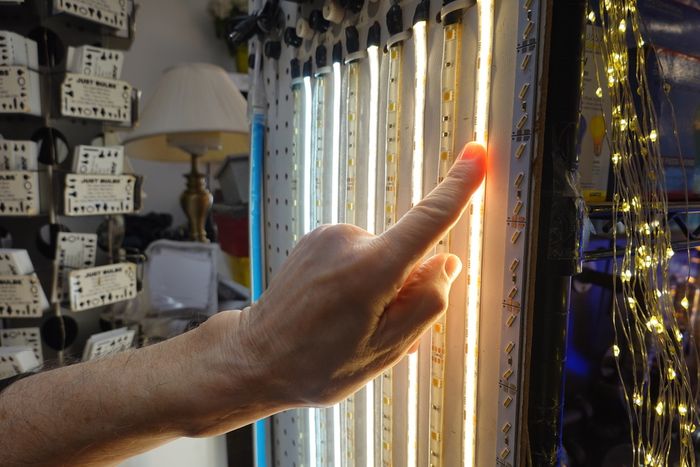
At Just Bulbs, a display of LED strips shows the standard range of warmth in bulbs, which doesn’t get close to the orange of old oil lamps.
Photo: Adriane Quinlan
Soft, warm orange light is also now widely available to the non-rich. Incandescents replaced oil and gas, but the standard filaments after World War I glowed brighter and yellower than carbon — the color of the tungsten burning, literally, inside them. We got used to this color enough to complain when early LEDs debuted in horrifyingly unflattering, stay-awake-all-night whites. When the smart bulb debuted in 2012, it was at $59.95 per bulb. But prices have mellowed — given a push from Chinese competitors with names like Zigbee and Govee, Philips Hue’s “essentials” line, and even Ikea’s smart bulbs, which are now about $6 each. These are all controlled by apps on smartphones, which have a color wheel, though many owners keep theirs stuck on one tone: orange. That seems like total nonsense to David Brooks, owner of Just Bulbs, a third–generation bulb man who warehouses incandescents like a typewriter repairman stocking ribbons. He thinks if customers want orange, they should buy orange, and he points me to $4.22 pre-painted, colored incandescents, which he describes condescendingly as “party bulbs.” “Why pay more?” he asks me.
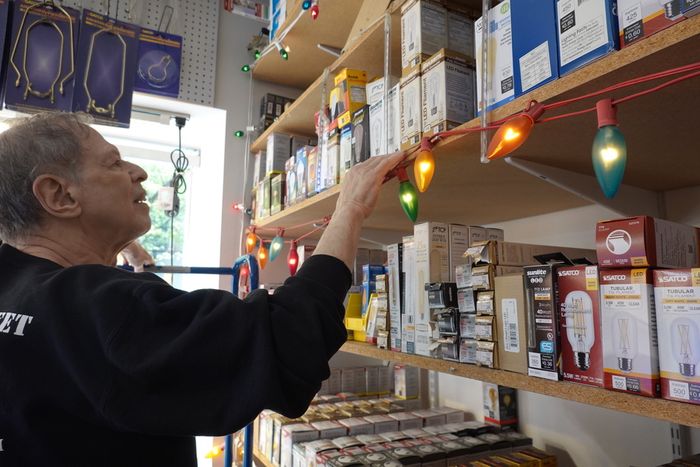
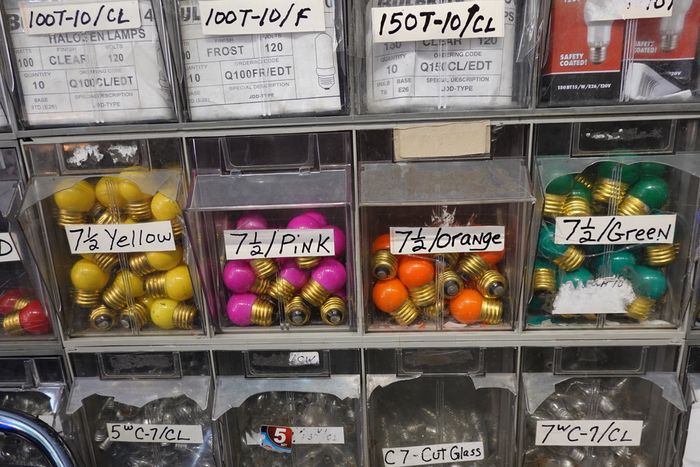
Brooks, left, and some of the colored bulbs he sells for marquees and parties. Adriane Quinlan.
Brooks, left, and some of the colored bulbs he sells for marquees and parties. Adriane Quinlan.
Because we may be at peak orange and want the freedom to make the change with a swipe. James Cherry, a lighting designer who helped bring warmth to Ha’s Snack Bar and its new bistro, wonders if we’re about to feel the dip. “I feel like designers are aware of that huge trend, and whenever something is trending that big people want to swing in the opposite direction,” he says. In Milan, Pietrantoni had just worked with a design studio on an installation with cold lighting, which was drawing interested crowds. Which happens in Brooklyn, too. Though the attention isn’t always positive. “When you walk by someone’s apartment and they do have bright white bluish white,” says Goedeker, the director of photography, “It’s like, Jesus Christ, how do they live in there?”
Sign Up for the Curbed Newsletter
A daily mix of stories about cities, city life, and our always evolving neighborhoods and skylines.
Vox Media, LLC Terms and Privacy Notice
Related