
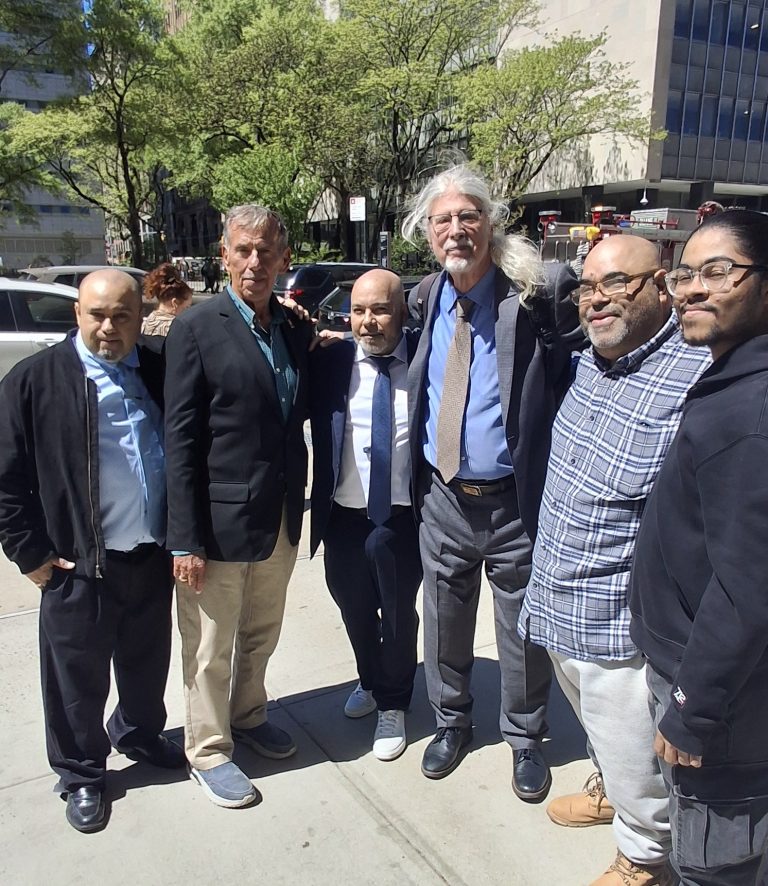
Note: The following is a condensed version of a recent court filing connected to the decision by Manhattan D.A. Alvin Bragg’s Post-Conviction Justice Unit to exonerate Harry Ruiz on Monday, April 27.
Ruiz was incarcerated for 25 years before his release in 2019. Noted exoneration attorney Ron Kuby has represented Ruiz since 2003, after a referral from veteran private investigator Michael Race. In the filing, Kuby does not use the names of key witnesses, and in this version we use pseudonyms for the two mentioned, calling them “Andrea” and “Jose.” —Ted Hamm
THE MURDER OF FELIX EMMANUEL
On August 29, 1993, at about 12:30 am, one Felix Emmanuel (Manny), 23 and six feet tall, was walking on Amsterdam Avenue, between 136th and 135th streets. Someone appeared behind him and fired a single shot that entered his head at the right temple, traveled downward and to the left, and exited through the left occipital lobe at the bottom of the skull. He collapsed on the street by a bus stop across the street in front of 1532 Amsterdam Avenue. The gunman fled. A large crowd gathered. The police canvass of the area turned up no witnesses. There were no leads. It was not an uncommon event. Manny was known to the police as a drug dealer who had at least one open criminal case where he was awaiting sentencing.
When that shot was fired, 24-year-old Harry Ruiz was in his fifth-floor apartment at 504 West 135th Street, with his mother, sister, and sister-in-law—all of whom later testified that he was home at the time of the killing. All of them heard the shot. As people started congregating at the location, Harry went outside to see what had transpired. He was noticeably short for a man—4’11” or 5 feet. His nickname on the street was “Little Harry.”
Once he was named as a suspect, the respective height of the victim and Harry Ruiz, in conjunction with the bullet path, should have posed a major issue for the police and prosecutors. It was undisputed that Manny was walking when he was shot, and that the gunman, on foot, came up behind him. It would have been extremely difficult for a five-foot tall assassin to raise the firearm sufficiently high that a bullet could enter at the right temple of six-foot Manny, proceeding downward; that is, the gun must have been significantly higher than Manny’s temple to descend on the trajectory indicated by the medical examiner. While not beyond all physical possibility, it was wildly implausible. Moreover, a five-foot tall gunman could far more easily fire a shot into the back of Manny’s head that would enter at the base of the skull and exit in an upward trajectory.
There was neither forensic evidence nor a motive linking Harry Ruiz to the crime.
Witness “Andrea” was thirteen years old when the shooting took place. She lived in a small apartment on at West 134th Street, with her mother, who was unemployed addicted to drugs. It was a precarious existence, surrounded by narcotics dealers and violence. Her mother allowed many of the “guys from 135th street” (as they were referred to by various people) to regularly come over to sell or give her drugs or just hang out and get high. Andrea was a very good friend of Manny. She knew Harry from the neighborhood.
On September 2, 1993, at 3:00 am, Andrea’s mother called the police, claiming that she had been awakened by someone banging on their door at 3:00 am, demanding to be let in. She told police that there were more of them entering the building and still more in the hallway. She claimed that it had something to do with her daughter witnessing Manny’s murder—the first mention of any witness in the case.
The police arrived and did not find any evidence of criminal activity. They detained and searched four of the young men who were hanging out in front of the building; none were armed and all apparently explained their presence to the satisfaction of the police. They were released without charges. The claim that Andrea had witnessed a murder a few days earlier received much more attention.
Andrea was immediately interviewed by the police. She told the police that she was playing with her friend, running toward West 135th Street, where they waited for another friend. Andrea said she heard one shot and saw Harry Ruiz running behind her, holding a black pistol. She watched as he entered 509 West 135th Street. She signed a statement to that effect.
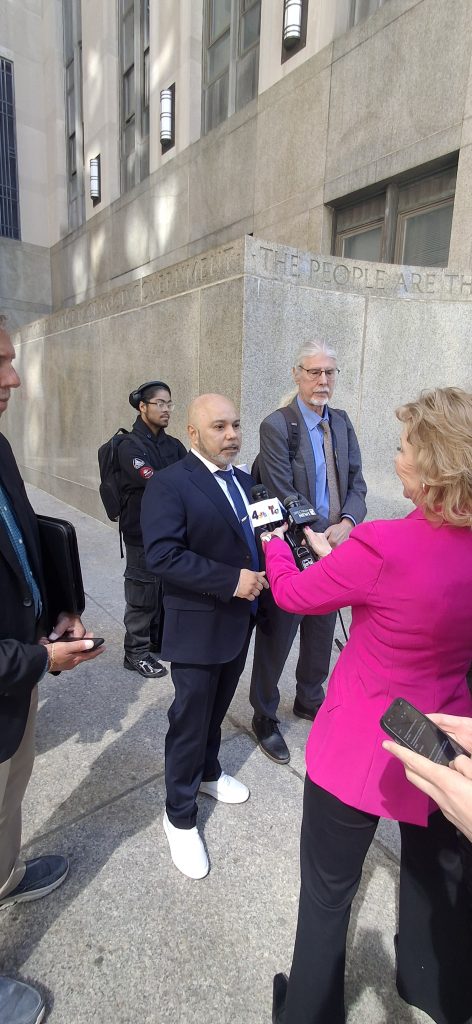 Ruiz speaks to a reporter after his exoneration on April 27, 2026 (photo credit: Ted Hamm).
Andrea claimed the group who attempted to effect entry into her apartment were friends of Harry Ruiz and that they were there to intimidate her from testifying against Harry. She said that is what motivated her to speak with the police.
A few hours later, Andrea was interviewed by detectives. Her evolving accounts of what she saw, where she was, where she went after the shooting, her relationship with Manny, and the various threats she claims to have perceived, differed from interview to interview, differed from her testimony at trial, differed from physical evidence, and differed from the account she later provided to DA Bragg’s team.
Andrea was the only witness who identified Harry Ruiz. Other people who saw the alleged gunman fleeing did not identify him. Her identification was not corroborated by either of the two young women she was with that night. Harry did not confess. There was no forensic evidence linking him to the crime. There was no evidence of any motive.
Ruiz was not arrested until June 9, 1994, over nine months later. It remains unclear what was responsible for the delay, although police reports generated during the time between Andrea identifying Harry Ruiz and the latter’s arrest demonstrate that detectives were still looking for more evidence. The trial of Ruiz began on November 7, 1994, before the Hon. Alfred B. Kleiman.
ANDREA’S TRIAL TESTIMONY
Andrea’s appearance on the witness stand did not start off well for the prosecution. After providing a brief biography, she claimed that she knew Harry Ruiz for a year and saw him “several times.” She quickly changed that, under the guidance of the prosecutor and Judge Kleiman, to twice a week. When asked to identify Ruiz, she pointed to someone in the rear of the courtroom. When confronted over this, she then claimed that person “looks like Harry” and then proceeded to identify Ruiz, who was seated at his defense counsel’s table.
Andrea stated that on August 28, 1993, she and her two girlfriends went to a birthday on West 164th and St. Nicholas. Andrea said they remained at the party until “around 2:30,” which she quickly changed to 12:30, then took the subway and exited at 137th Street and Broadway. The trio then walked up 136th Street toward Amsterdam. She then saw Manny on 136th Street “walking down the block.”
While running down Amsterdam Avenue with one of her friends, Andrea said, she turned back “and seen Harry shoot Manny,” from a distance of 60 feet away. She did not see where Harry had come from but was only a couple of feet from Manny. Harry, she said, took the gun out of his waistband and shot Manny in the left temple, before the trial court asked her if she remembered whether it was left or right, to which she stated that she did not remember. She was clear that the shooter did not hold the gun above his head. Andrea stated that when Harry put the gun to Manny’s head, Manny moved slightly backward “in a jerking motion.” However, she later agreed with the prosecutor who asked “[a]t the time you heard the shot, you indicated that Manny jerked his head back.” She then claimed she saw Harry turn the corner of 135th Street.
Andrea testified that she did not tell anyone about what she had seen—not her two close friends who were with her that night and not even her mother. She did not go to the police until “the guys from 135th Street came to my house knocking on my door.”
Based on Andrea’s testimony, Harry Ruiz was convicted. At sentencing he repeatedly swore to his innocence. After the judge imposed the maximum term of 25 years to life, his last words were “Your Honor, I’m innocent.” To which the court replied, “Go in, sir, you have been found guilty” before turning to a drug case.
Ruiz engaged in extensive post-conviction litigation, all of which was vigorously opposed by the DA’s office. In his first appearance before the parole board, Harry maintained his innocence—and succeeded, gaining release in June 2019. In late 2023, he was discharged from parole due to his exemplary record of compliance and community re-integration.
CRACKS EMERGE IN THE CASE
While Ruiz challenged his conviction, the DA’s office learned of new and credible evidence which, while stopping short of completely exonerating Ruiz, cast substantial doubt on his guilt and the testimony of the only eyewitness. They then buried it.
On May 3, 2000, a major narcotics trafficker, “Jose” was charged in the Southern District of New York with a decade-long conspiracy to distribute narcotics. One “overt act” that was part of that conspiracy alleged that Jose in August 1993 “paid another individual in the vicinity of 180th Street and Broadway to murder Felix Emmanuel in furtherance of the defendant’s drug distribution organization.” Under the federal sentencing guidelines, Jose was looking at life without parole.
Jose wanted Manny killed because he was stealing from him.
This was the first time that Jose’s name came up with respect to Manny’s murder. Jose later pleaded guilty and stated, as part of the plea negotiation, that he had paid someone to kill Manny because Manny was stealing from him. Over the next three and a half years, Jose fully cooperated with the federal authorities, providing everything he knew. Jose informed federal authorities that the person he had paid to commit the murder was known to him as “Shorty,” and crucially, that “Shorty” was not Harry Ruiz. But he always disclaimed any personal knowledge of who actually pulled the trigger—only that someone who was not Ruiz was hired to commit the murder. When Jose was sentenced on December 3, 2003, the judge noted that he was “completely truthful and that the testimony and information you gave was complete and reliable.”
Jose’s motivation for the murder was simple—Manny was stealing from him. Specifically, Jose averred that he owned the drug spot at 139th and Amsterdam and Manny worked for him. One of Manny’s jobs was to take care of a safehouse where drugs, money, and weapons were stored. In the fall of 1992, the safehouse was burglarized and $150,000 in cash, three kilograms of cocaine, and several handguns were stolen. Jose believed that Manny had participated in the burglary. Moreover, Manny was becoming hostile, threatening other workers, starting fights, and scaring away customers.
At some point after Jose’s arrest, the murder information he provided ended up in the hands of the Manhattan DA’s office. ADA John Dormin interviewed him in June 2002. ADA Dormin took largely unintelligible notes, but Jose, a cooperating federal witness whose pending sentence depended upon his total truthful cooperation, presumably gave the same account to Dormin as he had been giving consistently to others. The DA’s office did not disclose the fact of this interview, or the notes, to Ruiz’s legal team until the reinvestigation by Bragg’s Post-Conviction Justice Unit’s (PCJU) that started in early 2024.
THINGS FALL APART
The PCJU reinvestigation was extensive and exhaustive. The team re-interviewed everyone who would speak to them, interviewed persons that had never been questioned, located and interviewed new witnesses, and endeavored to actually find the real “Shorty.” While that latter effort failed, the unit uncovered more than enough new evidence to exonerate Harry Ruiz.
In the course of the re-investigation, the PCJU made substantial disclosures of documents that would have seriously undermined Andrea’s testimony. Ruiz’s trial counsel was interviewed and he was clear that he never received these documents. There is every reason to trust this account—defense counsel was exceptionally zealous and competent in his representation, both before and after the conviction.
The documents revealed a fifteen-year relationship between Andrea and the DA’s office, with the latter helping to provide Andrea with everything from cash and apartments to legal assistance cancelling debts.
In June 1994, the DA’s witness protection staffers attempted to expedite Andrea’s mother’s NYCHA application, claiming that her apartment had been “consumed by a fire,” that the “primary suspects” are friends of the defendant, and that the “defendant has gone through great lengths to harm the witness.” Indeed, Andrea herself would insist that Harry’s friends had started a fire in her apartment by throwing a Molotov cocktail that burned up the apartment.
The DA’s office helped Andrea with cash, apartments and legal assistance cancelling debts.
In fact, as other documents released by the PCJU demonstrated, the apartment had been abandoned by Andrea and her mother for a month before the fire broke out. It was used as a crack den. The door had remained unlocked. The fire was a surface fire that started on a couch and the most likely cause was accident. It was easily extinguished. Thus, nothing in the letter was true. The apartment had not been “consumed,” it was not labelled an arson, and there were no “primary suspects” or suspects at all. Not only was the DA’s office providing secret assistance to Andrea—they were lying to NYCHA about it.
During the period of trial through sentencing (mid-fall 1994 through March 1995) the DA’s office then made arrangements for Andrea and her mother family to live in a Holiday Inn at Lafayette Street, paying out over $700 per week and totaling about $13,000. These were substantially better quarters than their old $980-per-month apartment, which Andrea’s mother struggled to pay.
Since the family was no longer living in the neighborhood, Andrea’s mother could not continue to do whatever it was she had been doing to take care of her living expenses, not the least of which was feeding her drug addiction. The DA’s office turned on a cash spigot. The trial prosecutor authorized at least $5,000 in cash payments for “living expenses” between November 1, 1994 and June 5, 1995. It does not appear that A or her mother submitted any receipts justifying such expenditures. Rather, the payments seemed to represent a $210 weekly stipend that was increased to $250 in March of 1995. This was an exceptionally large amount of money being handed over to an unemployed drug addict.
The DA’s office remained there for all of Andrea’s needs. On May 8, 2002, eight years after Harry Ruiz had been shipped off to prison, the office wrote to the clerk of the Civil Court in Manhattan, with respect to Andrea’s desire to change her name. The DA’s office asserted, again baselessly, that as “a result of her cooperation with the prosecution of this case, Andrea’s safety is at risk. Our office is assisting her with safety planning.” The letter requested the court waive fees and expenses for the name change, keep the procedure confidential, and not publish the name change, “for her safety” (emphasis original). There are no records of what other “safety planning” benefits were provided. Thus, the DA’s office lied to a court.
Finally, in 2009, Sean Gardiner, a distinguished former reporter at Newsday then working as a defense investigator for my law firm, reached out to Andrea. He met with her then-husband, who informed Gardiner that she would like to come forward and “do the right thing,” but was afraid of the DA’s office.
CONCLUSION
This recap does not do full justice to the work of the PCJU, and all the interviews DA Bragg’s team (led by ADAs Terri Rosenblatt and Shalena Howard) conducted and leads they followed. That body of work, as a whole, paints a terrifying picture of life in a few blocks of Manhattan in 1993—Puerto Rican drug dealers on West 135th and Dominican dealers on West 139th. Families were devastated by drugs and children were pretty much left to fend for themselves in an unspeakably violent environment. The police were generally indifferent to any crimes short of murder—even then, their m.o. was to simply make an arrest and move on to the next case. And the DA’s office was an instrument of mass incarceration, not justice.
In conclusion, let’s consider the words of lead Detective Adrian Jones. Jones did not recall much about the case but stated one thing quite clearly: “If I locked him up, he did it.”
And that is how, and why, wrongful convictions happen.
The Indypendent is a New York City-based newspaper, website and weekly radio show. All of our work is made possible by readers like you. During this holiday season, please consider making a recurring or one-time donation today or subscribe to our monthly print edition and get every copy sent straight to your home.