
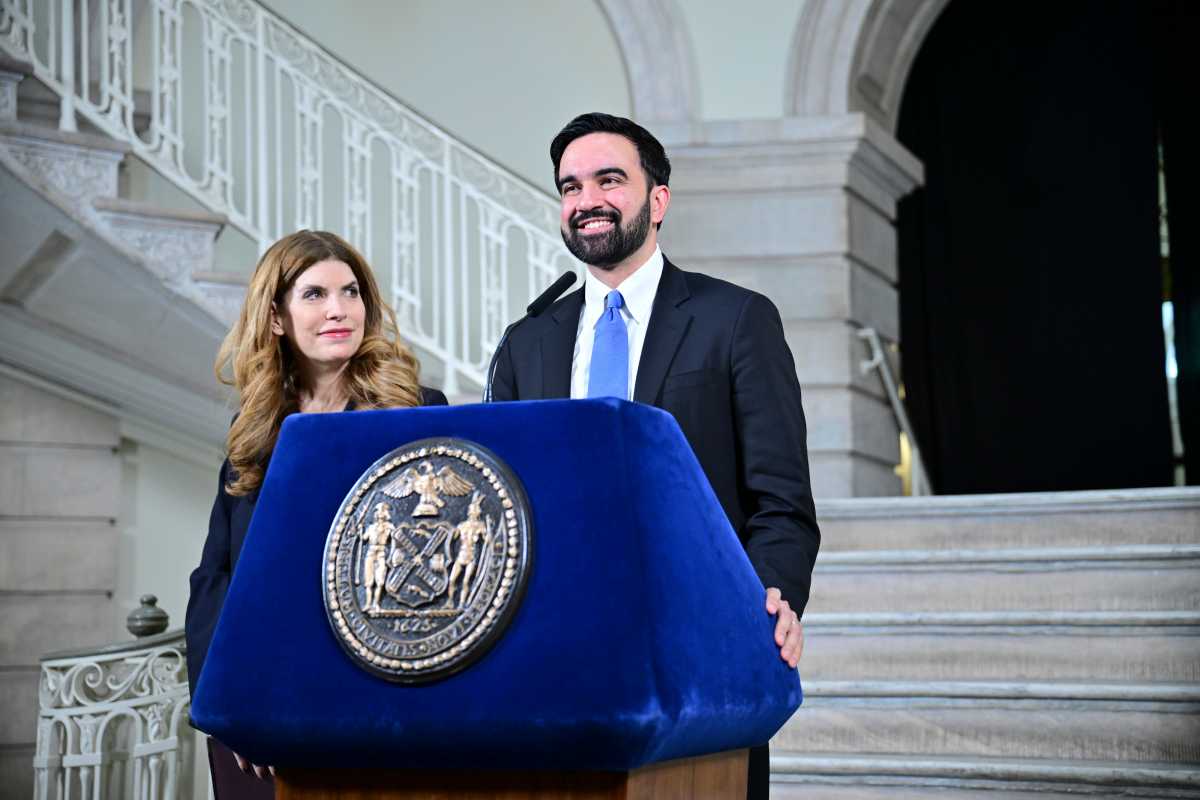
After weeks of discord over how to close New York City’s multibillion-dollar budget gap, Mayor Zohran Mamdani and City Council Speaker Julie Menin were singing from the same hymn sheet Tuesday, praying for more revenue from Albany and agreeing to delay the city’s executive budget deadline until May 12.
The announcement, made at a joint press conference in the City Hall rotunda on April 28, comes as the state budget is almost a month late. The city’s executive budget was due this Friday, May 1.
“We are extending the executive budget deadline from this coming Friday until May 12, because a crisis of this scale cannot be solved without state action,” Mamdani said.
Gov. Kathy Hochul, however, was quick to reject a central piece of the joint Menin-Mamdani ask: reducing New York City’s passthrough entity tax credit (PTET) to 75%, a change the speaker and mayor said would generate nearly $1 billion in additional revenue. The PTET credit allows members and shareholders of partnerships or S corporations to pay state income tax at the entity level, and making it possible for those seeking the credit to avoid the $10,000 federal deduction limit for state and local taxes (SALT).
The mayor described the PTET credit as “a tax cut for the rich,” saying more than 95% of the credits go to people making more than $1 million a year, and more than 80% go to those earning more than $5 million.
But Hochul was hearing none of it.
“It’s not happening,” Hochul said at an unrelated press conference upstate when asked whether reducing the PTET credit amounted to a personal income tax increase. “We’re not changing PTET.”
Hochul also pushed back on the city’s framing, saying New York City officials were free to extend their budget process but should not blame Albany for the delayed budget.
“We don’t have to be done in order for you to do yours,” Hochul told reporters in Colonie. “We’re on different timetables.”
Mamdani and Menin seek more balance from Albany
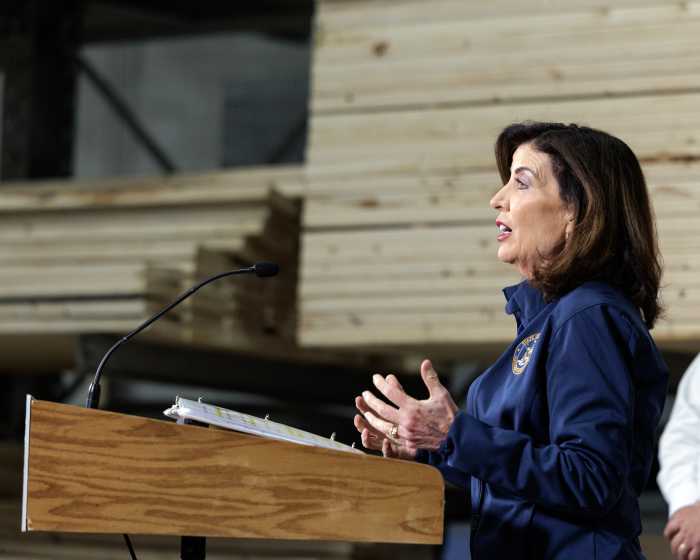 Governor Kathy Hochul speaks to reporters in Colonie, April 28Photo by Mike Groll/Office of Governor Kathy Hochul
Mamdani and Menin earlier urged Albany to address what they described as a long-standing imbalance between the revenue the city sends to the state and the amount it receives in return. Their offices said New York City contributes 55.6% of state revenue but receives 41.7% of state expenditures.
“We are not calling to eliminate the credit,” Mamdani said. “We are rather asking the state for a modest reduction from 100% to 75%.”
Menin said the unfinished state budget made it difficult for the city to complete its own spending plan.
“New York State has not yet finalized its budget, and until they do so, we do not have the necessary clarity to responsibly complete the city’s budget,” Menin said.
She said it was “far more prudent” to wait for the state budget than “rush one based on incomplete information.”
The mayor and speaker also said they support restructuring the city’s pension unfunded liability and providing relief tied to the state’s class-size mandate, measures their offices said would save the city more than $1 billion. Mamdani said the pension proposal would not reduce retiree benefits.
“This does not affect any New Yorker’s pension,” Mamdani said. “This is something that simply would determine the timeline by which we would reach the full funding of these pensions.”
Mamdani also acknowledged that the city has not yet sent Albany final language on the pension and class-size proposals, saying those discussions are ongoing with organized labor groups.
The joint appearance marked a public show of alignment after weeks of tension between City Hall and the Council over how to close the budget gap. The mayor said they are “not simply asking others to act,” and that he and Menin have “already identified meaningful savings.”
No shift in Council’s push to find savings in budget
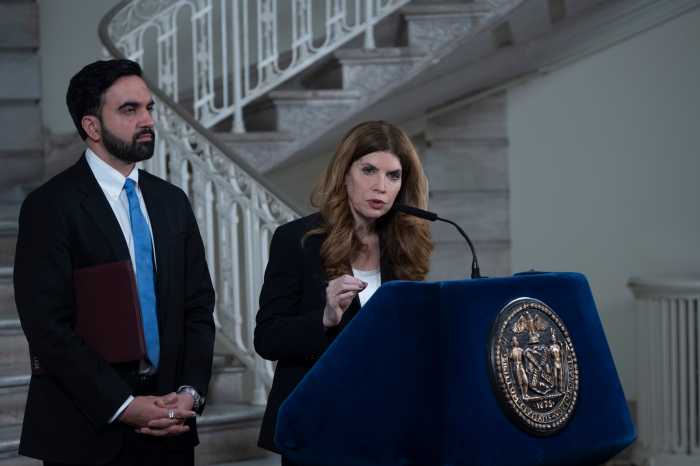 Photo by Lloyd Mitchell
Less than a month ago, Menin said lawmakers had identified roughly $6 billion in resources to close the gap without raising property taxes, cutting services, or dipping into reserves.
Mamdani sharply rejected that approach at the time, saying the Council was double-counting savings, overestimating revenues, and failing to address the city’s structural deficit.
Menin maintained Tuesday that the Council’s position had not changed, pointing to the PTET proposal, savings ideas, and other revenue raisers included in its April 1 response.
“No, it’s not a shift,” Menin said when asked whether her position had changed. “We included billions of dollars of savings.”
Menin pointed to proposed savings from areas such as Department of Education consulting contracts, debt service, and airport revenue, as well as revenue proposals including speed camera enforcement. She defended PTET as temporary and regional, comparing it to Connecticut and Massachusetts, rather than embracing Mamdani’s broader tax-the-rich agenda.
“We’re not talking about doing it long term,” Menin said. “We’re talking about a short-term solution to this problem.”
Mamdani said he spoke with Hochul on Monday before moving forward with the announcement. He praised state leaders for aid already provided, including support for child care funding, restored city funds, and a proposed pied-à-terre tax, but said the city still needs additional help.
“There is no amount of savings that will absolve Albany from the partnership that’s required to get all of us to a balanced budget by the end of this process,” Mamdani said.
Hochul to NYC: You’ve got enough
Hochul said the state has already provided the city with “over $4 billion in assistance,” citing the recently proposed pied-à-terre tax, $1.2 billion in child care funding, and $1.5 billion in other aid.
She also said she has repeatedly urged city leaders to look for spending reductions, saying she had raised the issue in “January, February, March, and April.” She pushed back on calls to restore AIM (aid and incentives for municipalities) funding to the city, arguing that the program supports localities constrained by the state’s 2% property tax cap.
“The city has no such restrictions,” Hochul said.
The City Council must approve the budget extender and is expected to do so on Thursday.