
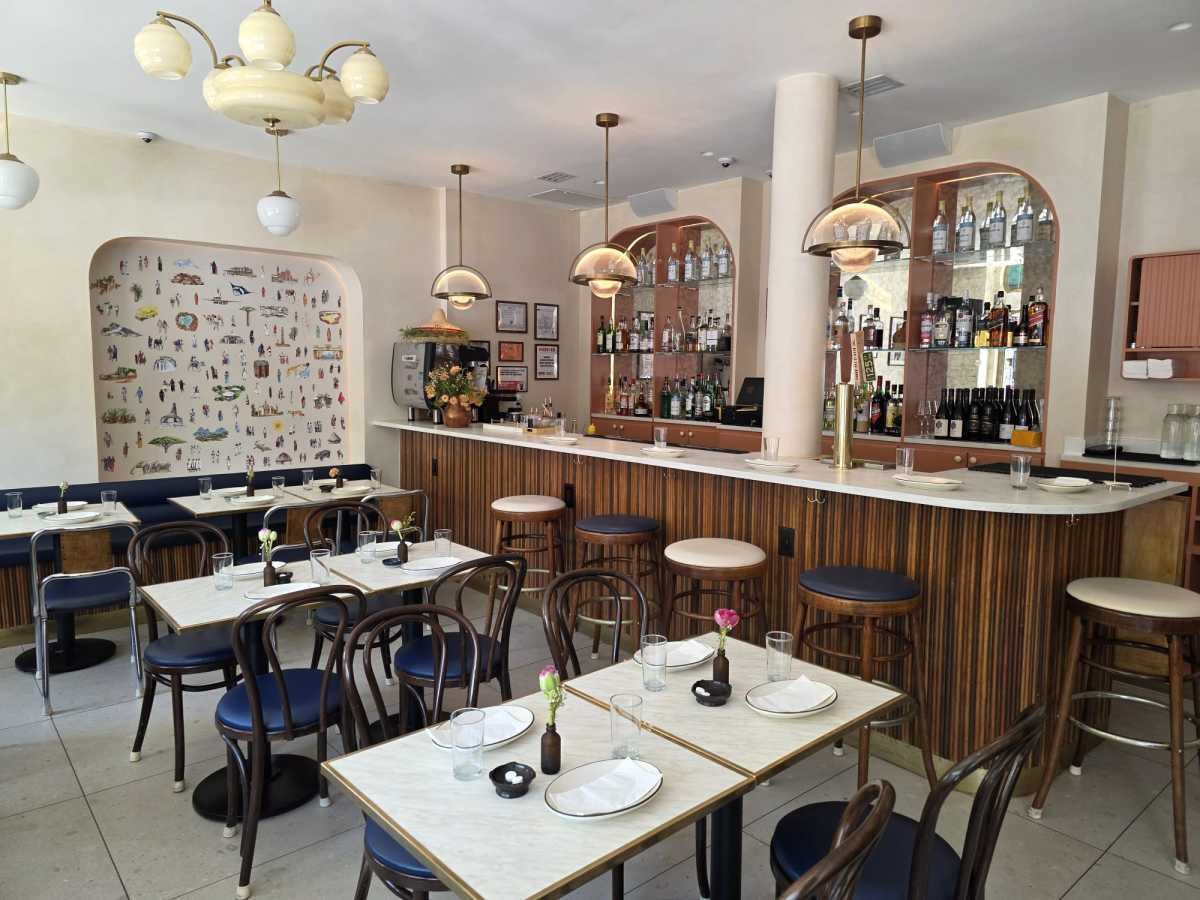
A new restaurant serving Eritrean-Ethiopian fusion has quickly become one of the most popular spots in Sunnyside.
Makina Cafe, which opened its doors in the neighborhood shortly before Christmas last year, stands as the only brick-and-mortar Eritrean-Ethiopian restaurant in Queens, but Makina enjoyed a long history before opening its doors at 46-11 Skillman Ave.
The concept was launched as a food truck by Eden Gebre Egziabher in 2017, bringing Eritrean-Ethiopian cuisine to the New York City food truck scene for the first time. Gebre Egziabher, who moved to the U.S. from Ethiopia as a child, said Makina’s position as the first Eritrean-Ethiopian food truck on the market presented both an opportunity and a challenge.
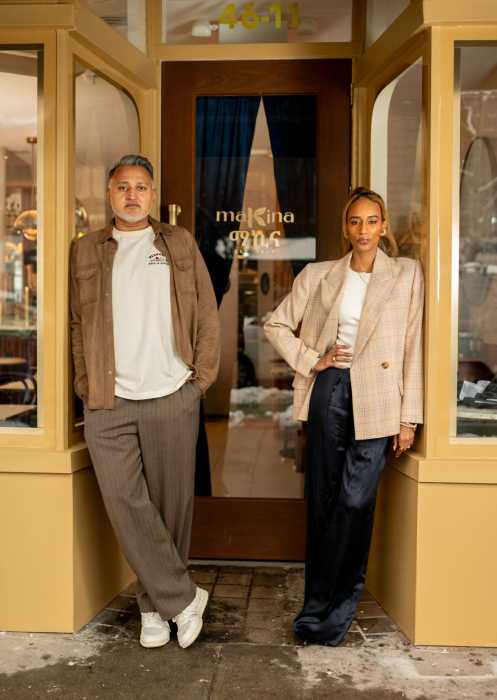 Makina owners Renny Itwaru and Eden Gebre Egziabher. Photo courtesy of Makina
“I left my job to start the food truck and it was something that hasn’t really been done before,” said Gebre Egziabher, who also has Eritrean ancestry. “We were the first Eritrean-Ethiopian food truck, so it wasn’t like I had somebody else to look at and say ‘oh, this works.’”
Regardless of that challenge, Makina proved an instant hit, offering a variety of Eritrean and Ethiopian staples such as sambusas, a flaky Ethiopian pastry filled with beef or lentils.
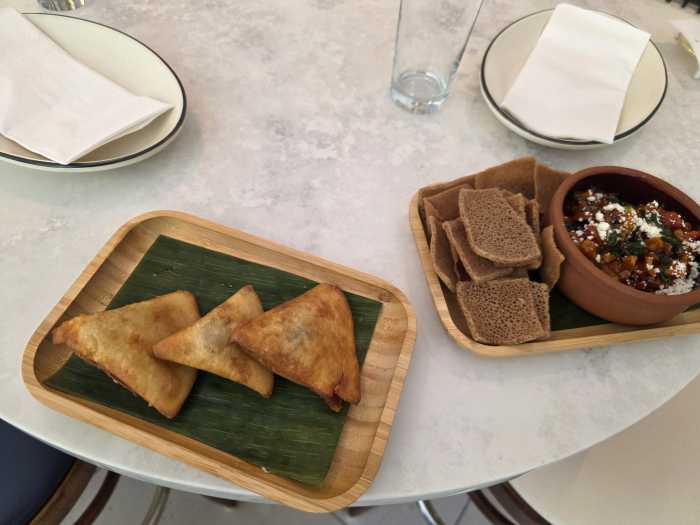 Sambusas (left) and injera bruschetta at Makina. Photo by Shane O’Brien
Gebre Egziabher and her partner Renny Itwaru later opened a location on Governor’s Island before setting their sights on a brick-and-mortar location in Queens.
“So many people had gotten to try our food… but there was no place where they could come and sit down,” Gebre Egziabher said.
The couple eventually settled on Makina’s current home in Sunnyside, overlooking the then-condition of the space because of the connection they felt with it.
“It was just an automatic connection,” Gebre Egziabher said. “And it certainly wasn’t because the place was in good condition. It required gut renovations, but there was just an energy and we really felt that it would fit us.”
Itwaru, meanwhile, recalls visiting the space for the first time on a sunny afternoon, stating that he instantly fell in love with the neighborhood’s character.
“We landed up in Sunnyside on a really beautiful day,” Itwaru said. “It was bright and people were walking and we were like, ‘why have we not found this earlier?’”
After undertaking extensive renovations at the space, Itwaru and Gebre Egziabher finally opened Makina to the Sunnyside community last December, and the restaurant has gone from strength to strength ever since.
The expansion to a brick-and-mortar location has allowed Makina to expand its menu offerings, including Ethiopian and Eritrean staples such as lamb alicha, a slow-cooked stew; berbere-spiced prawns; fish tshebi, a fish dish cooked in a spicy tomato-based berbere sauce; and awaze tibs, a vegan sampler featuring spiced lentils, turmeric cabbage and string beans.
At the heart of every dish at Makina’s new location is injera, a type of Ethiopian bread that is central to food across the nation.
“Injera is the number one food that separates Ethiopian food from the rest of the world,” Gebre Egziabher said. “It’s our sourdough flatbread. It’s as thin as a crepe and has a taste of a sourdough bread.”
She explained that injera is a substitute for rice, which largely does not exist in Ethiopian cuisine. The bread also serves as utensils in Ethiopia, allowing people to eat with their hands.
“We are a culture that eats with our hands,” she said. “We don’t usually utilize utensils, so injera is something that is used instead.”
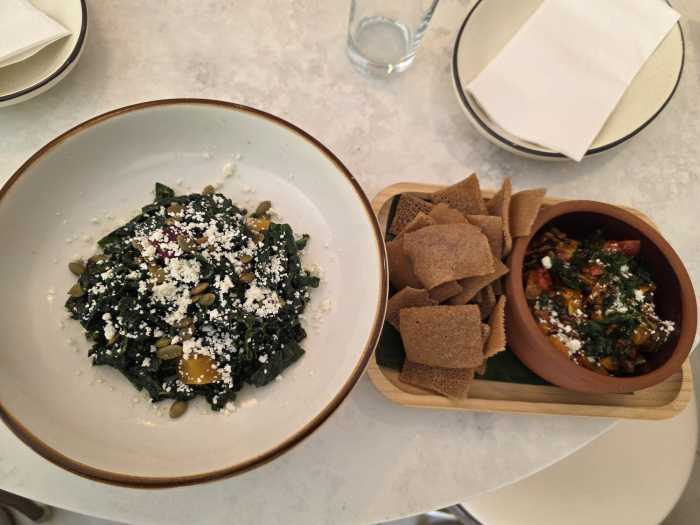 Keysir Salata and injera bruschetta at Makina. Photo by Shane O’Brien
Injera serves as the base of most dishes in Ethiopia – and at Makina – allowing guests to scoop up their meals. Tables at the newly-opened hotspot are laid without utensils, although guests can request knives and forks from staff.
Makina also serves its food family-style, allowing groups to sample a wide range of dishes.
“We wanted to continue that communal dining known from Ethiopian culture,” Itwaru said.. We wanted to continue that tradition. While we’re limited with the amount of space we have in the restaurant, we’re still trying to make sure that we are staying true to the communal feel, the sharing of cuisine amongst friends and family.”
For now, Makina stands as the only Eritrean-Ethiopian restaurant in the entire borough of Queens and one of the few such establishments in New York State, but Itwaru and Gebre Egziabher would both be happy to see other similar locations open their doors in the future. Even if it means they will face more competition.
“We would love to see more Ethiopian and Eritrean restaurants,” Gebre Egziabher said.
Itwaru, meanwhile, believes that there is an enormous “opportunity for growth” in the city, citing the prevalence of Thai restaurants throughout New York.
“There’s a Thai restaurant on every corner in New York,” he said. “Thai cuisine is one of the most popular cuisines in the city and that’s one of the reasons why Thailand was one of the most visited countries in the world last year… I believe Ethiopia and Eritrea could benefit from that as well.
“The more restaurants that pop up , the more awareness that this cuisine exists,” said Itwaru, who is of Guyanese descent. “These people are amazing. This culture is fantastic, and this food is damn delicious.”
For Gebre Egziabher, the opportunity to showcase the cuisine of her homeland is central to Makina.
“It was always in the back of my head that this is something that the world needs to know,” she said. “It’s such an ancient culture, but because it has been so submerged in conflict, the stories, the beauty, the culture, the food have been overlooked.
“I wanted to be able to share that story.”
Although Gebre Egziabher and Itwaru have found a brick-and-mortar location, they still operate their food truck and their Governor’s Island location. They are also not against expanding to other brick-and-mortar locations in the future.
For now, however, the couple is happy to lay down roots in Sunnyside, stating that they have been embraced by the local community since opening their doors half a year ago.
“It feels like we’ve received a warm hug from the community,” Itwaru said. “We’ve really felt the love.”