
The Port Authority of New York and New Jersey will be installing transponders in ground vehicles at the airports it controls, the bi-state body said Tuesday, allowing automated systems in the control tower to better track all vehicles on the tarmac.
The announcement, first reported by The New York Times, comes after the National Transportation Safety Board cited the lack of such transponders as a possible contributing factor in last month’s fatal crash between a landing jet and a fire-rescue truck at LaGuardia.
“We … recognize that transponder technology can provide an additional layer of visibility on top of existing surface-surveillance systems that already track ground movements,” James Allen, the Port’s chief communications officer, said in a statement Tuesday.
Allen added that the technology has been in place as a test program at Newark Airport since December.
“We will be expanding that capability across our airports, building on the technology already in place,” he said.
The Port Authority runs all three of New York’s major metropolitan airports — Newark, LaGuardia and Kennedy — as well as Stewart International Airport in Orange County and Teterboro general aviation airport in northern New Jersey.
The transponders are designed to report a ground vehicle’s precise location to an airport’s automated surface-detection system, known in “plane speak” as “ASDE-X.”
That system did not alert air traffic controllers on the night of March 22, when a Port Authority firefighting and aircraft rescue vehicle began crossing Runway 4 as Air Canada Flight 8646 was landing.
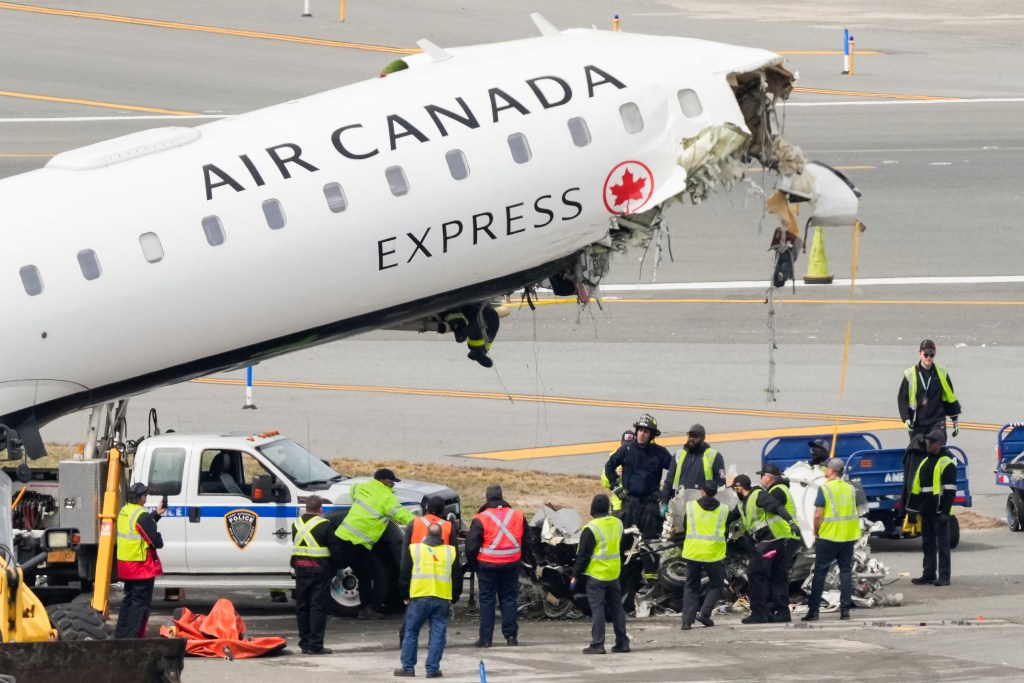
The jet smashed into the truck at 104 mph, separating its cockpit from the fuselage and killing both pilots. The two Port Authority police officers aboard the rescue truck were seriously injured. Thirty-seven people aboard the plane were injured.
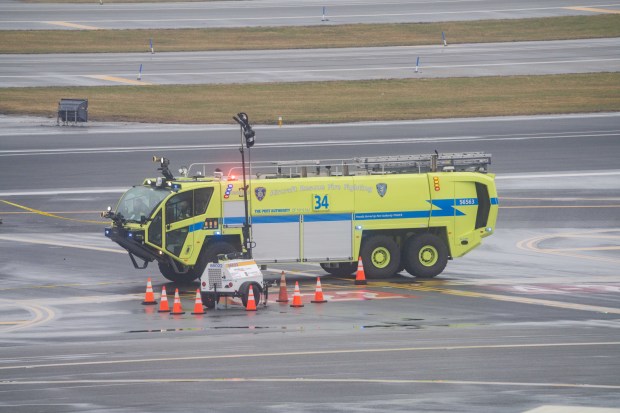 A Port Authority emergency vehicle is pictured after a different emergency vehicle collided with an Air Canada Express plane at LaGuardia Airport in Queens, New York, on Monday, March 23, 2026. (Theodore Parisienne / New York Daily News)
In the wake of the crash, NTSB Chairperson Jennifer Homendy said the truck should have had a transponder.
“The controllers should have all the tools they need to do their job,” Homendy told reporters two days after the crash. “Whether it’s aircraft or vehicles moving in the taxiways, they should have it all.”
While the ASDE-X system did not alert, controllers in the tower were apparently aware of the truck’s location in the seconds leading up to the crash.
The truck had been at the head of a column of seven rescue vehicles, all of which had received clearance from the tower to cross Runway 4 at Taxiway D and head toward a United Airlines flight that was evacuating due to a strange odor onboard.
Just seconds after clearing the convoy to proceed, the tower attempted to wave the lead truck off its collision course.
“Stop, stop, stop, stop,” an air traffic controller shouted over the radio.
“Truck 1, stop, stop, stop.
“Stop, Truck 1, stop.”
One of the two officers aboard the truck later told investigators that he had heard the command over the radio, but did not immediately understand it was meant for his truck.