
For most of its students, East Brooklyn Community High School was Plan B.
Young people enroll in the transfer school in East Flatbush after dropping out or falling behind on credits. In return, the curriculum at East Brooklyn Community is designed to help students get back on track and plan for the future.
For years, that meant helping students earn a high school diploma. But in a bleak youth job market, there’s a growing recognition that crossing the graduation stage is not always enough to put young people on a path to gainful employment.
By any measure, New York City’s recent graduates are struggling to land their first jobs. The local youth unemployment rate has yet to rebound since COVID-19 pandemic era highs. Thousands of entry-level jobs have been wiped out, coinciding with the rise of artificial intelligence.
Against that backdrop, East Brooklyn Community — like more and more public schools across the five boroughs — is going a step further and teaming up with the City University of New York to connect students with paid job opportunities and college credits. Education officials are focusing on six industries: business and finance, healthcare, technology, human and social services, HVAC and, at East Brooklyn Community, education.
“The more that we are aligned with industry, with new trends, and giving our students a leg up by having internships and apprenticeships, we hope that is an antidote to a slow market,” CUNY Chancellor Félix Matos Rodríguez told the Daily News during a recent visit to the Brooklyn school.
“Everybody hopes that at some point, [the market] will bounce back. But we need to navigate where we are,” Matos Rodriguez said. “This is why I think the more that we are connecting the students to these career opportunities early, the better chance they’re going to have to fight that. Because these are sobering numbers.”
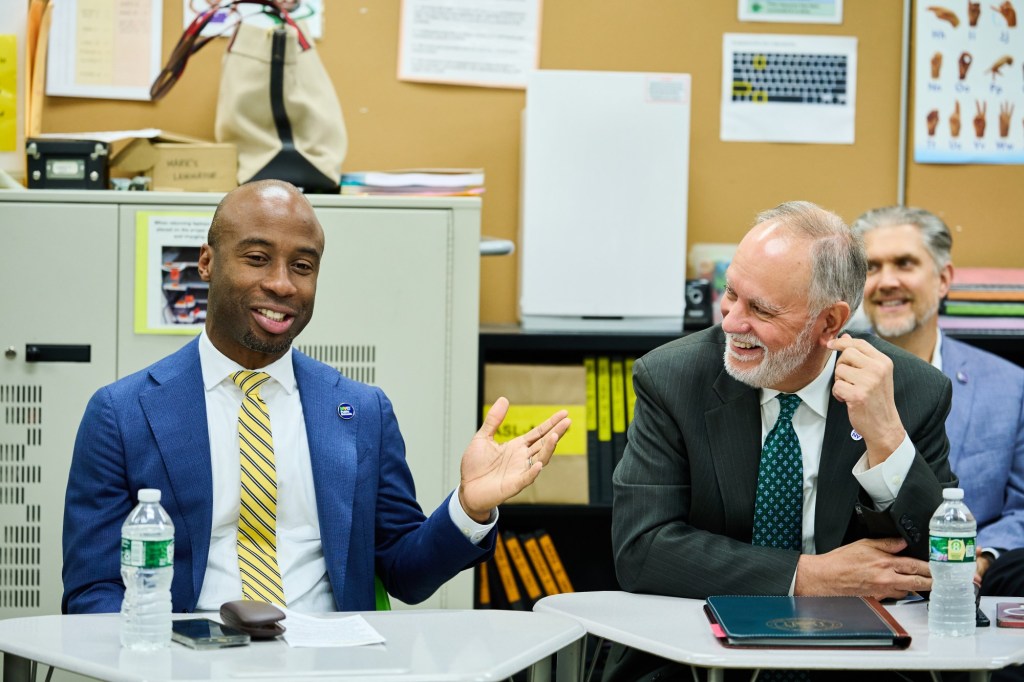
 CUNY Chancellor Félix Matos Rodríguez visits East Brooklyn Community High School in East Flatbush, Brooklyn, on April 16, 2026. (Photo by Marcus Beasley / CUNY)
The numbers indeed are cause for concern.
The city’s unemployment rate for young people ages 16 to 24 is 11.9%, with some improvement over the last year but still higher than the pre-pandemic rate of 9.6%, according to a report this month by the state comptroller, Tom DiNapoli.
Like his counterpart in state government, Mark Levine, the city comptroller, also published a report in February sounding the alarm about a “weak labor market for new grads.”
Levine offered some theories depending on whether a young person is college-educated or not, but most defied simple narratives. Those without a college degree could have been impacted by what the comptroller called a “sluggish recovery” after the COVID-19 pandemic in youth-dominated sectors, such as retail and hospitality. For recent college graduates, the arrival, or even just the prospect, of artificial intelligence could be having an impact.
That’s a particular concern for entry-level jobs in high-paying fields that require at least a bachelor’s degree, but that may be most vulnerable to automation.
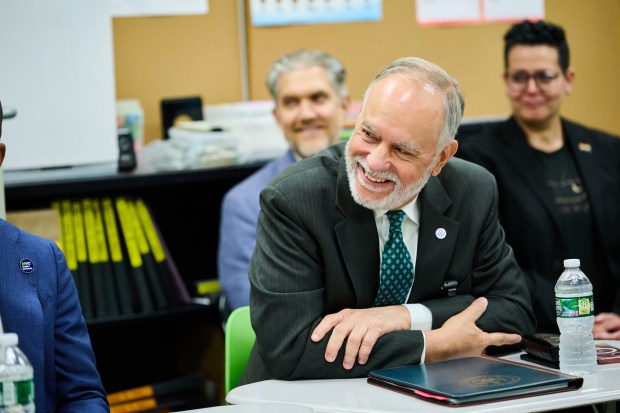
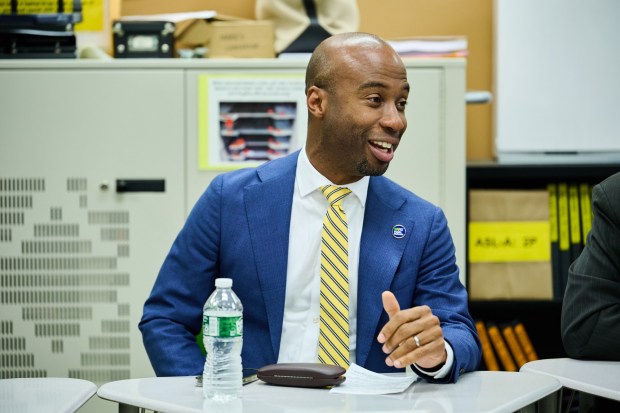 NYCPS Chancellor Kamar Samuels visits East Brooklyn Community High School in East Flatbush, Brooklyn, on April 16, 2026. (Photo by Marcus Beasley / CUNY)
Between 2022 and 2024, entry-level job postings across the five boroughs plummeted from nearly 72,500 to 45,400, a 37.4 percent drop, according to a recent Center for an Urban Future report. Internship postings fell at a similar rate.
“AI is part of that,” Matos Rodríguez said. “I don’t think anybody really knows how much it is, if I can be very candid. But I think that’s been part of the equation. I think there’s also anticipation about what AI might do.”
“Independently of what is causing it, we need to do everything we can to get our students to the front of the room. And that’s going to be better in better economic times, and that’s going to shelter them better in downturns — like the one we’re facing.”
East Brooklyn Community takes part in two citywide programs: College Now, which allows students to earn college credits through CUNY’s Brooklyn College, and FutureReadyNYC, which also has a college credit component but with more of a focus on careers.
“Whether it’s the students taking the Brooklyn College Now class, whether it’s a student who’s in job training,” said Patrick McGillicuddy, the school’s founding principal. “Whether it’s the student who comes to us and is like, ‘I don’t even want to talk about post-secondary planning. I just want to graduate. I’ve already been to multiple high schools. I just want to get out.’”
“I think regardless of where students are at, the staff here give them the same attention, the same energy, and really the same love.”
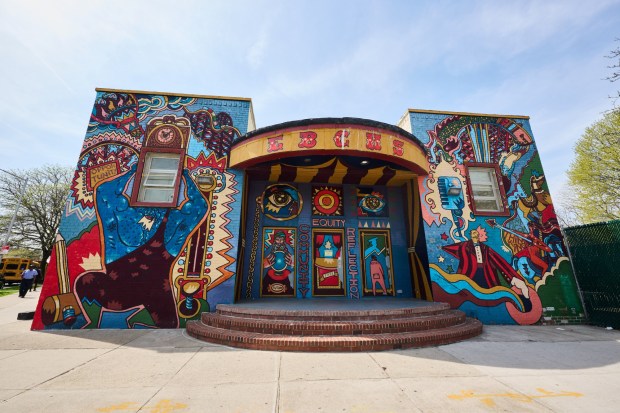 East Brooklyn Community High School in East Flatbush, Brooklyn, is pictured on April 16, 2026. (Photo by Marcus Beasley / CUNY)
“Future Ready is not just for the students who are in the most competitive schools. It’s for all of our students,” said Jane Martinez Dowling, chief of the Office of Student Pathways at New York City Public Schools. “Today was a real proof point of that.”
More than two dozen EBC students interned last summer with the public schools as teacher aides. Now, five graduates are employed this school year as paraprofessionals, laying the groundwork for more young people to become teacher aides, a shortage area, and get a foot in the door of the city’s sprawling school system.
Hannah Aaron, a recent graduate, was in her final semester last spring when she was asked if she wanted to participate in a program for aspiring paraprofessionals. She applied for the summer.
“I was still stuck on what I wanted to do,” Aaron said. “So each opportunity that came to me, I made sure that I would take part in it. Because you never know what’s going to happen.”
Through the program, she landed an internship and participated in workshops: “That’s how I got my certification and into the DOE in general,” she said, referring to the city Department of Education.
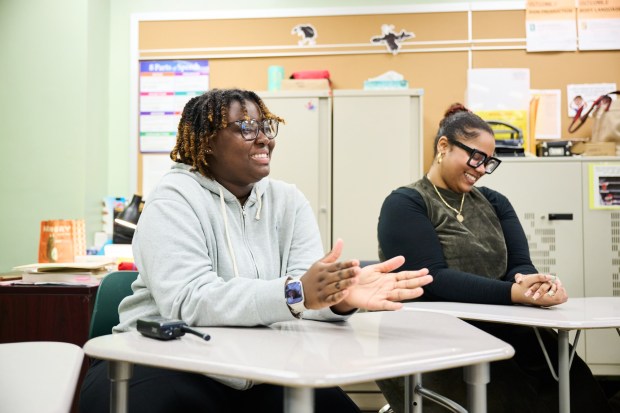 Students and recent graduates at East Brooklyn Community High School in East Flatbush, Brooklyn, explore careers in education. (Photo by Marcus Beasley / CUNY)
It’s not clear if or when the job market will ease up for young people across the five boroughs, though national trends suggest relief could be on the way for this year’s college graduates. According to reporting in The Wall Street Journal, employers across the country expect to ramp up entry-level hiring this spring, while the college-educated youth unemployment rate is falling nationwide.
“We have to make sure that our young people are prepared for the world that exists, and the job opportunities that exist,” New York City Public Schools Chancellor Kamar Samuels told The News. “When we start connecting them early to College Now opportunities, to FutureReady opportunities — that is what’s going to make sure that they’re prepared.”
“You know, there are jobs available,” he added. “Sometimes there’s a misalignment of skill.”