
The Bayonne Board of Education (BOE) voted to approve a tentative $233 million 2026-2027 scholastic year budget that comes with a 12 percent tax increase at last night’s meeting.
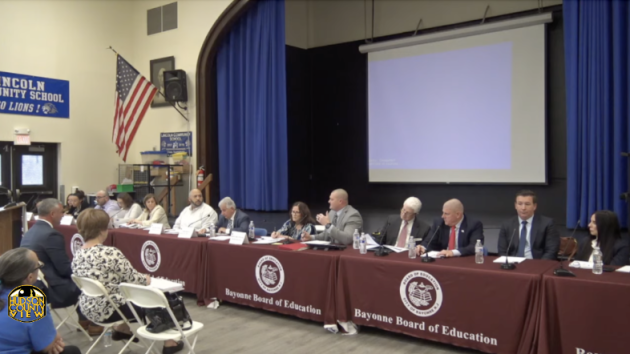
By Dan Israel/Hudson County View
They voted 5-2(2) to adopt the preliminary budget, with Trustees Hector Gonzalez and Melissa Godesky-Rodriguez voting no. Board President Mary Jane Desmond and Trustee Miriam Bechay abstained.
School Business Administrator Daniel Castles presented the $223,043,006 budget, $12.8 million more than last year’s spending plan.
According to Castles, the two biggest revenues streams come from the tax levy and state aid, $85 million and $135 million respectively.
Anticipated revenues, including the tax levy but excluding state aid, total $85,652,469.
The district is currently heavily dependent on state aid due to the 2018 New Jersey school funding reform law that saw the state fully fund the state aid portion of school districts, he said.
However, as the law sunsets, the district will no longer “receive jumps in revenue” through state aid, instead more heavily depending on the local tax levy- likely indicating additional future increases.
“ … Moving forward, that is going to be our revenue generator and we’re going to have to live within those parameters because in a majority of years, you can only raise the revenue two percent,” he said.
Bayonne’s local fair share, or the amount that the state calculates that the local entity should fund for the school district, is a $133 million tax levy, according to Castles.
The current tax levy is $76 million and the board is requesting an increase of nearly 12 percent by about $9 million to $85 million for next year- still $47 million short of fulfilling the district’s fair share.
Castles said that based on the average assessed property value, for a $500,000 home a taxpayer would pay $770 more for the year.
He said this matters because the state is now looking at which districts are close to or at their fair share when deciding state portions of funding.
On rising expenses, increases to health benefits to costs were a major contributor to the $250,735,936 in total appropriations.
“The reason why we can adjust the tax levy, is because our health benefits are increasing by $12.79 million,” he said.
According to Castles, the total budget is increasing by nearly $12.79 million from last year, calling it “pretty much budget neutral.”
He further stated the district accomplished this through efforts such as the energy savings improvement plan that saved the district over $1 million and reduced maintenance costs, adding that 82 percent of the budget comes from salaries/personnel.
“I always say that that’s a good thing, because people teach people, things don’t teach people,” he said.
“So being in that range is important, however, when you have 59 percent of your budget being salaries, if health benefits increase, obviously you’re going to feel some pain with that.”
Castles said the rest of the budget are small portions for instructional programs, supplies, consultants, programming, utilities, and things of that nature.
Before the board voted to approve the budget, independent 2nd Ward council candidate Omar Elgarhi said the city “deserves honesty, clarity, and fairness” when being asked to pay more, demanding a further explanation of the 12 percent tax increase.
“Taxpayers deserve more than a scary headline number. They deserve a clear explanation of what kind of increases are actually being discussed, how it was calculated, and how much of it is tied to rising healthcare costs,” he continued.
Elgarhi asserted that there was a conflict of interest of for Desmond, who is also the city’s business administrator and a mayoral candidate, as well as the trustees who voted for her leadership.
“When City Hall keeps approving more luxury developments under PILOT [payment in lieu of taxes] agreements, City Hall may collect money but the school district and taxpayers are often left in a weaker position,” he declared.
“I believe 10 to 15 percent of PILOT payments from all approved developments should go to the schools, so developers start paying more of our fair share and Bayonne residents, especially seniors living on fixed incomes, are not asked to carry the burden again and again.”
Mayoral candidate and former City Council President Sharon Ashe-Nadrowski disputed Desmond’s comments at the last BOE meeting “that there would be no impact to classroom or services in this budget” amid alleged staff cuts.
“We are all very well aware of notices that went out about layoffs. If you’re taking aids out of classrooms and potentially teachers, to me, that’s a change in service level for our students,” she stated.
Ashe-Nadrowski raised concerns over the tax increase while acknowledging the health benefits cost increase and asked that the BOE be “good stewards” of taxpayers money in educating Bayonne children, highlighting that services including individualized education programs (IEPs) are not being provided as required per law.
“Some people are getting no services. That’s very, very disturbing. These kids are entrusting with you to get the services and we’re paying for that,” she added.
During the vote, Godesky-Rodriguez, who is running for the 2nd Ward council seat on Ashe-Nadrowski’s ticket, said she was going to vote no until additional information was brought to the table.
“ … There is way more work to be done on this budget to reallocate and look at how we are spending those dollars in our classrooms. So I’m a no on [this] until we can revisit how that money and the actual increase will impact us.”
After the initial vote, Godesky-Rodriguez recalled that Desmond said earlier she couldn’t vote on the budget due to conflicts of interest, causing Desmond to change her vote from yes to an abstention.
After the budget was approved, a slew of residents such as Mina Shafik raised concerns over being slammed with the 12 percent tax increase, questioning the board for more answers while calling for cost-cutting measures like reducing “bloated” administrative salaries and limiting pay increases.
The board did not respond to any of the criticisms.
“Taxes have gone up every single year. Yet I see Bayonne is degrading … I don’t really see much happening in the educational system… So what is it exactly we’re raising taxes for?” expressed Shafik.
“I think a proposed or possible twelve percent tax increase from the Board of Ed, possibly with an eight percent coming from the county, and whatever the percentage is from the city to continue operating the city, taxpayers are looking at a potential 20 percent tax increase,” added Keith Galant, noting that the increase is about $1,600 per household.
Julie Sanchez Lynch suggested the board fire employees who “are sitting at home and collecting a paycheck but not working” and terminate duplicitous positions.
“At Lincoln School, for the two children who drowned, who is taking responsibility for that?” she demanded.
“Why is the [vice principal] still home collecting a check? … Nobody wants to come forth with any information, but you want my taxes to go up twelve percent to keep funding people that are doing the same job.”
Laura Wiles was shocked to see there were 27 half-days on the calendar this year since there were only 12 half-days in 2019, asking the board to remove 12 half-days since taxes were increasing by 12 percent.
“If we’re paying so much more, what are we getting for that?” she questioned.