
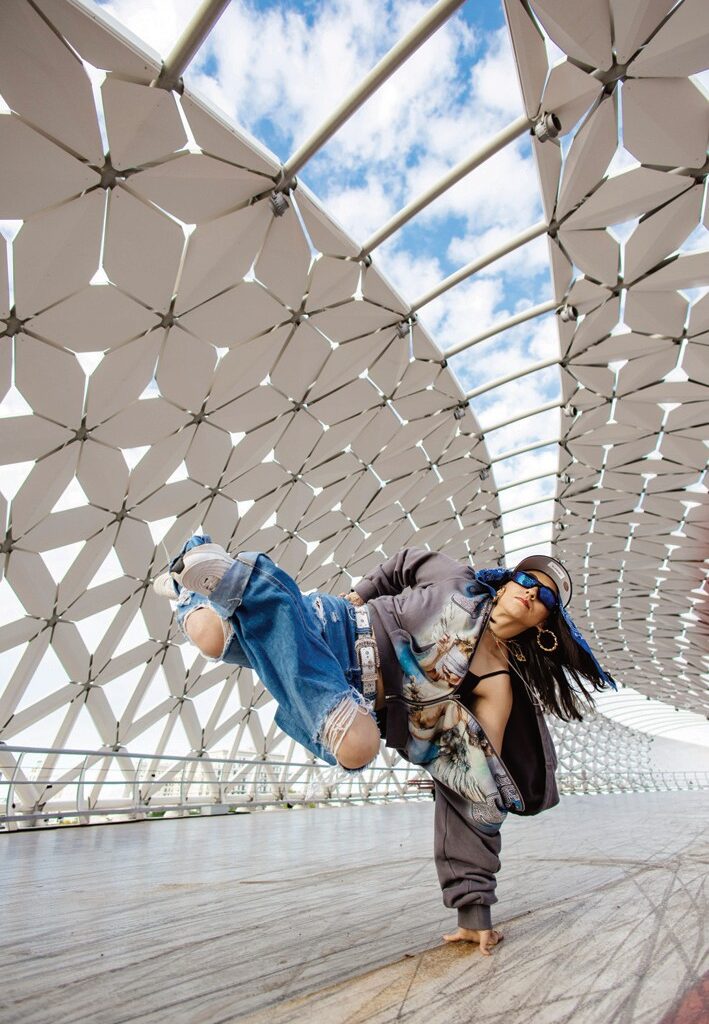

Photo credit: Rinat Dermer in Astana, Kazakhstan July 2025
Victoria “B-Girl Kween Victoria” Kalmius is an Italian American, Queens-native B-girl, dance teacher for students with autism, graffiti writer, and poet. She discovered breaking (also known as breakdancing) at sixteen in the New York City subway. Kween Victoria has over a decade of experience in breaking, training from Queens-based crews Titanz and Supreme Beingz, as well as with Hip Hop pioneers Rokafella and Kwikstep of Full Circle Dance Company. She was later mentored by B-boy and curator Prevail, and became a member of One Society, NYC’s most active and emerging crews. She is currently a prospective candidate for the Mighty Zulu Kings (MZK), one of New York’s first breaking crews and a worldwide organization. She is now mentored by her biggest inspiration, her husband, Vladimir Kalmius, an internationally recognized champion B-boy from Kazakhstan who competed in the Red Bull BC One World Finals in 2024.
She has represented Queens in prestigious competitions: Red Bull BC One New York Cypher (2021), placing in the semi-finals; the Northeastern Regional Qualifier (2022), placing top 16; and Ladies of Hip Hop Festival in 2022. Her participation in international events include, IBE in Holland, Outbreak in Slovakia, and Silverback Bboy Championship in Budapest (17th out of 100 international B-girls). She has also traveled through Central Asia to experience and study global breaking culture.
Kween Victoria learned the importance of community from her family’s business, “Pat and Son’s Salumeria,” an Italian Deli in South Queens for more than 30 years. She was inspired by how her immigrant grandparents and father built relationships with locals and helped those in need.
Victoria curated her own breaking event in 2023, “Break Thru NYC.” She partnered with NAMI (National Alliance of Mental Health), to provide free mental health resources to the NYC breaking community.
Kween Victoria holds a BA in Dance from Queens College and an MA in Teaching Students with Disabilities from Touro University. She has six years experience teaching dance to inner-city youth at Queens Community House, and five years experience teaching students with autism in a public school in Queens. She is currently writing about her experiences in teaching and as a B-girl from Queens, and her mental health journey. She aspires to teach at the university level and publish her work.
NB: Other than the amazing diversity, what do/did you love most about living in Queens (or Queens in general)? How has Queens changed over the years?
VK: What I love most about living in Queens, aside from the amazing food and diversity––to me Queens is like cities within a city. Every part of Queens has a different vibe, some parts have more parking and quiet, other parts are more congested and much louder. People from each part of Queens are very proud about which neighborhood they are from, and it plays a huge part in their personalities. Queens does not give you the feeling of being in a rat race, a fight for the spotlight, or bombarding commercialism or competition, like Manhattan for instance. Queens feels more personalized and lived in. Each part is covered with its own history and lineage. The vibe in Astoria is completely different from the vibe in Flushing or Jamaica or Rockaway. They all have their own sounds, smells, emotions, and styles. I never feel the same when I am in a different part of Queens, but at the same time I feel home no matter which neighborhood I am in. No matter where I go in the world, I carry this with me, in the way I walk and talk and dress and even dance. Queens is alive in me. I would be a totally different person if I wasn’t lucky enough to grow up in Queens.
NB: How does Queens inspire you? What are some of your favorite places to be inspired in Queens?
VK: Growing up I would take the 7 train a lot. This was my first time seeing graffiti on the rooftops all along Roosevelt Avenue, from Flushing Main Street all the way to Vernon Blvd-Jackson Ave. I remember being 17 taking the 7 train to 5-pointz or a breaking session in Flushing Meadows Park or Astoria Park, so inspired by the writing on the walls. The graffiti writers I always used to see were Klops, 143, Faes, Ajes, ASR crew and R2B, JCNY, and BE LOW KEY. Their letters looked like they were dancing and inviting me to join. Their pieces always inspired me to want to do graffiti, especially ASR crew because it seemed as though wherever I went in Queens, their names were up. It felt like I had guardian angels in a way, always around me. And their style was raw. I loved taking the subway and getting off at a random station, and watching all of the street vendors, the people walking, the cafes, the parks. To this day I love to sit on the 7 train, and write my poetry and work on graffiti outlines in my blackbook, often listening to Queens-based hip hop artists on the way like Nas and Mobb Deep.
NB: What is the best piece of advice you’ve ever received? What is something you wish you knew a decade or two ago?
VK: One of my dance professors said, “You can plan all you want, but life has its own plan.”
When I was in Queens College, I thought I wanted to become a therapist to help people. And it was an acceptable career that my immigrant Italian American family would be proud of. But my first semester I got C’s. I felt more fulfillment in my elective dance classes. I changed my major to dance and it felt right, despite losing my parents’ support in the beginning. However, I put so much pressure on myself to become a successful dancer, to make my family believe in my career choice. I felt I was running out of time. I used to compare myself to other dancers. All of this just led to injuries and setbacks. Later, I started auditioning and I realized I hated it. I didn’t want to be a performer, I still wanted to help others. So I taught dance in youth and community centers like Queens Community House and afterschool programs. And I felt fulfilled again. Right before Covid I started subbing as a paraprofessional in different schools for students with autism. I felt even more fulfilled. Long story short, I went for my master’s in teaching students with disabilities. The school that hired me needed a dance teacher, and I was able to teach dance under my special education license. Everything came full circle.
So something I wish I could have told myself a decade ago is: it’s not a race, don’t compare yourself to others. When you have a gut feeling inside that you never had before, run with it and don’t let anyone convince you otherwise. Trust yourself and pursue it. Make a plan but be open to plans changing. Through vulnerability you find your stability, comfortability and confidence. Simply, it is your life, you don’t owe anyone anything. Life does not have one destination you must reach. One dream may be the prerequisite to lead you to the dream that was meant for you. Remember life has its own plan and it may pleasantly surprise you if you just give yourself the chance to find out.
NB: Who are some of your favorite dancers, performers, artists, musicians, poets, teachers, graffiti writers, and other creatives with a Queens connection?
VK: B-Girls from Queens: The first break dancing session I went to (which I snuck out to go), was at Queens Community House in Forest Hills. The first B-Girls were Yaya, Abgirl, Sunni (who represented the USA in the Olympics), Bongo Rock and Lacuna. All respected, strong women, and well-known dancers in the breaking community, and all Queens based. As a shy 17-year-old girl seeing this for the first time, I was inspired to want to be just as fierce and strong as them and outspoken as the way they moved. They always encouraged me and looked out for me, and still do to this day.
Poet: A poet from Queens that inspires me is Maria Lisella. I met Maria in the bakery I go to every day. I was introduced to her by the owner and her aura was stunning. She expressed her opinion and knowledge proudly amongst conversations at the table, and I was in awe. When I found out she was an Italian American poet and travel writer, we began talking. We had many things in common about where our families were from in Italy, and similar upbringings. I felt as though I met a girl from Queens just like me, but with more wisdom and experience. She saw something in me, and sparked a fire in me so big, that I began writing my own poetry again. The person she is and her poetry inspires me because it is as though every poem or travel article she writes, she is bringing you along on that memory or experience with her, as if you were living it too. Thank you Maria, for lighting that flame again.
Musicians: Growing up, my father always played Ramones roaring through the house or in the car as if it were our national anthem while my Sicilian mother would scream for him to lower the volume. He made sure to show us their albums, music videos, and even their movie, “Rock and Roll High School.” At about the age of 7 or 8, I realized The Ramones were just a couple of kids from Forest Hills, going against the norm, and expressing themselves. This definitely sparked something in me that followed into my adulthood. Thank you Daddy.
NB: What are your favorite restaurants, cafes, dance studios, parks, theaters, exhibits, museums, communities, and venues in Queens? Favorite places to dance or perform?
VK: Every morning I go to Gian Piero Bakery in Astoria to have a coffee before work. It has become my second home. I simply cannot go to work without starting my day here. It is family run, just like the family business I grew up in. Everybody knows everybody. I don’t even have to say what I want to order, they already know, sometimes having it ready for me before I even arrive. It is not just a bakery, it is personal, a community, a safe place. Every morning, and sometimes at lunch time too, I sit and talk to Mike the owner, about life, about my heritage, and with some of the other older Italians that are regular customers. When I come here I feel connected to my roots, my culture, and my grandparents, almost as if I am back in time for 45 minutes at my family’s Salumeria. When I come here, I remember where I am from, and who I am.
NB: What do you wish more people knew about being a breakdancer, poet, graffiti writer, and educator? What is something you wish you knew before you became a breakdancer, poet, graffiti writer, and educator?
VK: What I wish that more people know about being a b-boy or a b-girl, that we are not just “breakdancers, doing stunts and tricks to music.” I want people to know the history, the reason behind the movements we do and where they originally came from. I want people to know its not just a dance from the 80s that was made a mockery out of in the Olympics. It is a culture, a community, a lineage, a place where all kinds of people with all different backgrounds, problems, experiences, ethnicities, abilities, body types, and languages coexist in communication through movement and music. New York is the birthplace of hip hop, and it was born from Black and Latino youth living in a burning down, forgotten, warzone, the Bronx. They created something positive out of ruins and hardship, and it spread all over the world, giving people with their own inner wars, a place to belong and express themselves.
NB: If you could choose only one poem or dance piece to represent Queens, what would it be and why?
VK: If I could choose one dance piece to represent Queens, it would be the one a man made that I just met filmed for me. We met at a dance event, he was from Kazakhstan, I was from Queens. We barely knew each other then, barely spoke the same language, but I took a chance and asked him to dance together one day. He preferred a walk instead. So I took him to Flushing Meadows Park and Astoria Park and he filmed me dancing in my baggy jeans and puffer with a north face jacket. He caught moments of me catching “tags” around Long Island City, walking and talking through my city, which led us to the Long Island City Piers, where we had our first kiss. Years later, we were back at that same spot sharing a kiss only this time he was in my north face puffer jacket and I was his wife. That is the magic of Queens.
NB: Can you tell us more about your work as an educator? What makes effective teaching, and does it depend on the discipline one is teaching?
VK: I teach dance to students with Autism. But I don’t just teach them choreography or pedagogy. I teach them body awareness, spatial awareness, life skills and emotional regulation. My goal is to give them a pathway to find their voice, express themselves, and show their understanding in another way.
I think what makes any type of teaching effective is remembering it’s not about you. You can plan all you want, but plans can go out the window the minute your class arrives, someone is crying, someone is running away, or someone is disengaged. My philosophy is “read the room.” If your class is not ready for what you planned to teach, don’t teach it. Shift gears and give them what they need. Understand who your students are, what their home life is like, what happened right before they got to class, what they like, what calms them down, what engages them. Getting on your student’s level and finding out what they need will give them the opportunity to have the focus to learn. Giving students a choice and praising them even for just looking or participating, encourages them more than only praise for doing something right.
NB: What’s a wild story (PG-13) you have about NYC before the times of cell phones or social media? If you weren’t in NYC then, what’s a story you have of NYC past (or the past)?
VK: I don’t know if this is a wild story, but it is one of my favorite memories about a Queens summer night. It was a hot August evening in 2003, I remember just finishing playing baseball in the street with kids from the block. My parents told us the lights went out all over the city, but no one on my street was in panic. Instead, all the neighbors gathered their plastic lawn chairs in circles sitting on their stoops, having Italian ices and ice cream, just talking. Kids were running around playing in the street, some barefoot, me being one of them, some playing tag and “manhunt” behind the cars, and laying on the grass looking at the stars. It was a night of just being present and together. A night I wish would last forever.
NB: Can you tell us more about being inspired by your immigrant grandparents and learning about the importance of community from your family’s business, “Pat and Son’s Salumeria,” an Italian Deli in South Queens?
VK: My grandparents taught me that no matter what age you are in life, you can still build a life and learn something. My Nonno (grandfather) was 50 years old when he opened Salumeria. At this age he could have settled for working for someone else and getting by. But instead, he saw his chance and took it. I saw how they not only served customers but took care of them. I remember my father’s compassionate nature. He would not only make sandwiches for customers, he took interest in their lives, knew everybody’s names, and gave food away. I remember people coming to him just to talk or to feel better. I remember lines out the door wrapping around the block with customers, and it wasn’t just for high quality food. They could easily have just sold cold cuts and Italian products. But they taught me that having a business is not just about selling products and making a profit. It’s about creating a space where people want to come. So when I would see someone coming in to buy a hot pastrami sandwich or soppressata, I saw that they were also coming home.
Photo credit: Rinat Dermer in Astana, Kazakhstan July 2025
—Nicollette Barsamian
The Local-Express interview series was originated on July 3, 2013 by Nicollette Barsamian