
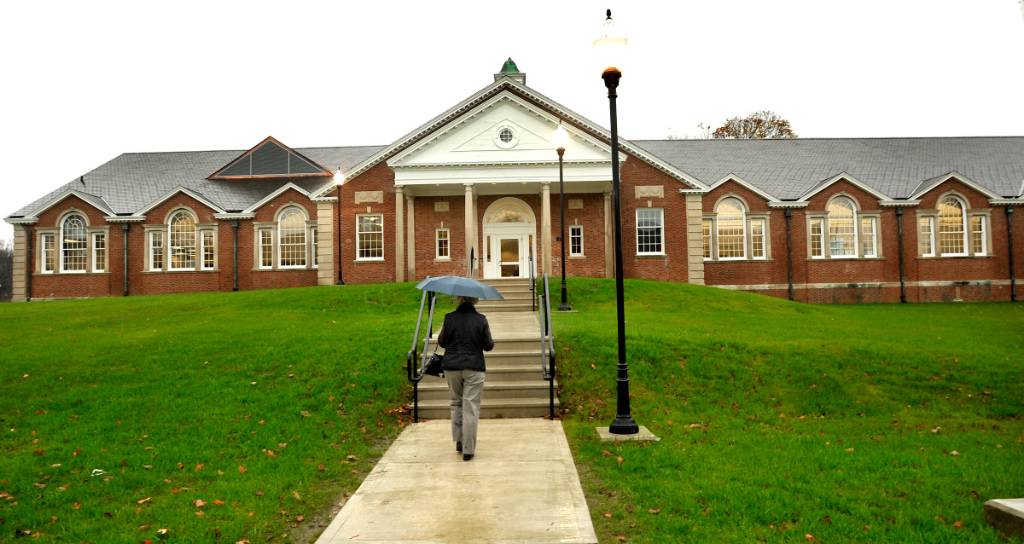
Newtown Town Hall, on Tuesday, Oct.27, 2009.
Michael Duffy
NEWTOWN — Voters resoundingly defeated both the town and school proposed budgets, according to unofficial results from Tuesday’s referendum, sending town officials back to the drawing board to seek more cuts.

The Legislative Council put forward a $147.7 million spending plan — a 4.6% increase year over year. It included nearly $96 million for education, a 4.6% jump, and $51.4 for the town municipal budget, 3.18% more than the present year.
Article continues below this ad
But residents voted down both budgets, each by about 300 votes. Advisory questions for whether, if voted down, the budget bottom line should increase were also rejected, 2,592 no to 645 yes for the town and 2,315 no to 947 yes for the schools.
If it had been approved, the mill rate would have become 29.54, a 2.79% increase.
The Legislative Council must now work on reducing the rejected budgets within seven days, then send it back to the voters.
“After last year’s increases, the voters want to see lower increases to average out the two cycles of increases,” said First Selectman Bruce Walzcak, referring to the 2025-26 fiscal budget which saw a 6% tax rate increase.
Article continues below this ad
“With inflation at 2.7% or higher, voters locally are feeling the national economic pain,” Walczak added.
Walczak said a large portion of both budgets are tied to personnel, so there is “not a-lot of room to bring budgets lower.”
“Some extremely hard decisions will have to be made,” he added.
Residents also voted on six advisory questions on capital projects, and the results were mixed.
Article continues below this ad
Voters, by a 2,017 to 1,261, rejected $1.125 million for replacement of artificial turf fields at Treadwell Park. Residents also denied, by a 2,007 to 1,256 vote, some $500,000 for improvements to a rear parking lot and yard area at the town maintenance facility on Trades Lane.
Voters, by about 800 votes, rejected $1.1 million for replacement of artificial turf fields at Treadwell Park. Residents also denied, by a similar margin, some $500,000 for improvements to a rear parking lot and yard area at the town maintenance facility on Trades Lane.
Voters approved $720,000 for improvements to the parking lot and sidewalks at the C.H. Booth Library; $600,000 for work at the public works salt storage facility; $280,000 for improvements to the Head O’Meadow parking lot; and $200,000 to be set aside for open space acquisition.
Regarding the town operating budget, Walczak had previously called the final municipal number “well-examined” with only a 3.18% increase from the present year, “barely higher than the projected increase in the cost of living.”
Article continues below this ad
The council made $177,000 in cuts to the budget submitted by the Board of Finance, most notably some $95,000 to hire a senior administration aide, which Walczak said would reduce the operational burden on the first selectman, allowing that person more time to focus on major projects.
Council member Chris Gardner had motioned for $75,000 to be removed from the education side — a move which failed. The Board of Finance had already cut $125,000 from the proposed school budget during its deliberations.
Superintendent Anne Uberti stated in past meetings that the education budget as presented is necessary to maintain current programs and to begin to address additional student needs.
Newtown schools eliminated 30 staffers last year due to budget cuts, according to Uberti, and this latest budget proposal includes some new hires.
Article continues below this ad
Staffing requests this year include a teacher at Head O’Meadow School, two teachers at Sandy Hook School, a special education teacher and a paraeducator at Hawley School, a school psychologist, five behavior therapists, a fine arts department chair and a math interventionist. The district is also looking to add a dean of students at the middle school.
She added a significant portion of the budget reflects “baseline” or “rollover” costs — the contractual and operational expenses required to continue the programs and supports students rely on.
Uberti called proposed additions “strategic and grounded in data,” including expanded special education supports for the Program for Adaptive Learning (PAL), allowing schools to serve more students in district and avoid costly outplacements.
Article continues below this ad
Elementary staffing adjustments, she said, would maintain appropriate class sizes and support inclusive practices as needs shift across buildings, while the high school math interventionist is meant to address recent trends in math performance and align supports with those already in place in earlier grades. Restoration of fine arts leadership at the high school would support the program and increase student access to the arts.