
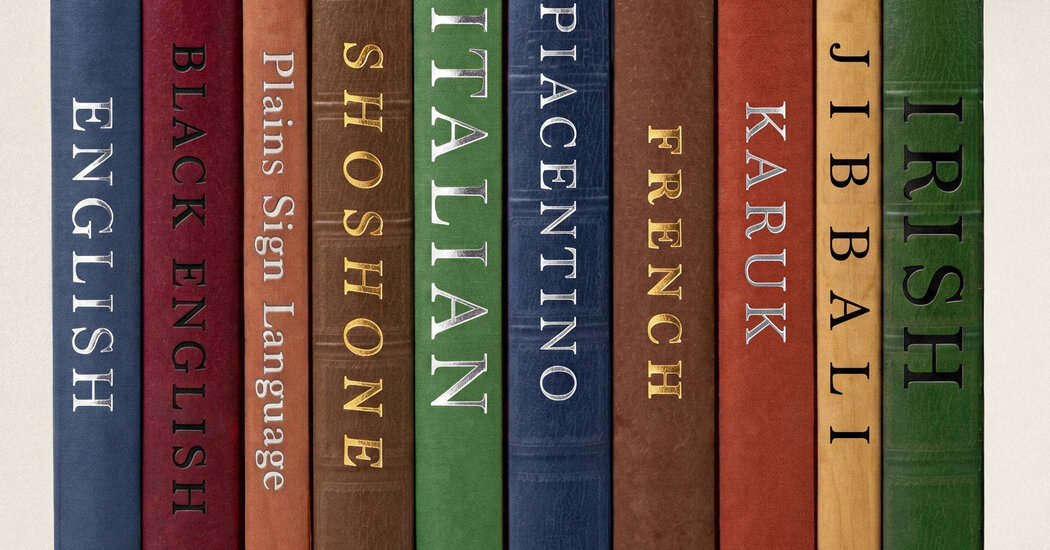
Sacagawea’s native language was Shoshone. Fewer people speak the language now, and efforts are being made to keep it alive through classes and printed materials. Language revitalizations like this are the subject of the journalist Sophia Smith Galer’s “How to Kill a Language: Power, Resistance and the Race to Save Our Words.” Once a language is no longer being passed on to children, it is increasingly likely to go extinct. Galer visits and reports on nine languages that are in, or are threatened with, this situation.
Galer casts a bright light on the massive linguistic diversity that the world seems set to lose, with about 3,000 of the world’s 7,000 languages unlikely to see the next century. Often people don’t even know that the languages are, well, languages. Galer starts with her mother and grandmother, Italian immigrants raising her in England and speaking among themselves both Italian and what they call “the dialect.” They know no other name for it, but it is actually more like French, and Galer at first finds no information on it in print or online sources. In her grandmother’s home village in northern Italy, she learns that it is Piacentino, no more like standard Italian than Spanish. Like countless other “dialects” in Italy and beyond, it is not long for this world as a spoken language.
Every language that dies takes with it such fascinating stories. Galer notes that the Karuk language of Native Californians has at least 10 words for distinct varieties and uses of acorns and no one generic word “acorn.” In Jibbali, a relative of Arabic and Hebrew spoken in Oman, often some consonants are not actually pronounced but the tongue is placed as if they had been and you need to see it to know which word is being uttered. Understanding Jibbali requires watching as well as listening.
Shoshone has interesting elements like that, too. In the 1978 cult hit musical “On the Twentieth Century,” the lyricists Betty Comden and Adolph Green have a vainglorious theater producer dramatically bewailing that his creditors are like “angry birds pecking with their beaks.” I have always loved that overripeness — what else would the birds peck with, their tails? But then, all languages describe the world beyond what is necessary in some ways, and in Shoshone, it is normal to say something like “peck with its beak,” where the “with the beak” part is conveyed as a prefix to “peck.” It makes the verbs magnificently precise. You not only “bite with your mouth” and “kick with your foot,” but you can get more specific. We don’t have one word that means “break with your foot” — as in, breaking the glass at a Jewish wedding — but Shoshone does. There is even a word that means “jam yourself into a hole butt-first”!
I wish the people keeping Shoshone alive well. However, I’m sure they know that the version of their language they bring back from the brink will be different from the original. Usually, a language that was down for the count but comes back is slimmed down from the journey. Kids can learn a language of fearsome complexity, but when adults are doing a lot of the learning, they tend to iron out the irregularities and take shortcuts around the more pitiless intricacies. This has happened with the kind of Irish most people speak today, and other languages. I hope Shoshone can hold on to as many of those nifty prefixes as possible.