
New York Democrats’ push to overhaul the state’s redistricting process gained new steam in the wake of a the Supreme Court’s decision that weakened a landmark Civil Rights-era law, the latest sign that Democrats are prepared to embrace partisan gerrymandering in response to national political realities under President Donald Trump.
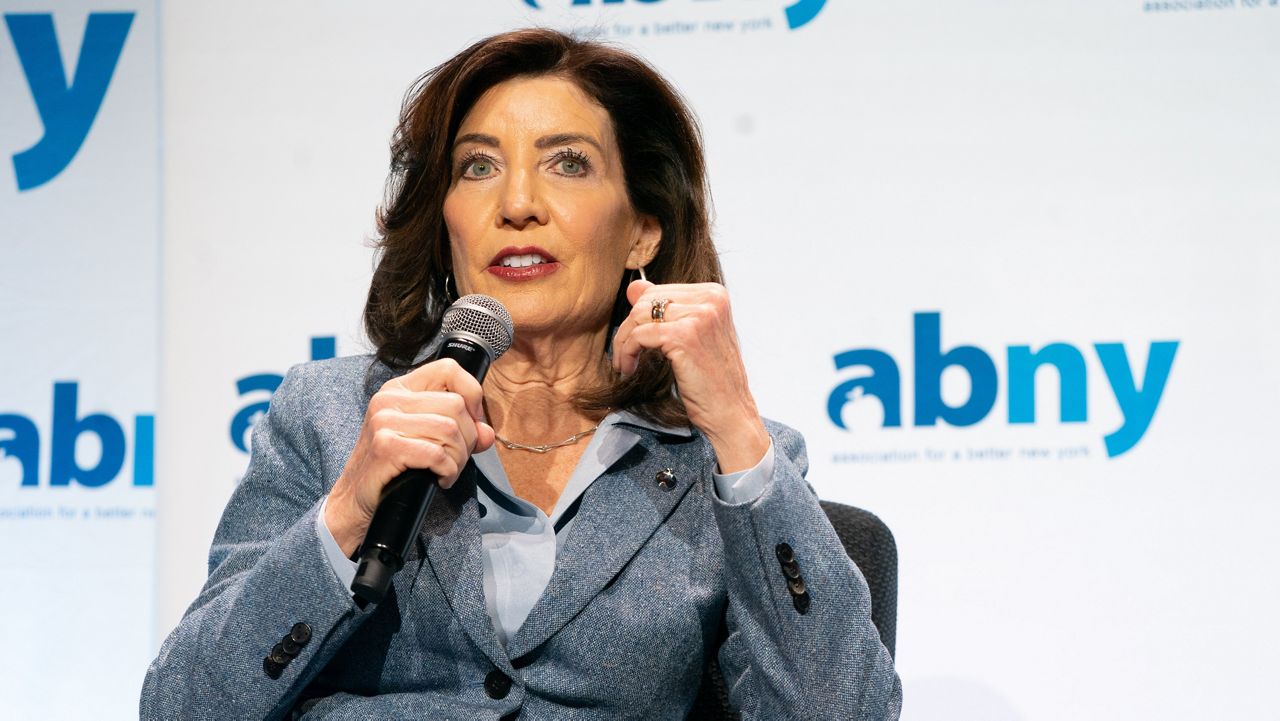
Gov. Kathy Hochul, a Democrat, along with state Senate Majority Leader Andrea Stewart-Cousins and Assembly Speaker Carl Heastie, all voiced a sense of urgency this week to pass a constitutional amendment to allow mid-decade redistricting in cases where other states have done so. A constitutional amendment must be passed by two consecutive, separately elected Legislatures and then sent to voters.
The effort in the Empire State — waiting in the wings for first passage while Hochul and legislative leaders negotiate a state budget which has progressed at a glacial pace amid an array of policy disagreements — is a convergence of three factors.
First, it is rooted in President Donald Trump’s nearly-yearlong effort to convince Republican-led states to redraw maps to maximize seats ahead of what is sure to be a tough midterm for the GOP, made more acute by the ruling over Louisiana. Hochul and leaders made their intentions clear last summer, but the conversation is now back in the spotlight.
The court decision and it’s implications for elections has opened opportunities for Republicans to gain seats and put Democratic states — which in previous years shunned gerrymandering in statute — at a disadvantage. State leaders insist there must be more state-level power to push back, they say, in the name of ensuring representation for underserved communities.
“The Supreme Court has been chipping away at our elections for years. It is clearly carrying out Donald Trump’s will with this decision,” Hochul wrote on X on Wednesday. “New York has always led the fight for voting rights and we’ll lead again.”
Multiple other Democratic states have advanced efforts, and House Minority Leader Hakeem Jeffries said this week there are more where that came from.
“We’re looking at a state by state, district by district battle,” said Jeff Wice, professor and redistricting expert at New York Law School. “If the Democrats in New York successfully redraw one district that could be offset by Republican gains somewhere else, that could make a big difference.”
The third reason is rooted more in New York politics and the dramatic shifts of the 21st century. That coming in the form of dissatisfaction among Democrats in power with the state’s Independent Redistricting Commission, implemented via constitutional amendment in 2014. The commission is a 10-member body composed of four Democrats, four Republicans and two members not affiliated with a party but appointed by the other members.
Heastie told reporters the system does not work in part because it is destined to deadlock, and its makeup is rooted in a time when New York state government was more bipartisan, and compromise was required to move the effort forward. The amendment was passed by a then-Democratic Assembly and Republican Senate under Democratic former Gov. Andrew Cuomo.
“That was something that had to be done,” he said. “It clearly doesn’t work so we need to look to change that. We’re going to have an independent redistricting commission, but I think the makeup of it and its ability to work have to change for it to work.”
Democrats have tried to change the rules over how party control changes the process through a proposed constitutional amendment which failed in 2021.
This time, they say they want the option of mid-decade redistricting if another state does it, and leaders have said the effort should also include a second look at the panel.
Stewart-Cousins said both aspects are necessary because of the chaotic experience of the 2020 redistricting cycle. The commission deadlocked and was unable to produce a usable map, so the Legislature drew one that was struck down in a controversial ruling, and then turned over to a special master for a redraw. That process continued through two more attempts by the commission and the Legislature in 2024. The final map was under scrutiny earlier this year but ultimately upheld.
“In extreme circumstances, we want to have that flexibility, but the other part, too, is what happened this last redistricting period when the commission could not come to an agreement,” Stewart-Cousins said Tuesday.
The amendment would do nothing for the 2026 midterms, and to affect the 2028 race, first passage must occur in the now-compressed, post-budget portion of the ongoing legislative session, as lawmakers will have just a few weeks to pass measures outside the budget process.
Deputy Senate Majority Leader Mike Gianaris, a key architect of the state’s recent redistricting strategy, called the Supreme Court ruling a “five-alarm fire” and stressed the need to move forward with the amendment.
Republicans and good-government groups have blasted state Democrats for engaging in what could become an unending redistricting arms race coast to coast.
Senate Minority Leader Rob Ortt, a Republican, told Spectrum News 1 that after Democrats took control of both houses in 2018, they tried to circumvent the deadlock-prone commission multiple times, including with the 2022 map that was struck down.
“We will be there to not only try to block them both at the legislative level and in the courts, but will also remind voters exactly what their goal is. It’s not free and fair elections — it’s a partisan power grab,” he said. “If you’re sitting there in New York and you’re upset about what Republicans did in Texas, I will tell you that the Democrats in your home state are no different.”