
Nassau’s three town supervisors rallied on Thursday, April 30, saying there are questions that need answers regarding the $3.26 billion proposed Propel NY Energy transmission project that will cross large sections of the county and demanding transparency.
Propel NY Energy said it has provided transparency for a project that is needed to keep electric costs down and ensure reliable delivery.
“From day one, the Propel NY team has provided transparent and fact-based information to communities,” Propel NY Energy said in a statement. “As we head into summer, New York is facing the lowest electricity reliability margins in recent history, with an almost 80% decline since 2022. The reality is that New York, and Long Island in particular, faces critical power reliability challenges, and without Propel NY, costs will continue to rise while reliability declines. We remain fully committed to delivering Propel NY efficiently, effectively, and with robust community safeguards in place.”
In a joint letter to the state Public Service Commission, Hempstead Town Supervisor John Ferretti, North Hempstead Town Supervisor Jennifer DeSena and Oyster Bay Town Supervisor Joseph Saladino said that without transparency, accountability, and real protection for residents, the project cannot move forward.
The supervisors said their top priority is protecting residents, whether it is financially or physically.
“We support smart energy policy—but not at the expense of our residents’ wallets, safety, or quality of life. No transparency, no accountability—no deal,” they collectively said.
The $3.2 billion Propel NY Energy project is expected to begin construction later this year, with its preferred route running in or adjacent to 18 Nassau villages across the county’s three towns.
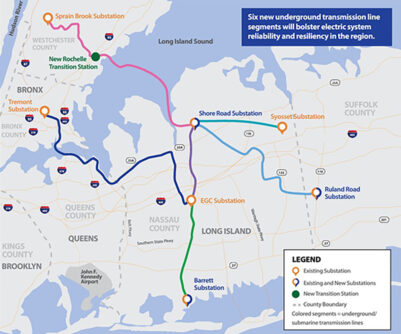
The project, a collaboration between the New York Power Authority and New York Transco, a New York developer, owner, and operator of bulk electrical transmission facilities, intends to improve the region’s electrical system and is set to install 58 miles of underground power transmission lines throughout Nassau County.
It would begin in Westchester and the Bronx and cross portions of Queens, adding miles of submarine electric transmission cables, predominantly in the Hempstead Harbor and Long Island Sound.
The project would establish three ties between Long Island and the statewide power grid, mostly utilizing 345kV transmission lines. Propel expects to begin construction in 2026 and plans to be in service by May 2030.
A majority of the lines will be placed in Long Island, with just 12 miles in New York City and 12.6 miles in Westchester County. A small portion of the project will also extend into Suffolk County with a new substation to be constructed in the Town of Huntington.
The Propel team said it has had hundreds of direct communications with town officials and has held dozens of public and tabling events throughout Long Island since the project was first introduced.
But the supervisors said they are demanding a wide range of answers before the project gets further approval.
Town officials said county residents already face high utility costs, and they called for a full cost breakdown of the Propel project. They are also calling for independent, route-wide testing, especially near homes, schools, and parks, after some residents expressed concerns about the proposed 345kV transmission lines for the project.
“Our residents deserve straight answers—about costs, health impacts, and safety. Until we have full transparency and independent verification, we cannot and will not support this proposal,” North Hempstead Town Supervisor Jennifer DeSena said in a statement.
“Show us the numbers, show us the plan, and prove this is fair—or it shouldn’t move forward,” Hempstead Town Supervisor John Ferretti said in a statement.
Propel officials have said the project will use 345kV underground transmission technology that has “been safely and successfully built and operated across the country for decades. The state has 831 miles of underground transmission, including 241 miles of 345kV lines.”
Propel has also said the project will be paid for with ratepayer dollars from throughout the state, not just Long Island, and it is projected to cost the average residential ratepayer approximately six cents per day. Additionally, project officials have said that Long Islanders currently pay higher utility prices because the region has only two congested connections to the state’s power grid.
The supervisor also called for full curb-to-curb restoration to avoid traffic disruption, for union labor and Project Labor Agreements to ensure local workers benefit from the project, and to see if Propel’s proposed project is connected to Battery Energy Storage Systems, which are temporarily banned in each of the three towns.
“We’ve seen what happens when infrastructure projects cut corners—our roads suffer, our first responders are put at risk, and taxpayers are left picking up the pieces,” Oyster Bay Town Supervisor Joseph Saladino said in a statement.
Propel has said that no part of its project involves battery energy storage and that its team is committed to building it with union labor. Propel said it estimates the four-year construction period will support nearly 2,000 jobs annually and provide a $2.4B boost to local goods and services.
Propel also said it is working directly with municipalities and stakeholders on detailed construction and traffic management plans that minimize impacts and protect health and safety, and that construction will occur in limited segments and phases with the proper safeguards in place.
Propel has been involved in Article VII proceedings wth officials from Nassau County’s three towns, as well as other community leaders. Propel officials said a majority of the supervisor’s concerns have been directly addressed during the settlement process.