
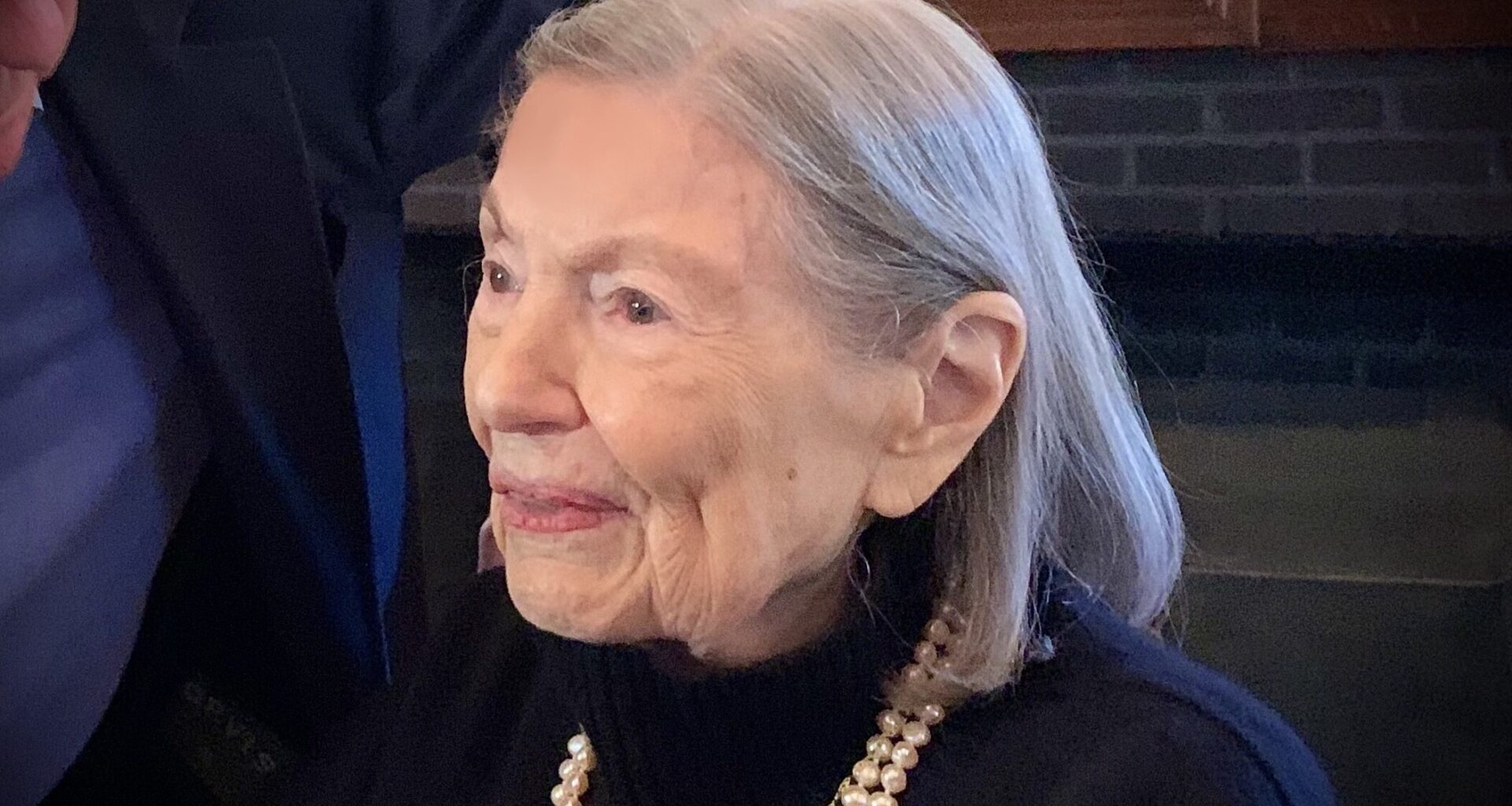
BROOKLYN HEIGHTS — Grace Gray Faison, one of the iconic matrons of Brooklyn Heights, passed away on April 26 at the age of 101, and with her a host of memories of an earlier era.
She generously shared those memories with her neighbors and friends as the years went by, and also dropped a few late-life surprises.
Faison retained her sharp memory, self-depreciating sense of humor and boundless optimism throughout her years.
A sixth-generation Brooklyn Heights resident — a member of the Heights Casino squash and social club, a leader at Plymouth Church, a supporter of nonprofits — Faison’s life blended seamlessly into the social fabric of the neighborhood. To the end, she projected the very image of white gloves and pearls — and later acknowledged using this image to achieve behind-the-scenes works of charity and social justice.
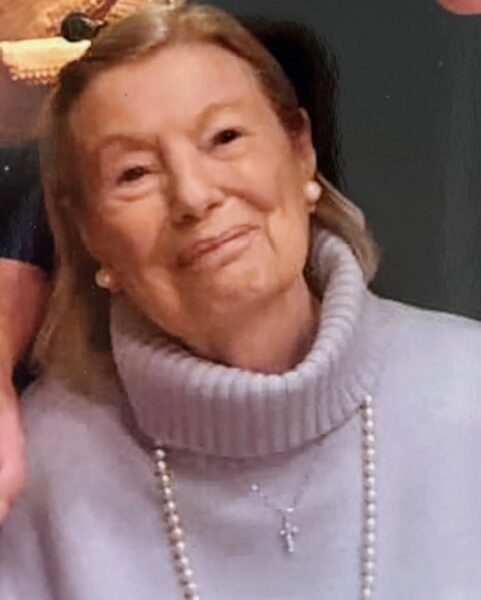 Grace Faison. Photo courtesy of her family
Faison was one of the few residents who recalled sledding beneath the former Montague Street “Penny Bridge”; playing in Miss White’s exclusive garden before Pierrepont Playground was built; and rubbing shoulders with “master builder” Robert Moses.
She was born on Oct. 30, 1924 to Horatio King Gray, president of the Turl Engineering Works, and Annabel Andrews Gray. Both were influential members of the Heights community.
She attended Packer Collegiate Institute, then an all-girls school, and took ballroom dance classes at Grace Church. After graduating from Katherine Gibbs School in Manhattan, Faison took a job doing the books for Mary Kingsbury Simkhovitch, founder of Greenwich House, a settlement house in Manhattan. Eleanor Roosevelt came by on Wednesdays, and Faison would make tea for the two women, sometimes being invited to sit and chat.
More than anything else, Faison was a central member of the Plymouth Church community for more than 70 years, where she served on numerous committees. Her great-great-grandfather, John Tasker Howard, was one of the institution’s original founding fathers.
“My grandmother was a force of nature and she will be so missed,” said her granddaughter Jenny Faison.
Church members describe Faison as an “unforgettable presence.”
 Party-goers raised a toast, sang ‘Happy Birthday’ and cut the cake to celebrate Grace Faison’s 100th year on Sunday, Nov. 3. Photo: Mary Frost/Brooklyn Eagle
As longtime head of Plymouth’s Garden Committee, she spearheaded the reclamation of the “Lost Acre,” a shady stretch of land east of the church’s sanctuary. In an unsanctioned operation (she seldom asked permission, church leader Jim Waechter said on her birthday last year) — Faison rescued the half-ton 1870s-vintage cast-iron bell that once hung in the steeple of Plymouth when it was located at 56 Cranberry St.
The bell is currently the centerpiece of a garden on Orange Street, at the entrance to the Lost Acre. The garden was dedicated Nov. 3, 2024, on the occasion of her 100th birthday, as the “Grace Faison Bell Garden.”
“I can’t imagine anything else that would make me feel that I’ve spent some time on this earth,” she told the crowd at the dedication. “When you plant a garden, you feel as though you have lived, and you’ve enjoyed, and I’m so glad.”
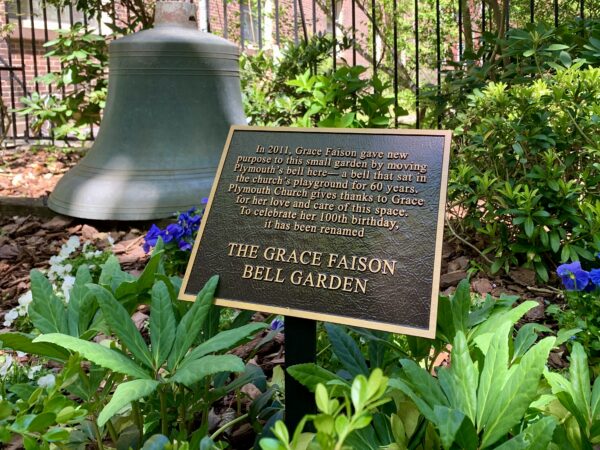 Faison rescued this 1870s-vintage cast-iron bell, now the centerpiece of a garden dedicated to her. Photo: Mary Frost/Brooklyn Eagle
First husband perished at sea
Faison’s first husband, George Jeffers Stockly Jr., was a Navy officer — “a Princeton guy,” she told Brooklyn Heights Association volunteer Andrew Nodell in a videotaped conversation. He perished at sea two weeks after the end of World War II.
“There was a typhoon off Okinawa and he was washed overboard a week before my son was born. And so I came home from the hospital to a fourth-floor walk up at 6 Willow St., which is no longer there, on my own, and I was a widow for four years.”
She raised their son Jeff alone, until she met John Faison — “a wonderful man” — and they married in December 1948. Everybody liked Jack, she said. “Jack was probably on every board in Brooklyn at one point or another.”
She worked in the real estate business for the Cruikshank Company in Manhattan, and for 13 years at the former Independence Savings Bank on Atlantic Avenue in Brooklyn.
Their daughter Sandy was born in 1950. Jeff went on to a career in law enforcement, and Sandy became a Broadway actress and singer. Faison has five grandchildren.
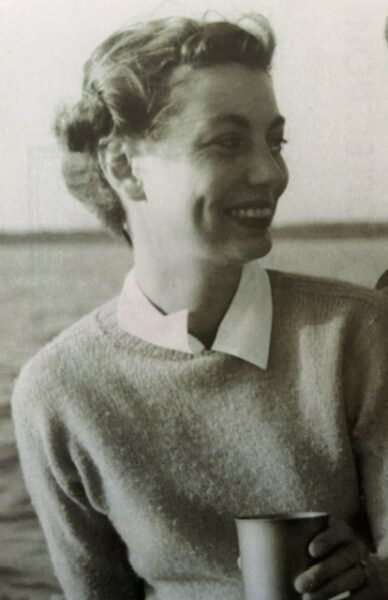 Grace Faison at a young age. Photo: Grace Faison’s family
A link to old Brooklyn Heights
Faison was frequently asked to describe early Brooklyn Heights by journalists and historians. One favorite topic was the legendary Miss White’s Garden, described by the Brooklyn Eagle’s Lore Croghan in 2013 as “one of the most extraordinary of Brooklyn Heights open spaces in private hands that anyone can remember.”
Miss White, the wealthy sister of philanthropist Alfred Treadway White, resided in a mansion that sat where Pierrepont Playground is now. (This was before the Promenade.) She maintained the private fenced-in garden across Pierrepont Place on property now occupied by two art deco apartment houses — 57 Montague St. and 2 Pierrepont St.
Miss White would allow young neighborhood mothers to visit her for tea if they wished to win her favor and — if they passed muster — be given a key to the garden to take their children inside.
Faison, by then a widow raising her toddler son alone during the final years before the garden’s 1948 closing, recounted receiving permission to visit Miss White for tea.
She told the Brooklyn Heights Press during the 1970s, “Young mothers knew they must wear white gloves when they went to that tea with Miss White. That was almost like a secret password to win her favor.”
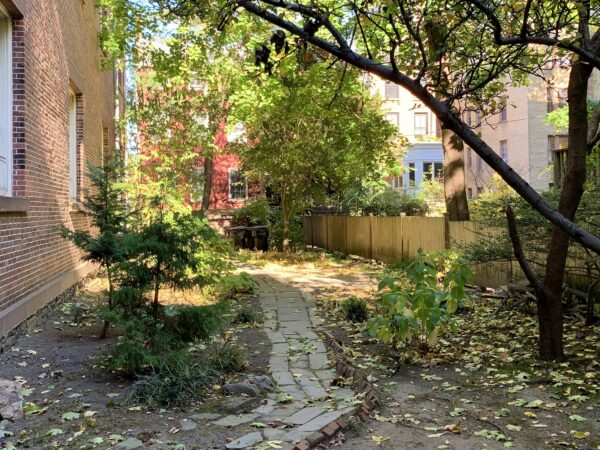 Grace Faison played a pivotal role in establishing the “Lost Acre” garden at Plymouth Church. Photo: Mary Frost/Brooklyn Eagle
Faison told Nodell that the couple regularly socialized with Robert Moses. One year they took him to the Harvest Moon Ball, a popular dance competition in Manhattan. “Seeing people dance like that, it’s just wonderful,” she said.
But then she found out that Moses “wanted to put a highway right down the block,” she said. “We were not going to let him do that. … So we sat on him really hard so that didn’t happen.”
Was Moses nice? “Well, he was interesting. I don’t think I’d use the word nice,” she told Nodell. “He was not cozy. I like cozy. I’m very big on cozy.”
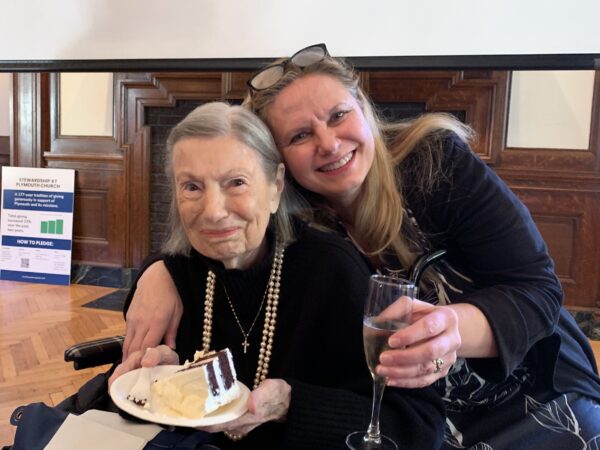 Grace Faison, left, with Kathleen Wolf. Photo: Mary Frost/Brooklyn Eagle
She knew how to keep a secret
It wasn’t unusual for Faison to quietly assist those whom others wrote off as “lost causes,” congregation members said. “We are all connected,” she would say. “We cannot do it alone.”
But one of her private acts of charity created a certain frisson when, after remaining silent for 50 years, she revealed to New York Magazine’s “The Cut” in 2022 that during the late ’60s and early ’70s, at the request of Plymouth Minister Harry Kruener, she had secretly put up women in her spacious Heights apartment while they obtained then-illegal abortions.
She utilized her facade as doyenne of Brooklyn Heights to carry it off.
“Nobody questioned me. I was Grace Faison,” she told “The Cut’s” Eliza Gray. “My family lived in Brooklyn Heights. I had friends coming and going. We did a lot of entertaining in that apartment.”
In her mature years, Faison continued to use her position in society to do good.
“The biggest thing I do at Plymouth now is support the Mission School of Hope in Cameroon,” she told Nodell. Faison and two others gave a cocktail party to raise money for the children there. “We raised enough money for 500 children to be fed for a year,” she said.
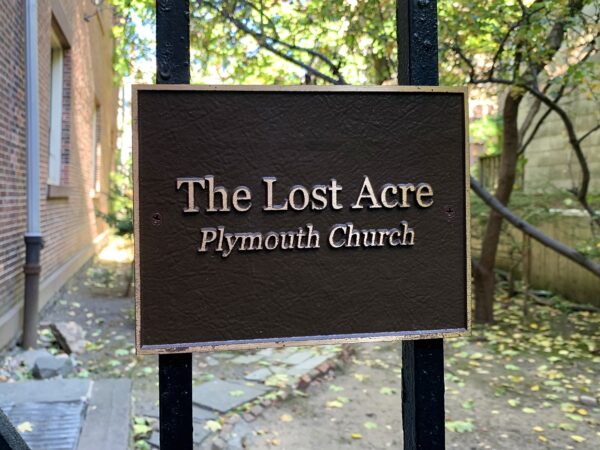 Grace Faison played a pivotal role in establishing the “Lost Acre” garden at Plymouth Church. Photo: Mary Frost/Brooklyn Eagle
She was also active in Plymouth’s History Ministry, supporting lectures on topics like Abraham Lincoln and the Underground Railroad. (Pew 89, where Lincoln sat when he attended services at Plymouth, is marked by a small plaque.)
At her 100th birthday party there, she thanked her fellow congregants and friends.
“The reason you keep going in life is because of friendships, and being connected and caring for each other,” she said. “All of you who have cared for me have meant so much to me and kept me going, and I just want to say thank you to all of you for being part of my life.”
She leaves her son Jeff, of Rio Rancho, New Mexico, her daughter Sandy, in Brooklyn Heights, and her grandchildren John, Jenny and Jeffrey Faison and Molly and Lucy Brush.
Plymouth Church will celebrate her life at 4 p.m. on Saturday, May 23. In lieu of flowers, gifts in her name to the church are welcome.