
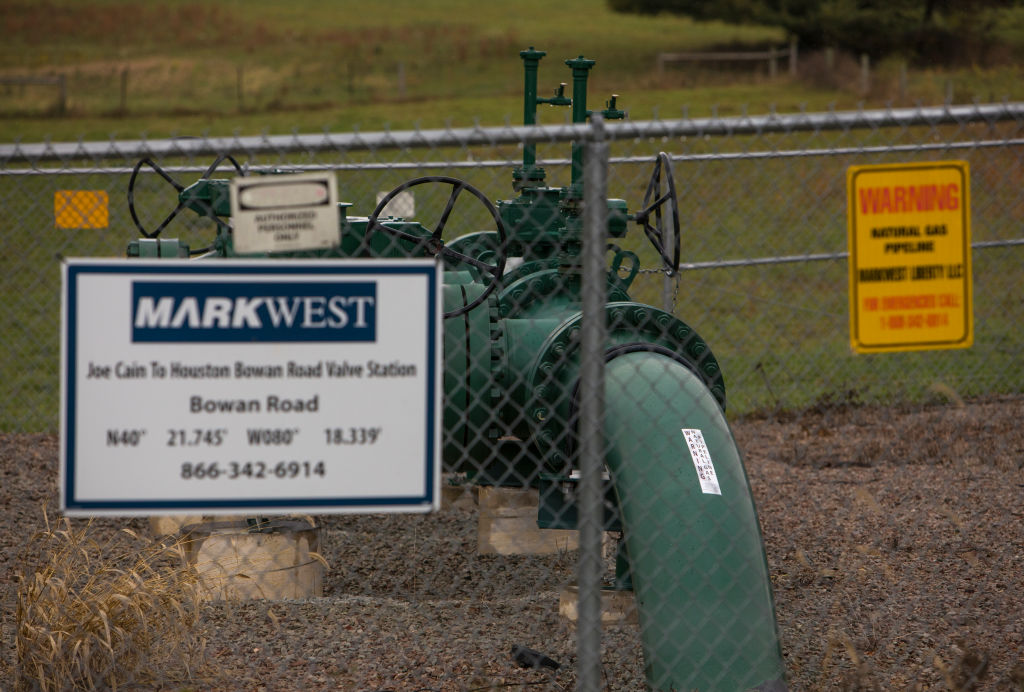
When New Yorkers turn on the heat or cook dinner, the gas powering those actions very likely came from beneath the hills and farms of Pennsylvania.
The Marcellus and Utica Shale formations, the second most productive natural gas fields in the nation, lie under Pennsylvania communities whose residents breathe the air around compressor stations, whose children are 5 to 7 times more likely to develop lymphoma, and whose physicians are treating elevated rates of respiratory illness, cardiovascular disease, preterm birth and childhood asthma tied to fossil fuel infrastructure.
New York consumes the energy. Pennsylvania absorbs the harm.
Last December, Gov. Kathy Hochul signed the Climate Change Superfund Act into law — a landmark measure that holds major fossil fuel companies financially liable for greenhouse gas emissions connected to fuel produced or transported into New York. The law demands $75 billion from the industry to fund climate adaptation and establishes a principle long overdue in American energy policy: Those who profit most from fossil fuel emissions should bear the costs of the harm they cause.
If fossil fuel companies face reduced financial liability for their emissions in New York, the economic incentive to increase production rises. That increased production will come primarily from Pennsylvania. More drilling. More compressor stations. More pipeline infrastructure. More emissions. And more illness among people who had no voice in New York’s deliberations.
Weakening the Superfund Act is a choice to shift costs from fossil fuel corporations onto the lives of Pennsylvania residents.
Here in Pennsylvania, our physicians treat these patients and see the connection between fossil fuel infrastructure and illness in clinical practice, not just in research papers. These are not hypotheticals; they are people in our communities who have had to accept a poisonous bargain from an industry that primarily serves markets elsewhere. They have not shared in the economic benefits of that industry. They have absorbed its health consequences.
Consumers and fossil fuel companies operating in New York’s market have benefited from Pennsylvania’s resources for decades. The Climate Change Superfund Act begins to account for that. It asks the companies that extracted profit from these communities, and from the atmosphere, to contribute to repairing the damage. Stepping away from the legislation does not make the damage disappear; it simply means continued harm for the people least responsible for the damage.
We urge Gov. Hochul to keep the Superfund Act intact, to say publicly that weakening it will harm Pennsylvanians and to move quickly toward full implementation.
Setting bold climate goals is the easy part. Owning the full footprint of where your energy comes from is harder. The people of Pennsylvania are part of that footprint, and their health deserves to be part of New York’s calculation.
Tonyehn Verkitus of Scranton, Pennsylvania, is executive director at Physicians for Social Responsibility Pennsylvania.