
The Knot
Miguel Abreu Gallery
March 12–May 9, 2026
New York
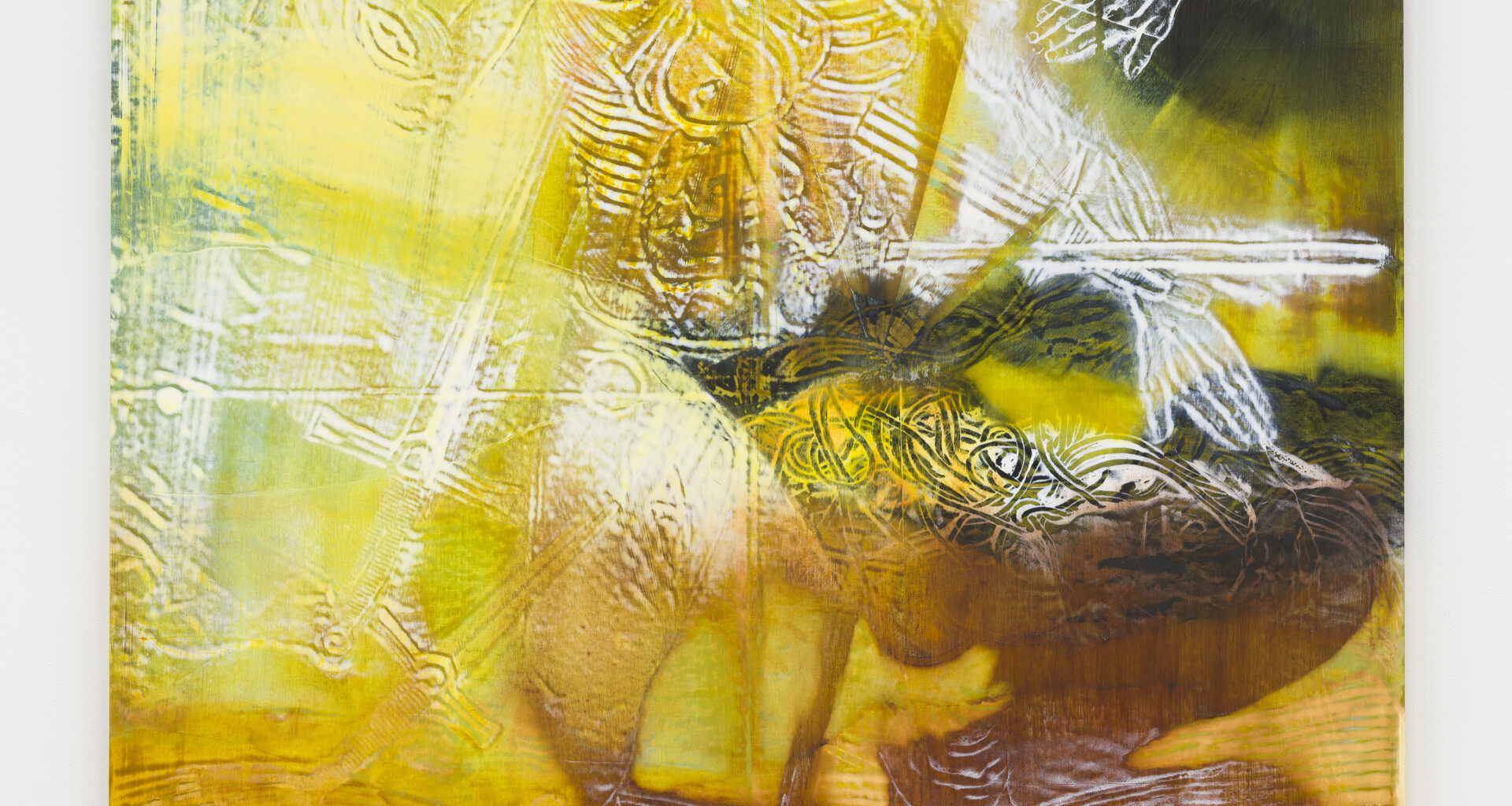
In their 2013 essay, “Notes on the Margins of Metadata; Concerning the Undecidability of the Digital Image,” writers Daniel Rubinstein and Katrina Sluis discuss how metadata is a way of locating and connecting the networked image, those that currently are so circulated and distributed that they lose any sense of position or meaning. While metadata has mostly been utilized as a forensic tool and to further search engine optimization (SEO), the essay sees its ability to solidify the flood of images produced by online culture and as a way of providing a sense of place to the infinity of the virtual world. What if painting could act similarly, as a kind of metadata of its own history, a recursive protocol that establishes the networked image with a kind of presence? The Knot, Alex Carver’s exhibition at Miguel Abreu, might just provide an example of this impulse. By building paintings into a series of nested images that collectively train our eye to a closed set of images, he nurtures meditation on their shifting presence.
Carver’s paintings use detail to generate delirium as he reworks the canon and turns the studio into another form of software by cutting, splicing, burnishing, cloning, and compressing images into new files. Much like a limited data set or language model, a controlled number of signifiers—a falling mountain climber entangled in ropes, a tree with no growth, coins, tree branches, entrails, spears, and bodies—converge to shift a given work back and forth between landscape, still life, and portrait. The compositions crest like waves or accrete like a series of sedimentary layers that rotate and fold forward and backward. The smooth surface of the canvas receives the paint like emulsion, emitting glare and oily spills of radiant and dark color. The soft edges and synthesis between different concepts of each painting elicit comparisons to early generative AI models (like Google’s DeepDream) and their attempts to soften the transition between opposing images. These trained images effectively evoke the sensation of both the clone stamp tool, the AI generative fill, and the oneiric limbo space of art history’s collective imaginary.
His network is defined by his spare image choice, in contrast with the large AI models and the infinite and downward pull of the image stream to which we are quickly becoming accustomed. He provokes irony by thinking algorithmically about only a finite number of options and limited choice. Medical imagery—depictions of surgery, anatomy, and the opened and operated-upon body—is a threshold. The medieval Wound Man, which was the pictorial symbol of the German Wundarznei, a fifteenth-century pedagogical book of healing, is a recurring image that he began using a number of years ago. In past exhibitions Wound Man was barely visible, but in The Return of the Repressed (After Wound Man) (2026) the body has taken on a more distinct and obvious presence. So then, with this interest in the wounded body, what is it that the artist is attempting to heal?