
LENOX — There’s a lot to glean from Edith Wharton’s “Roman Fever,” a 1934 short story getting new life as a one-act opera.
“I really admire her storytelling techniques and her narratives,” said Joan Ross Sorkin, the librettist helping shepherd the piece from page to stage. “It’s such a short story, and she packs a real punch.”
For one lesson: A lot of life is cyclical, like when its two central women of “ripe but well cared-for middle age” revisit Rome with their daughters 22 years after their own mothers took them.
For another: On the island of Manhattan, a few blocks — from facing homes on 73rd Street to the tony environs of Park Avenue, say — can make a world of difference.
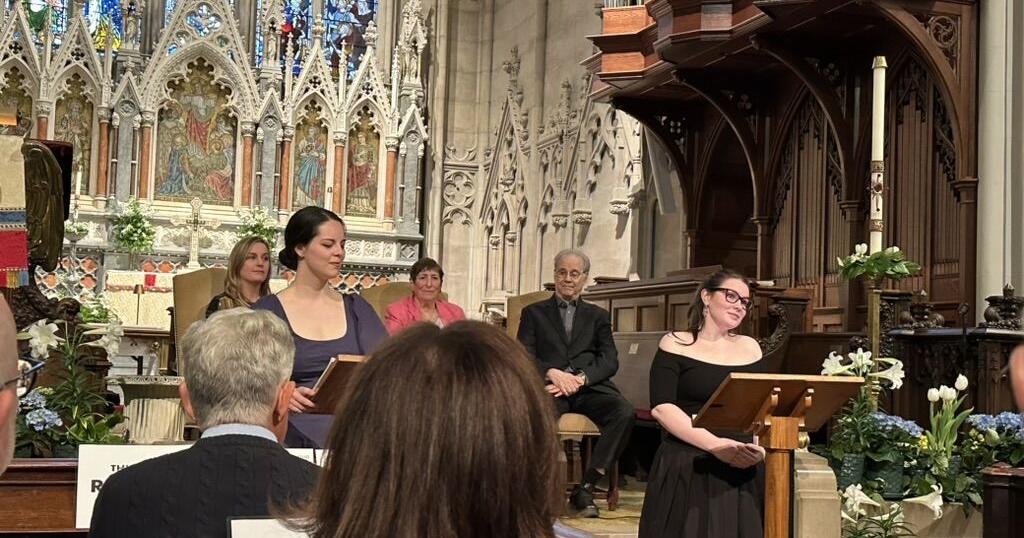
For Ross Sorkin and composer Louis Karchin, it took just two years to reach one of those full-circle moments. That was April 9 at Grace Church, an iconic parish and event venue in Greenwich Village, where two singers and a pianist offered a first look at 18 minutes of “Roman Fever,” the opera.
Their journey, though, was a comparative odyssey: 56 blocks down Broadway from Merkin Hall, a Juilliard School auditorium near Lincoln Center.
It was there, in a 2024 partnership with The Mount, Edith Wharton Cultural Center and Berkshire Opera Festival, that Ross Sorkin debuted Act 1 of “The Reef,” her operatic adaptation of another Wharton work with the Pulitzer Prize-winning composer Anthony Davis. Karchin, who has known Sorkin from the opera world for over a decade, happened to be in the audience.
“I was actually very impressed by the way that Joan was able to transform certain details from the story … in a way that actually made the story more operatic,” he said. “So I approached the idea of us possibly collaborating on something.”
“Right there [and] then at Merkin Hall,” Ross Sorkin added during a group video interview with Karchin. “Lou came up to me and said, ‘Gee, you know, I appreciated the work, and let’s think about doing something together.’ So it happened that night.”
The journey has led them to a one-act opera that runs 45 minutes total, with a planned orchestration for 11 musicians. And while “The Reef” transported its source material to a new setting, “Roman Fever” hews close to its source material.
As in the story, New Yorkers Alida and Grace perch in a Roman cafe to trade reminiscences, then secrets, then barbs, as their longstanding polite rivalry becomes irreparably ruptured.
Alida reveals that she once penned a letter, ostensibly from her beau Delphin, to lure Grace into a would-be midnight tryst and, thereafter, embarrassment at being jilted. Grace counters that the rendezvous did in fact take place after she wrote back to the real Delphin, accepting Alida’s faux invitation.
Salvaging what she can, Alida rubbishes the importance of one night with Delphin, noting it was she who got to marry him. But Grace isn’t finished: that one night gave her a daughter, too.
“Any time you’re adapting, you want to always keep to the core of what are the themes of that underlying author,” Ross Sorkin said. “We just loved her story, and so I really embraced it. And all the elements of her store are really in the opera.”
The libretto departs most in its relegation of the two women’s own daughters to offstage presences (and, eagle-eyed Whartonites will note, in shortening the time since their last visit by 3 years). The result is an uninterrupted look at the two main characters that Karchin, composing his third opera, was only too happy to score.
“There’s an accumulation of tension throughout the short story,” he said. “It becomes an interesting compositional challenge: how to keep the attention of the listener by steadily introducing elements which will increase the intensity of the music.”
Karchin said he utilized an increasing pace as the feud deepens, and a dissonant, strident edge “that becomes more and more evident as the work goes on, and … ends on a pretty marked question mark.”
He also decided to write both roles for sopranos, finding differences not in range but in vocal weight and color, usually categorized under the German Fach system.
“Alida, who is more the domineering character, and also the less-good character, the more scheming character, … should be represented by somebody with a heavier, darker voice,” he said. “And Grace, who, at least outwardly, is the purer character, would have a lighter soprano voice, more of a coloratura role.”
Still, he said, finding separation “actually is the challenge.” At times, he leaned into the vocal closeness as the women compared themselves — when and whom they married; when they moved to Park Avenue and where on it; who did what first, and who better.
“This was a great place to actually try to combine the voices together into a very narrow range and to try to create a sense of [them] trying to one-up each other,” he said. “Sometimes you actually blend them together.”
Natalie Johnsonius Neubert, a Mount board member who moderated the post-show discussion with Ross-Sorkin and Karchin at Grace Church, told The Eagle beforehand she was excited to hear the opera.
“I’m really interested in adaptations that really bring kind of timeless pieces … to modern audiences,” said Johnsonius Neubert, also president and CEO of Berkshire Opera Festival. “You get people who wouldn’t necessarily sit down and read a short story, but they would come to the opera.”
That public outreach, beyond the direct literary mission, is “the most important part of The Mount,” she said.
For the organization itself, that’s part of the plan — right down to partnering with Grace Church, a location in “The Age of Innocence” where Wharton was baptized.
“By engaging new audiences, … we strengthen Wharton’s legacy and illuminate the continued relevance of her work,” Sarah Margolis-Pineo, the organization’s director of programs, wrote in an email. “Presenting ‘Roman Fever’ in New York allows The Mount to extend beyond our physical setting and affirm that her legacy is not confined to Lenox.”
Ross Sorkin and Karchin visited the Berkshire home, where Wharton lived from 1902 to 1911, and the composer knows this region well: A Tanglewood alumnus who studied there under Gunther Schuller, he later conducted his chamber symphony at Seiji Ozawa Hall in 2011.
Karchin wasn’t sure the landscape influenced the Rome-set opera, but “it may have reinforced my appreciation of Edith Wharton,” he said.
“You can just listen to the birds, listen to the sounds of being out there,” Ross Sorkin said. “I think for any writer, [and] she wrote a lot of stuff there, it’s just inspiring.”
The “Roman Fever” creative team includes, from left, soprano Sofia Scattarreggia (Alida), conductor and accompanist Luke Poeppel, librettist Joan Ross Sorkin, composer Louis Karchin and soprano Kerrigan Bigelow (Grace).
LOUIS KARCHIN
The fruit of that inspiration, at least some of it, was brought to life in New York last month by singers Kerrigan Bigelow as Grace and Sofia Scattarreggia as Alida. They were accompanied by Luke Poeppel, a pianist and conductor who last year led outdoor performances of “In A Grove” at Opera Saratoga.
This fall, after a journey back up Broadway, “Roman Fever” will really come full circle, with a full concert premiere at Merkin Hall, where the idea first germinated.
Scattarreggia will return opposite newcomer Jennifer Zetlan, and the chamber orchestra of Washington Square Ensemble will offer a sized-up score.
Karchin and Ross Sorkin plan to be there, too. No word yet on what opera they’ll think up afterward.