
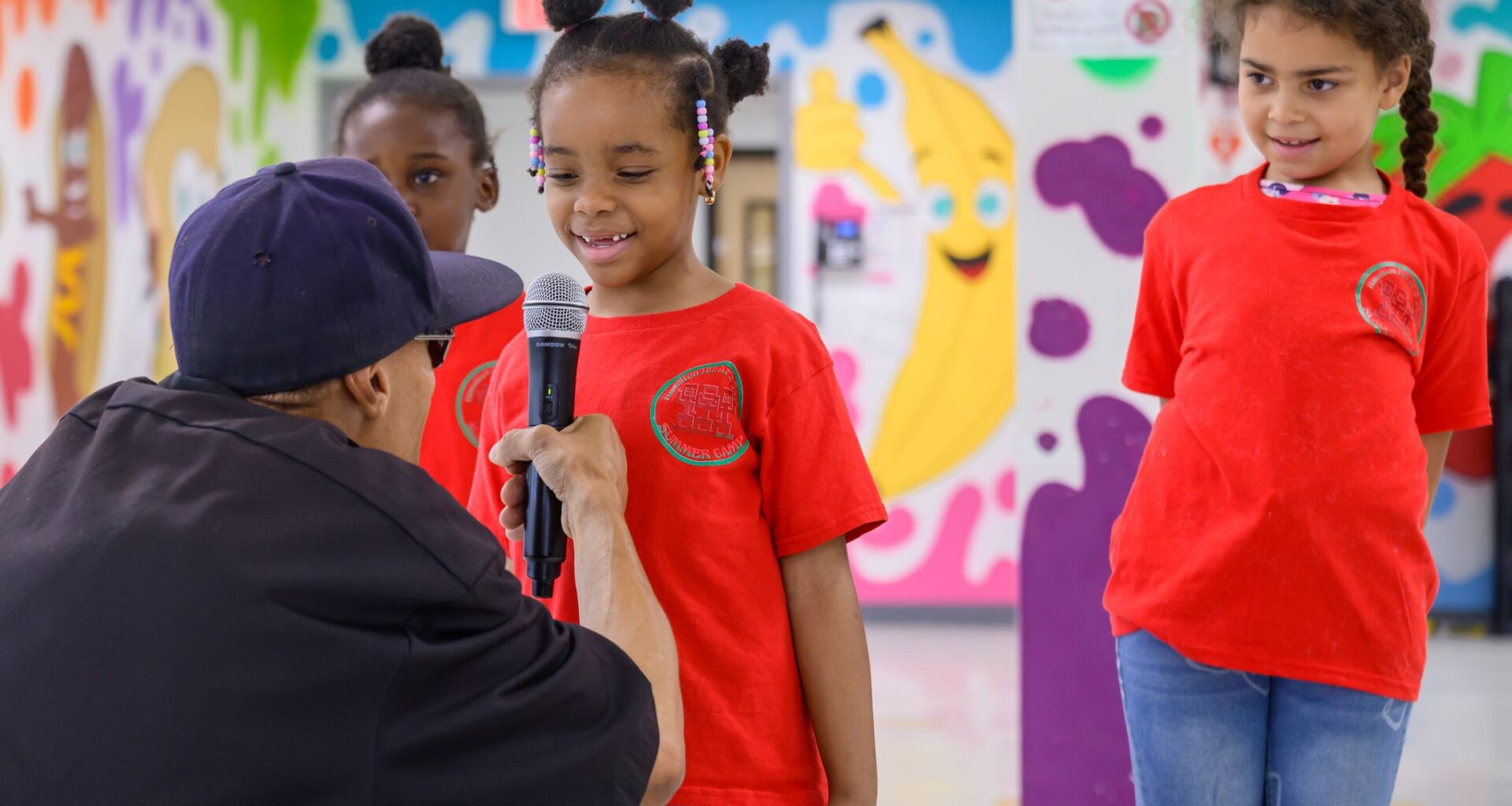
Jermain Hines, an instructor at the Hamilton Hill Arts Center summer program, listens as campers demonstrate how much of the Spanish language they learned at the arts center summer camp program during a celebration to mark the end of the camp on Aug. 5, 2025, at the Destine Prep Charter School in Schenectady.
Jim Franco/Times Union
More than 800 languages are spoken in New York, traditionally an immigrant-heavy state. Over 30% of New Yorkers, about 5.8 million, speak a language other than English at home. In recent years, however, the distribution of those speakers at home has been shifting — especially varying in the Capital Region.

According to the American Community Survey’s 2024 five-year estimates, Albany County ranks in the top 25% statewide for both the share of residents who do not speak English at home and the growth of that population. In Rensselaer, Schenectady and Saratoga counties, 7% to 10% of residents do not speak English at home, a bit below the 13% state average.
Article continues below this ad
Downstate, New York City, Long Beach and parts of the Hudson Valley have some of the highest shares, reaching nearly 60% in the Bronx and 55% in Queens.
In the Hudson Valley, Rockland County leads with 44% of residents not speaking English at home, followed by nearby Orange and Sullivan counties, all of which are close to New York City.
“While New York City and the downstate areas are still traditional gateways for foreign-born New Yorkers, there’s a dispersion that is happening across the state where you see more people who reside in suburban and upstate areas,” said Dina Refki, a professor from the department of public administration and policy at the University at Albany.
Though New York City still had the highest share of non-English speakers at home in 2024, a comparison with the 2019 five-year estimates shows the city lost nearly 5,800 of these residents over the years, while counties near the city gained a larger share of these populations.
Article continues below this ad
Make the Times Union a Preferred Source on Google to see more of our journalism when you search.
Add Preferred Source
Over the last two decades, high housing costs and lack of affordability has pushed people out of New York City, Refki said, affecting both foreign- and native-born residents.
People with limited English proficiency, who make up more than 40% of non-English speakers at home, are particularly vulnerable. They face greater barriers to job opportunities and to finding work that matches their education and experience, often leaving them to follow whatever opportunities are available upstate.
Other factors driving shifts in the population of non-English speakers at home include refugee resettlement and job demand in upstate, Refki said. Utica in Oneida County stands out as a successful example, with refugees first from Bosnia and, more recently, from Ukraine and other countries, helping to make the city more culturally diverse.
Article continues below this ad
However, challenges remain for immigrants living outside traditional gateways, especially in rural areas in the northern part of the state. Support, such as English as a second language classes, legal aid and language-accessible healthcare, is often lacking, and communities may be less accustomed to diversity than in cities. This leaves people with limited English proficiency more vulnerable and can push them to move, Refki said.
Statewide, the most common languages have remained unchanged over the years, with Spanish accounting for nearly half of the non-English-speaking population at home, followed by other Indo-European languages (13%) — excluding Spanish, French, German, Russian and other Slavic languages — and Chinese (10%), including Mandarin and Cantonese.
“Spanish is in American history,” said Ricardo Estremera, an assistant professor of Spanish at UAlbany, noting that large portions of the nation was once governed by Spanish-speaking countries, contributing to today’s sizable Spanish-speaking community.
Article continues below this ad
Natural disasters and country-specific crises also drive immigration to the U.S., with newcomers often settling in places where existing communities and support networks can help them find jobs and build stability, Estremera said.
At the same time, ethnic enclaves themselves have evolved. “They used to be defined by one or a few dominant languages,” Refki said. “Now, they are increasingly multilingual and multiethnic.”
Among the languages recorded, Spanish, though the most widely spoken language after English, saw the largest drop in share in New York among non-English speakers at home over the years, down about 1.3 percentage points, while other languages changed by only about 0.1 point.
The decline in the share of Spanish speakers also may be influenced by social perceptions, Estremera said. He noted that Spanish is sometimes stigmatized, which can push parents to favor English over maintaining their native language at home. In contrast, languages like French are often viewed more positively, creating less pressure to suppress their use.
Article continues below this ad
Estremera said he expects an even larger drop in the share of Spanish speakers at home in the near future, while Refki predicts that immigrants may return to traditional gateways like New York City to reconnect with established networks for safety and resources.
“There is an infrastructure of support, but there are also sanctuary policies. Immigrants feel safer and more accommodated by being with co-ethnics networks of support,” Refki said.