
by Michelle Mullen
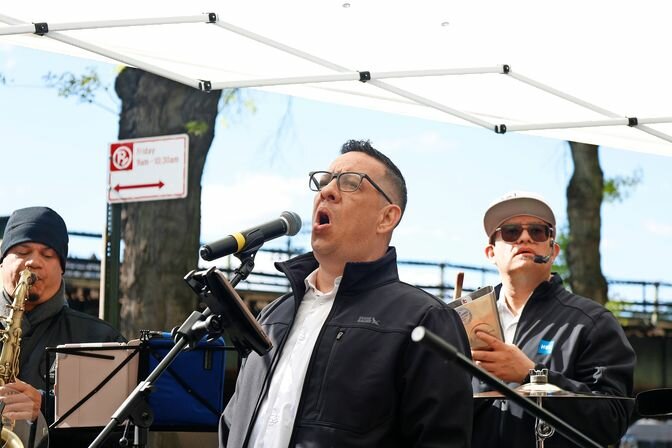
On May 3, music spilled into the intersection at West 239th Street and Broadway, where “Salsa in the Streets” turned an ordinary block into a dance floor — couples spinning, strangers stepping in time, the sound of horns and percussion echoing against storefronts.
The event, part of Bronx Week, brought a genre closely tied to the borough’s identity into a neighborhood that does not often host large-scale street programming. Salsa took shape in New York in the mid-20th century, blending Afro-Cuban rhythms, jazz and Caribbean traditions, and grew alongside Latino communities across the city. The Bronx became one of its central hubs, shaping both its sound and its cultural presence over decades.
The Kingsbridge celebration was organized by Laura Levine-Pinedo, executive director of the Kingsbridge Riverdale Van Cortlandt Development Corporation, who had been planning a street activation before it became tied to Bronx Week.
“People really love events on that street,” Levine-Pinedo said. “I actually grew up on Review Place right around the corner. So it’s just really an honor, and it’s so much fun for me, personally, to activate that street.”
Bronx Week had initially been canceled by Bronx Borough President Vanessa Gibson due to funding constraints before being revived in part through smaller, community-led events. Gibson encouraged local organizations to host their own programming, extending the festivities across neighborhoods that do not always take part.
“When we were looking to reactivate Bronx Week, I said to my team, call Laura, because I want to ensure that the northwest Bronx has some sort of event during Bronx week,” Gibson said. “It’s about variety, it’s about diversity, and it’s also about making sure that all residents can experience different culture, different music.”
On the ground, that approach brought together a mix of residents — families, longtime neighbors and visitors from other parts of the borough — creating a crowd that ebbed and flowed throughout the afternoon.
“It’s playing good music, and it’s a free event, and it has people getting together,” said Julio Casado, a Bronx resident who traveled from another neighborhood. “Well, the Bronx is a don dada of salsa, to my understanding, so I think it’s the perfect place to be doing it.”
Nearby, Rita Gonzalez said she had not originally planned to attend but changed course after hearing about the event.
“Beautiful people, just everyone coming together, unity, having a great time,” Gonzalez said. “It’s just nice to see people come together and just forget about the world.”
At the center of the afternoon was Arturo Ortiz, the headlining performer, who took the stage as Arturo Ortiz y Los Impostores, one of several ensembles he leads.
Born and raised in Puerto Rico, Ortiz began playing music at a young age before receiving formal training. By the time he moved to the Bronx in the mid-1980s, he had already established himself on the island.
In New York, he built a decades-long career as a performer, arranger and bandleader, working across genres while remaining rooted in salsa. Over the years, he has performed alongside major artists, including Marc Anthony — experience that he said informs his work leading his own groups.
Rather than performing with a single fixed band, Ortiz rotates between multiple ensembles depending on the style and repertoire he wants to highlight. Each group has a distinct sound, allowing him to move across different eras and approaches within salsa.
“There are at least 300 songs that have been hits in the history of salsa,” Ortiz said. “Why do you keep on picking from the same 25 or 30?”
He said the goal is to bring audiences back to the depth of the genre, not just its most familiar selections.
“I like to push people to look further into the salsa repertoire, which is immense,” Ortiz said. “And bring songs that they haven’t heard in a long time — songs that were hits that people recognize, but don’t get to hear live anymore.”
That approach shaped the Kingsbridge performance, where familiar rhythms were paired with less frequently played selections. The result was a set that felt recognizable without becoming repetitive, keeping dancers engaged and extending the life of the dance floor well into the afternoon.
The event was supported in part by Council member Eric Dinowitz, who said programming like this reflects the character of the community he represents.
“Salsa really speaks to the culture of so many who live in the northwest Bronx, particularly Kingsbridge,” Dinowitz said. “It’s a destination for community activity and for culture.”
Alongside the music, the event also included the “Longest Table,” a communal dining initiative designed to bring neighbors together over shared food. A long row of tables stretched along part of the block, where attendees sat with people they had not met before, sharing dishes and conversation.
The setup created a rhythm within the event that emphasized staying put rather than moving on. Some participants arrived with food prepared in advance, while others joined with what was available, filling seats as they opened. Conversations carried between songs and the tables remained active even as the crowd shifted around the stage.
In a borough known as “El Condado de la Salsa” — the Borough of Salsa — the afternoon reflected a piece of that identity. The event marked one of the early celebrations of Bronx Week, which continues with programming across the borough through May 17.
Keywords
Bronx Week,
Salsa in the Streets,
Kingsbridge Bronx,
salsa music,
Bronx culture,
Arturo Ortiz,
Arturo Ortiz y Los Impostores,
Vanessa Gibson,
Eric Dinowitz,
Bronx events