
The New York City board that sets rent increases for rent-stabilized apartments voted Thursday night to consider a rent freeze. Earlier that day, rent-regulated housing experts split on whether such a proposal would be detrimental to the city’s housing stock.
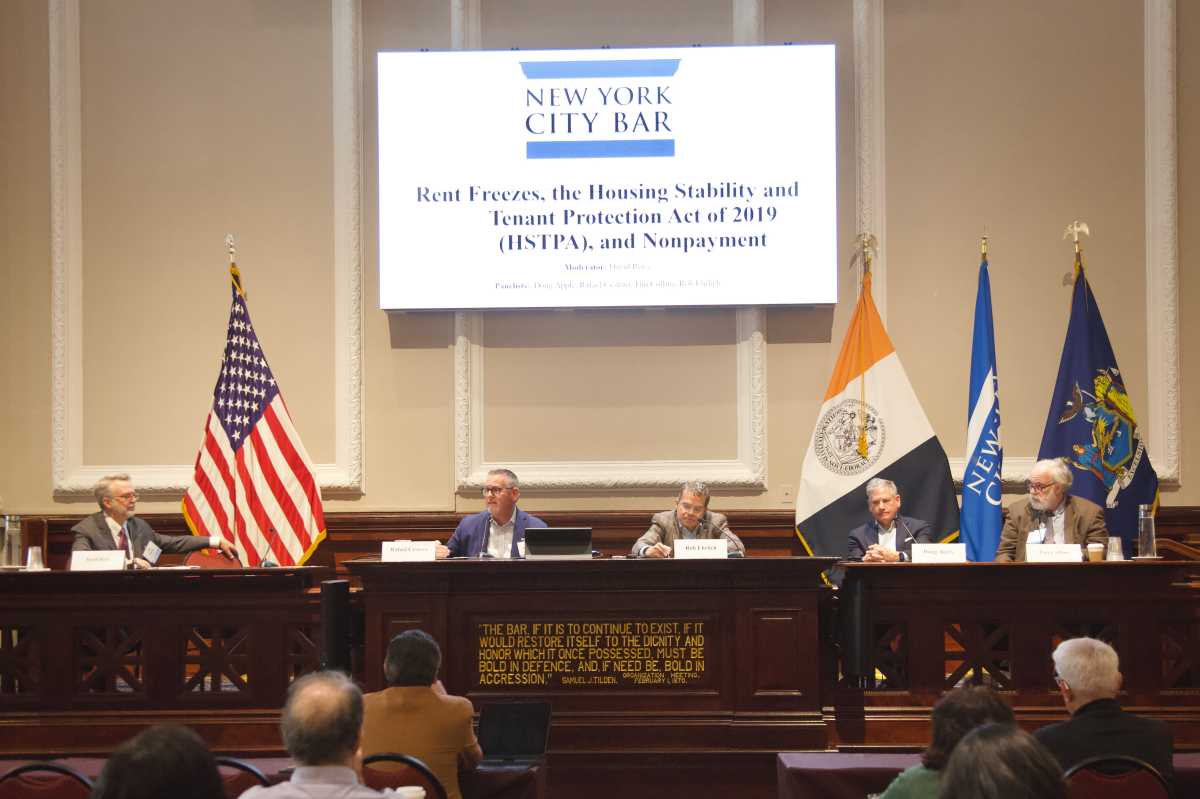
A panel of housing attorneys and affordable housing developers discussed the rent freeze proposal before the Rent Guidelines Board (RGB) at a New York City Bar Association panel at the association’s midtown headquarters on Thursday morning.
One object of consensus: much of the city’s aging affordable housing stock is in trouble. The housing stock, much of it decades old, is at risk of not receiving the repairs it needs to keep operating.
The panel’s moderator, David Weiss of Cornell Law School, called the state of the city’s housing stock a “slow-motion train wreck.”
Rob Ehrlich, a landlord-side housing attorney with Lazarus Karp Ehrlich McCourt and a member of the RGB, said the pressure on housing stock in northern Manhattan and the Bronx, where buildings are often over 100 years old, is immense.
“The physical plans of those buildings need a lot of maintenance, and the owners don’t have the money for that maintenance,” he said,
Doug Apple, the former chair of the RGB whom Eric Adams appointed in 2025, suggested that a rent freeze would be detrimental to these types of buildings.
“I know a 3% [rent increase] might not seem small if you are already barely able to pay the rent,” said Apple. “But a 3% or 2% or 2.5% increase doesn’t even keep an account of inflation. a massive correction to rent-free over multiple years I think could drive the stock which is already struggling into greater distress more quickly.”
The costs of rent increases
Tim Collins, a tenant-side housing attorney and partner at Collins, Dobkin & Miller, argued that over the past 36 years, rent-stabilized landlords have, on average, accumulated more than enough money to account for operating costs and inflation, according to data he pulled from RGB-reports.
He said the current moment of tenant activism was a response to what he described as a “march to the market” between 2008 and 2014, where the board massively overshot the level of increases that were necessary to keep owners whole, dramatically, “at the worst possible time during the Great Recession.”
“So the board has still authorized more in rent increases than were necessary to keep owners whole,” he said. “Tenants took the brunt of this bad policy, bad government for many years. It needed to be corrected faster and more decisively and it wasn’t and we’re still dealing with the consequences of it.”
Collins proposed a new city commission, similar to one enacted in 1980, to provide policy solutions. He said he agreed that the city needs to throw a lifeline to the owners of distressed properties, but it would be a mistake to do it across the board with a rent hike.
“I think frankly what we need is a whole building approach,” Collins said. “We need a capacity for government officials to intervene in distressed properties to look at the condition of the properties, the economic profile, the rent structure of the properties, the degree of indebtedness, etc.”
Rafael Cestero, the head of an affordable lender called the Community Preservation Corporation, said the political dynamic that dismisses the concerns of rent-stabilized landlords will lead to problems down the road.
He worried because nearly a third of the loans in CPC’s portfolio of rent-stabilized buildings are overleveraged.
“Tenant interests have the political power in Albany and in City Hall,” Cestero said. “Continuing to ask for more and more and more is just going to perpetuate the cycle that has put us where we are today.”