
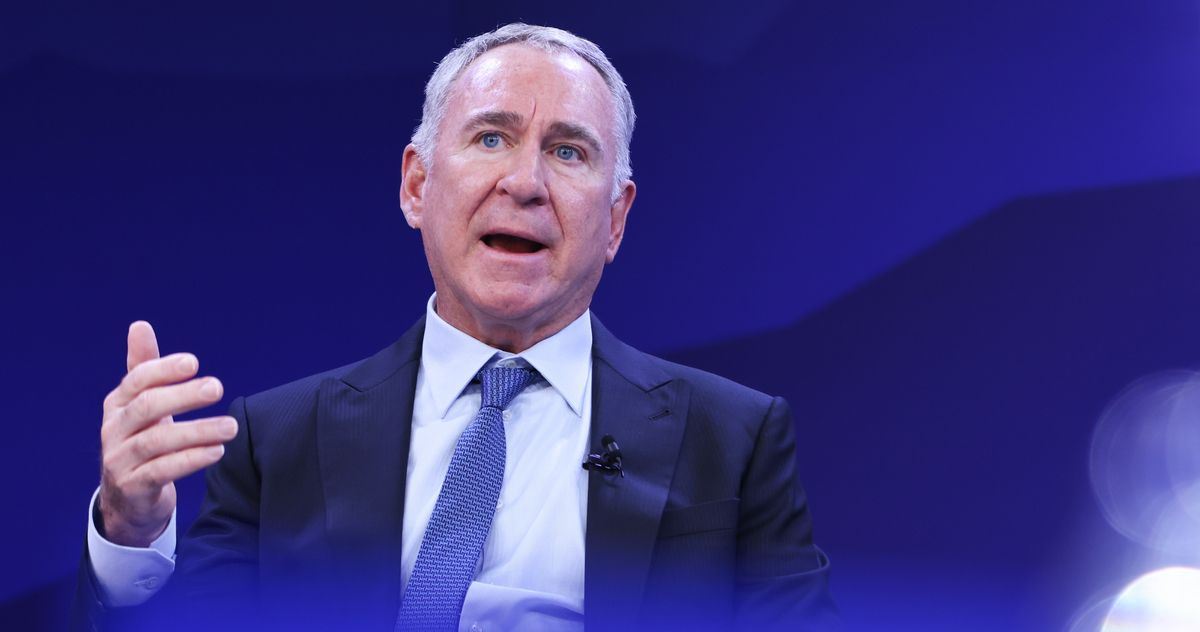
The hedge-fund CEO is displeased with New York’s new mayor.
Photo: Krisztian Bocsi/Bloomberg/Getty Images
There’s a good argument to be made that Mayor Zohran Mamdani should not have gone to war with Ken Griffin, the hedge-fund billionaire and one of the wealthiest men on earth. As Mamdani was celebrating a potential agreement in Albany to tax luxury second homes, he cut a widely viewed video that called out Griffin, noting that his $238 million penthouse would be subject to the new tax. Mamdani, to underscore his point about the “fundamentally unfair” New York tax system, shot the clip outside Griffin’s luxury skyscraper in Manhattan.
Griffin, in the weeks since, has been on the warpath. “What really upset me about the video was the fact that he put me in harm’s way,” he groused. “You know, he seems to have forgotten that the CEO of another American company was assassinated just blocks from where I live in New York. And to put any citizen in harm’s way is just inappropriate for one of our political leaders.” As retribution, Griffin announced that his hedge fund, Citadel, would be expanding its Miami office, adding more jobs there that would have, in theory, gone to New York City. The $6 billion supertall office tower Griffin has been planning to build on Park Avenue as Citadel’s new global headquarters is now in some degree of doubt.
Would Mamdani have been better off not referencing Griffin at all in his video? Probably. Griffin is a notoriously fickle Wall Street oligarch who already ripped his firm, Citadel, out of Chicago citing political differences with that city’s left-wing mayor. The departure was expensive for Chicago and Illinois, costing them a major corporate taxpayer and around 1,000 high-paying jobs. Mamdani doesn’t ever have to be nice to Griffin, a major GOP donor, but, strategically, it’s likely better to speak more generally about the ultrarich and not call out the most sensitive of their lot — especially when that person is a major New York employer making a credible threat to move his operations to Miami.
A Griffin ally, real-estate magnate Steve Roth, went even further, though, claiming that the phrase “tax the rich” was as “hateful as some disgusting racial slurs.” “We are all shocked that our young mayor would pull this stunt in front of Ken’s home and single him out for ridicule,” said Roth. Despite Griffin’s threat to abandon the supertall office tower that he is teaming up with Roth’s Vornado Realty Trust on, Roth said that “it’s a good bet that we will go all in.” Still, he whined, “this fence cannot be mended by a short, terse, insincere private apology.” Roth’s tantrum outstripped even Griffin’s absurd claim that Mamdani’s video somehow put him in harm’s way (it’s public knowledge he bought the penthouse, and as a proud and politically involved Donald Trump supporter, he should know that, like Mamdani, he’s operating in the public arena).
Even if the battle wasn’t totally advisable, it has some positive potential for the democratic-socialist mayor: He managed to find two pretty good political foils. Griffin is MAGA, and Roth is representative of what happens when extreme privilege rots your judgment. Roth, especially, is a reminder of how conservatives now exploit the language of “woke” or social-justice culture to deflect the mildest of criticisms. For them, speech must be policed, and speech equals violence. The billionaires, it seems, must be a protected class now. Mamdani has clearly emerged as the man on the right side of history.
In the grand scheme of progressive tax policy, the pied-à-terre tax championed by Mamdani and supported by Kathy Hochul, the much more moderate governor, is not overly ambitious (it will raise less than $1 billion annually). If Mamdani had a more populist partner in the governor’s mansion, he could pursue truly redistributive tax policy: increases in the income and corporate tax rates that could produce billions in new revenue for schools, parks, libraries, and public transportation. Griffin and Roth would still be inordinately wealthy with enough cash for a thousand lifetimes.
There’s a certain kind of sour-faced pundit who tut-tuts at Mamdani and politicians like him. Doesn’t he know the wealthy pay all the taxes in New York? Doesn’t he know they can leave tomorrow? Money, in this new age, is plenty mobile, but there’s only one New York, an American city of more than 8 million people with an iconic global status. Roth, who derives all his wealth from real estate, needs New York. Griffin, as a financier, may believe he can go anywhere and maybe one day he can relocate Citadel’s New York employees. That’s possible, if ultimately self-defeating. Citadel’s loss will be someone else’s gain, especially since the workers in his industry probably prefer living in New York.
In a small way, Mamdani is attempting to alter a dynamic that has held New York City mayors captive, in one form or another, since the city nearly went bankrupt in the 1970s. The financial class had wielded an enormous amount of leverage over the municipal government as the long shadow of the fiscal crisis forced city and state politicians to trim the welfare state and cater overwhelmingly to capital. Some mayors didn’t mind this at all. Ed Koch, Rudy Giuliani, and Michael Bloomberg could all be described, to varying degrees, as neoliberal in their governance. To them, the policy priorities and even personal feelings of the real-estate and Wall Street elites mattered far more than the actual electorate. Mamdani, as a democratic socialist, campaigned on hiking taxes on the wealthy and growing the social safety net, which few modern mayors, beyond Bill de Blasio, have actually done. He is not calling for the nationalization of industries or the expropriation of wealth. He is not saying hedge funds shouldn’t operate in New York. Even if Hochul, tomorrow, agreed to all the taxes he wanted to implement, none of them would be especially radical.
Yet this probably won’t be the last time we hear from Griffin and Roth. They’ll keep raging to the media over how poorly they’re supposedly being treated by the new mayor. In a way, their wrath does make sense: Neither Griffin nor Roth are used to being told “no.” They can’t buy off Mamdani or will him away. They can’t erase the people who elected him. Democracy, for them, is a burden they’ll have to accept.
Sign Up for the Intelligencer Newsletter
Daily news about the politics, business, and technology shaping our world.
Vox Media, LLC Terms and Privacy Notice