
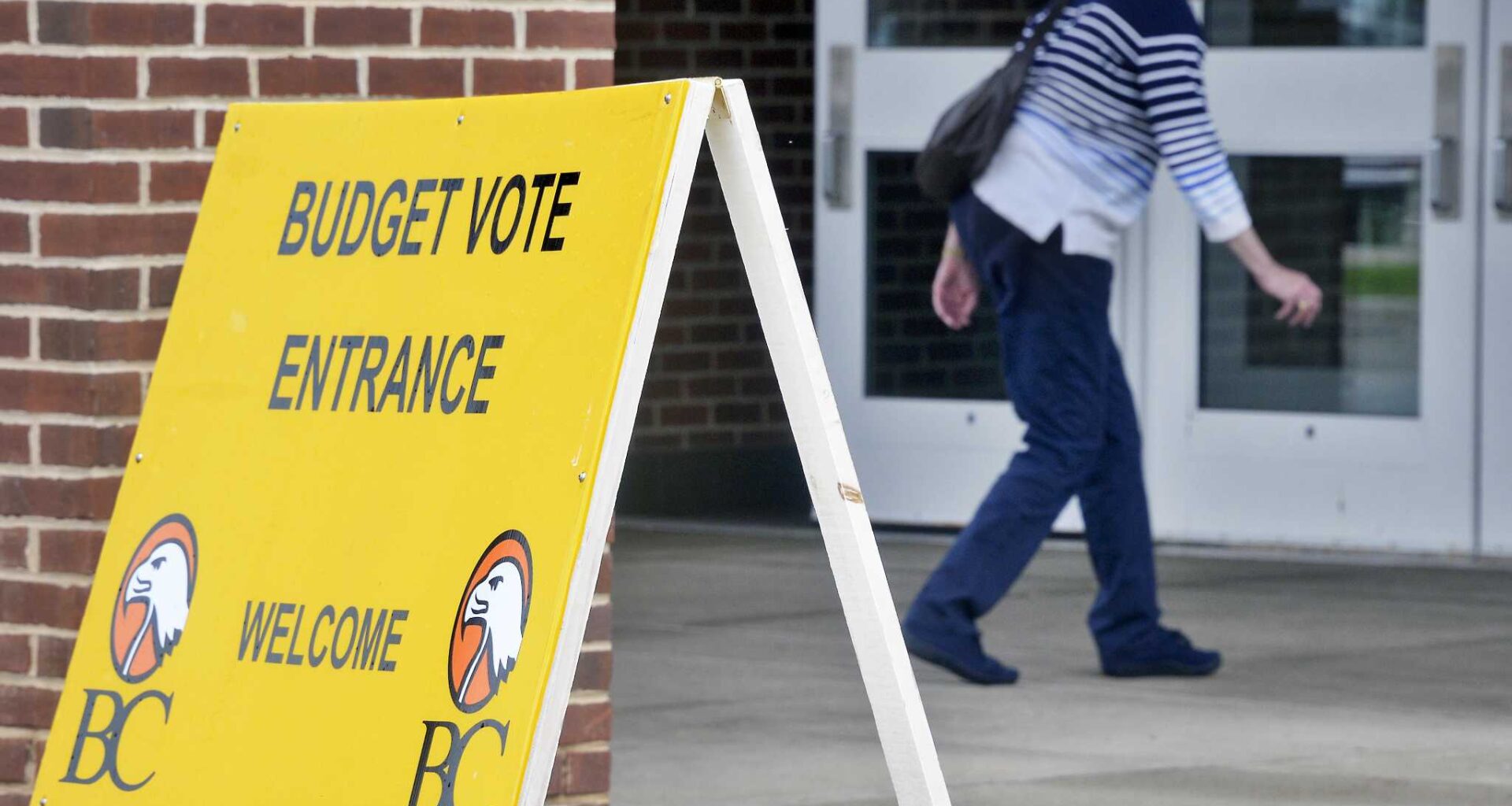
Voters turn out for the school budget vote at Bethlehem High School in 2018. The budget votes and school board elections for all of the local school districts will be Tuesday, May 19.
John Carl D’Annibale
Hoosic Valley School District has proposed a budget that would go over the tax cap.
Tyler A. McNeil/Times Union
As school districts put out their proposed budgets for the May 19 vote, it’s clear the declining birthrate is having an impact.

Enrollment is dropping in the Capital Region and school districts are beginning to cut staff. In Albany, Schenectady, Rensselaer and Saratoga counties, 47 instructional positions would be eliminated in the proposed budgets, along with 21 administrative jobs.
Article continues below this ad
The Guilderland school board even hired a demographer to map out the possibility of future babies being born in the district. The news was grim: expect “continual decline,” he said.
Scotia-Glenville is closing an elementary school due to the steadily declining birth rate. As fewer babies are born, the effects hit elementary schools first, since they welcome children just four years later. But the effects are cumulative, and eventually, high schools will see a decline in enrollment too.
Some districts are still seeing significant numbers of people move in with children — sometimes specifically for the quality of education there. North Colonie officials proudly noted in their budget presentation that enrollment is increasing at their high school. They had to move three instructional positions there in response to the influx.
Make the Times Union a Preferred Source on Google to see more of our journalism when you search.
Add Preferred Source
Budget votes and school board elections will be held at all local school districts on Tuesday, May 19. Check your district for poll times and locations.
Article continues below this ad
Health insurance
Usually, the biggest cost in a school district’s budget is its personnel. But this year, the biggest cost driver wasn’t their salary increases — it was their health insurance.
Many districts reported double-digit increases, and some got creative to reduce it.
Berne-Knox-Westerlo is switching to a self-insurance fund and purchased a separate stop-loss insurance policy for big claims. The board made that decision after all of its insurance quotes came in at increases of more than 15%. The self-insurance fund is expected to cost the district 5% more next year, said Stacy King-McElhiney, the district’s accounting and finance official.
Article continues below this ad
Bethlehem school officials also complained about the big increases. For next year, costs are going up $2.8 million, a nearly 16% increase, they wrote in their budget presentation.
That accounted for more than 90% of the district’s total spending increase for next year, they said.
“Since 2024-25, health insurance costs have significantly outpaced the rate of inflation, rising 26.2% over two years,” they said.
Going above the tax cap
Only two Capital Region school districts are proposing budgets that would increase the tax levy, the amount collected from taxpayers, above the state-mandated tax cap. For those budgets to pass, a supermajority of voters would have to vote yes.
Article continues below this ad
Cambridge is proposing a 12% tax levy increase. The district’s tax cap is 3.17%.
The cap is set by a state formula that takes into consideration inflation and does not count certain expenses, like capital projects, toward the cap.
For a house assessed at $250,000, Cambridge officials estimated the proposed tax increase would be $374. The school board warned if they have to go to a contingency budget, they will cut 12 positions. The board would be required to go to a contingency budget if the voters rejected the proposed budget twice.
Hoosic Valley school district is also proposing a budget with a tax levy increase above its state cap. The proposal is for an 8.5% increase, while the district’s cap is 3%.
Article continues below this ad
For a house assessed at $100,000, Hoosic Valley officials estimated the proposed tax increase would be $92.
“As your Board of Education, our primary mission is to provide every student with a high-quality education while acting as responsible stewards of your tax dollars. Finding the right balance between these two goals has always been important, but it is becoming increasingly difficult as the cost of running a school district rises faster than the support we receive from the state,” the board said in a statement.
The board listed the many cuts it has made in the last three years, including 10 teachers, four teaching assistants and two counselors. The proposed budget would cut another teacher and another TA.
Very few districts propose to break the tax cap each year, and voters have historically rejected almost all of those proposals.
Article continues below this ad
A run on buses
For many districts, this budget represents the last year they are allowed to buy a diesel- or gasoline-powered bus. So districts went all-in, proposing to buy a total of 122 buses in the four-county heart of the Capital Region.
They are only proposing buying eight electric buses, though many are awaiting additional electric buses they ordered after last year’s budget vote.
Galway decided to propose buying four buses, only one of which would be electric.
Article continues below this ad
The district’s goal is to “comply with (the electric bus) mandate enough to avoid loss of aid/fines,” while also buying diesel or gas-powered buses for “as long as we can,” officials said in their budget presentation.
State law requires all new bus purchases to be electric, starting next year. Some districts have gotten an extension while they undertake expensive upgrades in their electrical system to charge the buses.
More: Capital Region schools slowly embracing electric school buses
Article continues below this ad
The state law also requires all school buses to be electric by 2035. But those buses are still $200,000 more than diesel buses, and even if districts began buying them at their current replacement rate, they would not have replaced their entire fleets by then. Many school officials expect the state to extend the deadline at some point, but legislation to do that failed this year.