
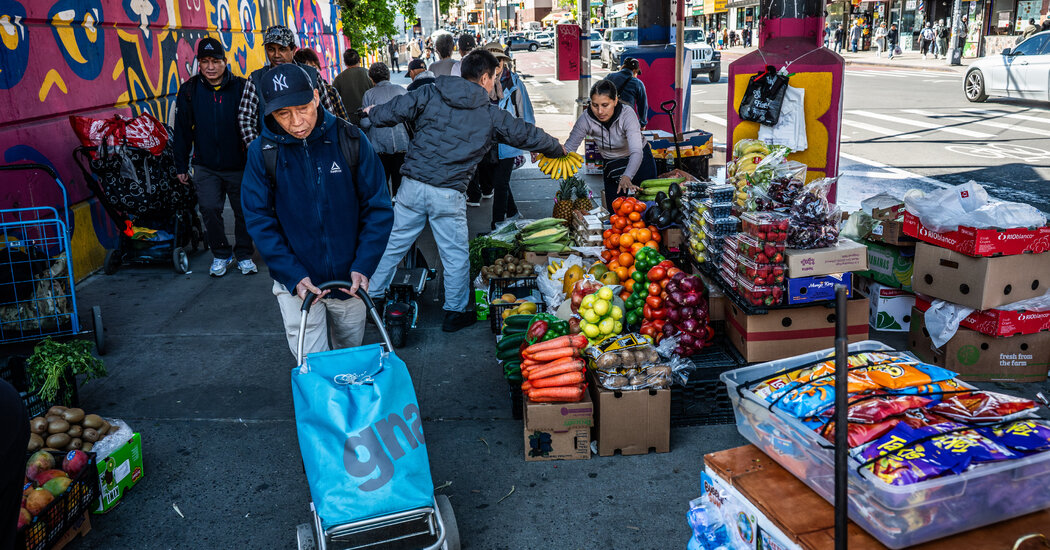
So much happiness in a single mile in Queens. Elmhurst is a thicket of possibilities; almost every storefront beckons. To the west of the Elmhurst Avenue subway stop, along Broadway and Woodside Avenue, is an astonishment of small, idiosyncratically chic Thai restaurants, bars and cafes. (Three — Khao Kang, Saranrom and Zaab Zaab — appear on The Times’s list of the 100 best restaurants in New York, but I could easily have included more.) To the south and east, the Malaysian and Taiwanese stalwarts Taste Good and Taiwanese Gourmet remain bluntly functional and great (and cash-only) after all these decades. Walk to the next stop, Grand Avenue-Newton, and cross Queens Boulevard to reach Warung Selasa at the tiny Indonesian grocery Indo Java. Every Tuesday, Anastasia Dewi Tjahjadi makes a set $15 lunch heaped on a banana leaf, mostly for takeout, since there are just two folding tables set up between the shelves. Ms. Tjahjadi has no plans for expansion. “This is unique,” she says. The same could be said for the whole neighborhood.
Chinatown Welcomes the World
Since Cantonese migrants first found refuge here in the late 19th century, Chinatown has both grown and diminished, sprawling into surrounding areas even as it contends with gentrification and population decline. It’s still one of the city’s most vital quarters, its make-do spirit sustained by restaurants high and low, Chinese and beyond. Go back to its original crooked lanes and you’ll find the veteran Hop Lee, where the waiters still wear red jackets and the cooks understand velvet as a verb, not far from the newcomer Lei, scandalizing the older generation by serving chrysanthemum greens raw and lily bulbs on crudo. The Canal Arcade, a covered passageway once thronged by herbal pharmacies and Cantopop record shops, now houses several discreet Japanese restaurants, including Kono, a temple to yakitori. To the east, tiny Mắm channels the energy of a night in Hanoi, and the modernist Mexican spot Corima makes the best tortillas in town on a flipped-over wok. Closer to the river, Golden Diner celebrates the motley New York pantry, with gochujang on the burger and Thai tea in the tres leches cake.
The East Village Finds Space
How does a neighborhood keep its identity over time? The East Village has been aided to some extent by the peculiarities of its real estate: old tenements built on marshlands, cut up into narrow apartments (some still with the bathtub in the kitchen), and under it all, subterranean streams that threaten to flood the basements every time it rains. Grit, attitude, bravado: Compact Carnitas Ramirez hands out offal tacos to diners perched on upturned buckets, moody Smithereens collects fish bones in a moody catacomb of a dining room, and Superiority Burger — in the former home of Odessa, the beloved Ukrainian diner — proves that there are no limits to what a vegetable can be. Ho Foods, with its hot creamy soy milk and profoundly deep beef noodle soup, has two cubbyholes of storefronts and is still tiny. Intimate Penny and Claud, upstairs and downstairs in the same building, make a virtue of railroad layouts. And the room at Bánh Anh Em is all naked pipes and clamor, befitting its no-reservations, eat-like-you’re-on-the-street credo.
Harlem Has a Big Heart
Reaching from river to river, Harlem, the historic hub of Black life in the city, contains multitudes. Up in tree-lined Hamilton Heights, at Cocina Consuelo, the Dominican-born chef Karina Garcia brings a Black Latina perspective to the Mexican food that her husband, Eduardo Rodriguez (known as Lalo), grew up with. Just off the 125 Street subway station, Accra Express is the Manhattan outpost of a Bronx institution, its steam table and foil tubs overflowing with Ghanaian soups, stews and sunset-stained jollof. To the south is the heart of El Barrio, a glorious place to ramble on the weekends, where population density and the high number of small apartments mean that much of life is lived on the streets, in shared public spaces. The compressed storefront of Tamales Lupita harks back to its origins as a street cart, with tamales that stay steamy and hot on the walk to a nearby park. And Taco Mix is still the standard-bearer for al pastor in the city, the pork crimson with crispy jags and the pineapple almost drunkenly sweet.
South Brooklyn Takes the Stage
North Brooklyn, gentrified, expensively bohemian and ostentatiously artisanal, tends to monopolize the conversation when it comes to dining outside Manhattan. But head south and the world opens. In Bay Ridge, Yemenat, with its munificent stews and lamb haneeth roasted to near-collapse, is at once convivial and consoling, welcoming both the neighborhood’s growing Arab population and those more generally hungry and curious. Laghman Express, which specializes in hand-pulled noodles and mighty manti (dumplings) from the nexus of Uyghur, Kyrgyz, Kazakh, Tajik and Uzbek cooking, began as one small, functional spot in Mapleton and now boasts another, slightly sleeker, in Gravesend. (Its young staff also makes what may be the most charming Instagram reels of any restaurant in the city.) Steady emigration from the Republic of Georgia, spurred by decades of political instability and economic duress, has led to a flowering of Georgian restaurants in Manhattan, but Toné Cafe, one of the city’s first, continues to preside in Brighton Beach. And up the avenue, where boats chop against the docks in Sheepshead Bay, Randazzo’s Clam Bar still faithfully dispenses fresh seafood, Italian-style, honoring a family tradition stretching back to the 1920s, when Sam Randazzo opened a fish market on the Lower East Side of Manhattan.
Follow New York Times Cooking on Instagram, Facebook, YouTube, TikTok and Pinterest. Get regular updates from New York Times Cooking, with recipe suggestions, cooking tips and shopping advice.