
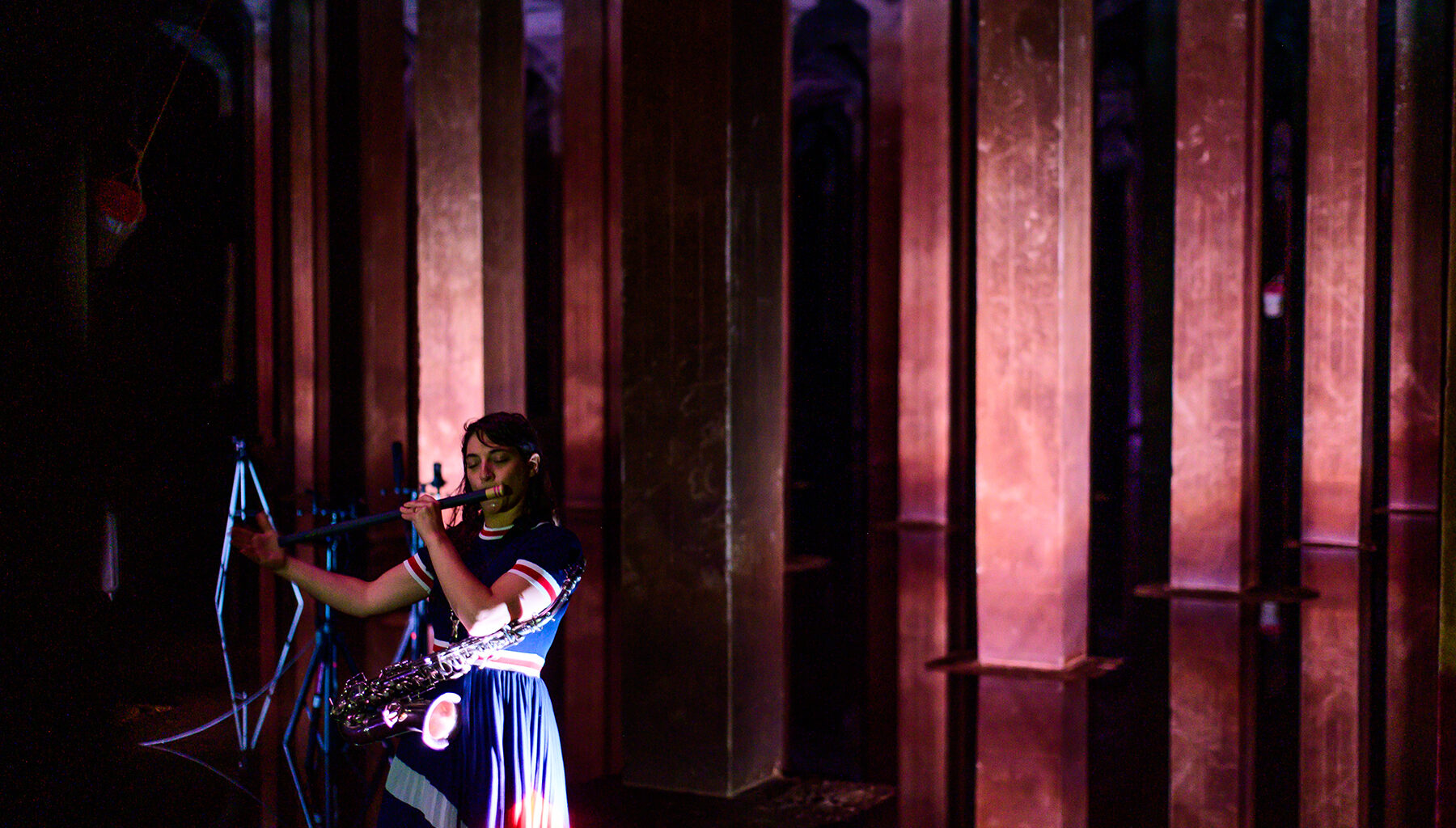
POUGHKEEPSIE — On a rainy Saturday at College Hill Park, visitors descending into a decommissioned cistern were asked to do something unusual before the music began: put away their phones and simply listen.
What followed was a rare performance inside one of Poughkeepsie’s most unusual hidden spaces — a cavernous 1920s-era water reservoir where echoes linger for up to 14 seconds and every note seems to hang in the air.
The free, daylong event featured 20 musicians performing 20-minute sets for groups of about 40 people at a time inside the city-owned cistern. Hosted by MASS Design Group in partnership with the city of Poughkeepsie and the Revive College Hill Park Coalition, the performances transformed the abandoned utility space into an immersive concert venue.
Built into the hillside in 1923, the 36,500-square-foot cistern once held 1 million gallons of drinking water for city residents. Supported by 187 concrete columns, the reservoir was part of the city’s gravity-fed water system: water treated at a pumping station near the Hudson River was sent uphill to College Hill Park, then distributed back down through the city.
The underground chamber replaced an earlier open-air reservoir built in 1872 that now serves as a pond in the park. The cistern was drained in 2021 after the city constructed two modern water tanks nearby.
Today, the massive structure remains largely untouched and acoustically extraordinary. Its vaulted ceilings, scalloped floors and concrete construction create a haunting reverberation effect that musicians used to layer sounds over themselves in real time. Saxophones, drums, strings and vocals echoed across the chamber as performers built self-accompanied compositions from reverb alone.
“You’re in the center of a cello, essentially,” said Chris Kroner, a principal at MASS Design Group.
After each performance, Kroner encouraged audience members to experiment with the space themselves by shouting, clapping or making noises to hear the echoes ricochet through the cavernous room.
Inside, dim lighting reflected off shallow standing water on the floor, creating the illusion of endless arches stretching into darkness. Guided by glow sticks, visitors shuffled quietly between columns before settling into seats or standing spots to take in the performances.
Saturday’s event was a one-time program funded through a grant from the Mellon Foundation. But organizers hope it could become the start of something larger. Kroner said MASS Design Group envisions turning the cistern into a permanent performance venue in the Hudson Valley, though the project would require roughly $6 million in upgrades to the facility and surrounding site.