
May is Mental Health Awareness Month — a time to take stock of how our communities support, or fail to support, the nearly one in five American adults living with a mental illness.
That is roughly 60 million people. And a significant number of them will, at some point, find themselves not in a therapist’s office or a hospital — but in a courtroom.
The numbers are sobering. According to the National Alliance on Mental Illness, approximately 2 million times each year, people with serious mental illness are booked into jails. Nearly two in five people who are incarcerated have a history of mental illness. Seventy percent of youth in the juvenile justice system have a diagnosable mental health condition. Suicide is the leading cause of death for people held in local jails.
Closer to home, data from Albany County Mental Health Commissioner Dr. Stephen Giordano tells a striking story: as of the end of March 2026, the Albany County jail census stood at 591; 301 of those individuals, roughly half, were housed in the Mental Health Unit. In recent months, that proportion has climbed to as high as 60%. The largest de facto psychiatric institutions in this country are not hospitals. They are Rikers Island, Cook County Jail, and Los Angeles County Jail.
That is not justice. That is a crisis wearing a badge.
We have seen this up close. We have watched people cycle through courtrooms not because they are beyond help, but because help never reached them. We have seen the intersection of untreated illness, fractured support systems, and legal consequences compound in ways that leave individuals, families, and communities worse off. And we have seen what happens when the court does something different.
One graduate of the Albany City Alternative Treatment Court knows what that difference looks like. She came into the program at what she describes as a very dark moment — facing eviction, addiction, and arrest simultaneously. What she found on the other side of that door was not a system ready to dispose of her case. It was a team ready to invest in her.
She engaged in mental health treatment, completed inpatient rehabilitation, and went on to finish intensive outpatient treatment — continuing to attend recovery meetings long after she was required to. Along the way, she secured a new apartment, repaired family relationships, and purchased a vehicle. She graduated in October 2025.
“ATC is transformative,” she has said. “It transformed my life.” Her story is not an exception to what our courts can do. It is an example of what they are designed to do at their best.
Problem-solving courts are one of the most meaningful developments in American justice in a generation. Rather than processing every case as a purely legal transaction, these specialized courts pair judicial oversight with community-based treatment, case management, and wraparound services. Mental health courts, drug treatment courts, veterans’ treatment courts, and family treatment courts all share the same animating insight: that justice is better served when we address why someone is before the court, not merely what they did to get there.
New York State operates 42 mental health courts. They are not a soft alternative to accountability — they are a rigorous, supervised path toward stability.
Participants appear regularly before a judge who knows their case, their progress, and their struggles. Research from the Center for Justice Innovation on the Brooklyn Mental Health Court found that participants are 46% less likely to be arrested than their peers processed in traditional criminal court, and 29% less likely to be convicted. The state recently invested millions in problem-solving courts because the evidence supports it.
In the Third Judicial District, this work is not theoretical. Our problem-solving courts serve communities across a geographically vast and largely rural region — from Albany to Sullivan County and beyond. The Office of Justice Initiatives programming that operates in partnership with our courts reflects a deep commitment to reaching people who need more than a verdict. Veterans who come home carrying invisible wounds. Parents whose substance use disorder has put their families in Family Court. People whose first meaningful contact with mental health treatment comes because a judge insisted on it — and followed through.
Rural communities face a particular challenge in this work. Access to mental health treatment in our district is not the same as it is in a major city. There are fewer providers, longer distances, and less infrastructure. That makes it more important, not less, that our courts serve as connective tissue between the legal system and the services that can actually change someone’s trajectory. A court date, when handled thoughtfully, can be the most consistent point of contact a person has with any institution willing to hold them accountable and hold them up at the same time.
None of this means the courts can solve the mental health crisis alone. They cannot. What they can do is refuse to make it worse — and, at their best, serve as a bridge to something better. The average delay between the onset of mental illness symptoms and receiving treatment in this country is eleven years. Eleven years of struggling, often in silence, often in circumstances that bring people into contact with law enforcement and courts long before they reach a clinician. When courts recognize that intersection and respond with something other than pure punishment, lives change. The Albany ATC graduate’s life changed.
This Mental Health Awareness Month, we are proud to serve a district that takes that responsibility seriously. Our problem-solving courts, our OJI programming, and the judges and staff who show up every day with both rigor and compassion — they are proof that the gavel and the helping hand are not opposites. They can, and must, work together.
The system will never be perfect. But it can be better. And in the Third Judicial District, we are committed to making it so.
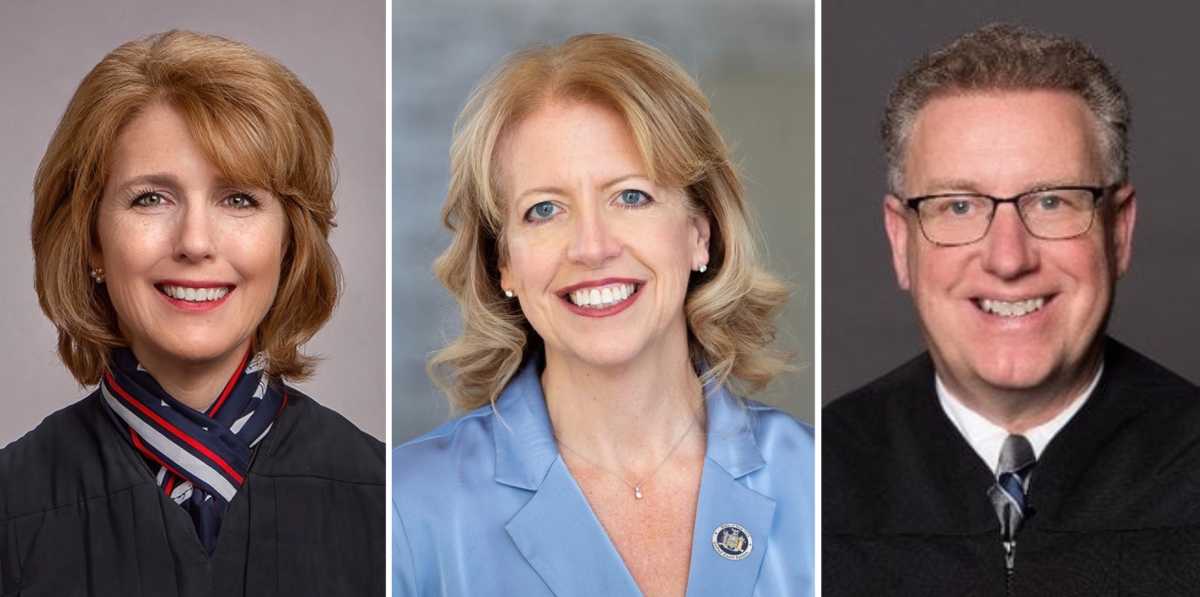
Hon. Debra Young, AJSC (Rensselaer County) is the Statewide Coordinating Judge – Problem-Solving Courts. Hon. E. Danielle Jose-Decker, AJSC (Sullivan County) is the Administrative Judge – 3rd Judicial District. Hon. John Reilly, City Court Judge (City of Albany) is the 3rd Judicial District Coordinating Judge – Problem-Solving Courts.