
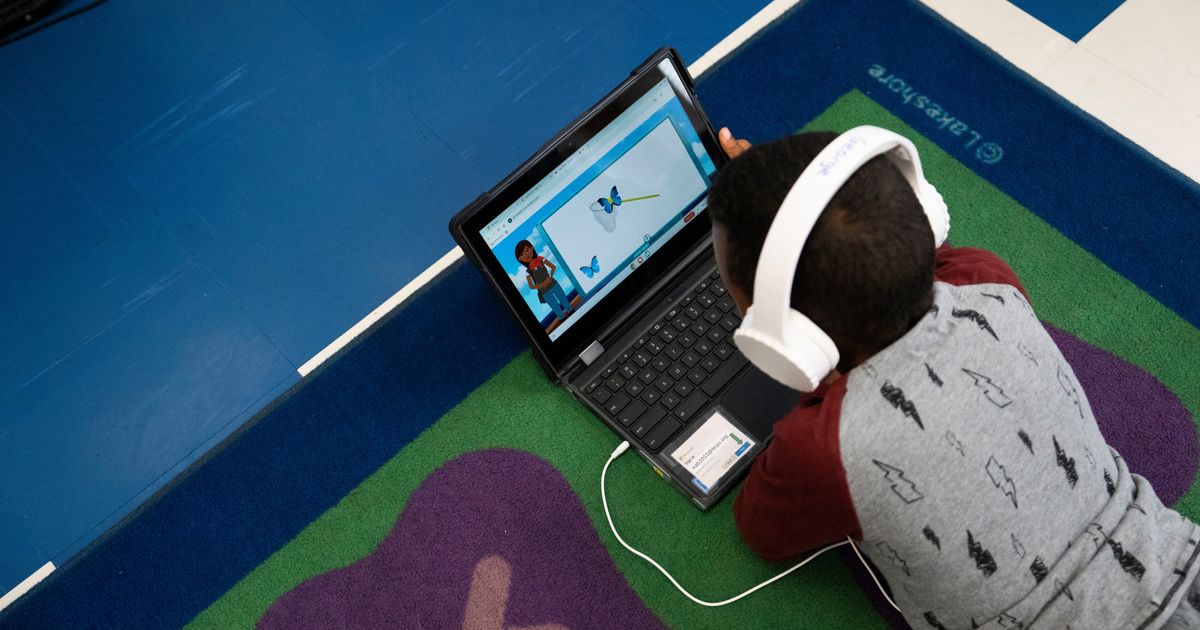
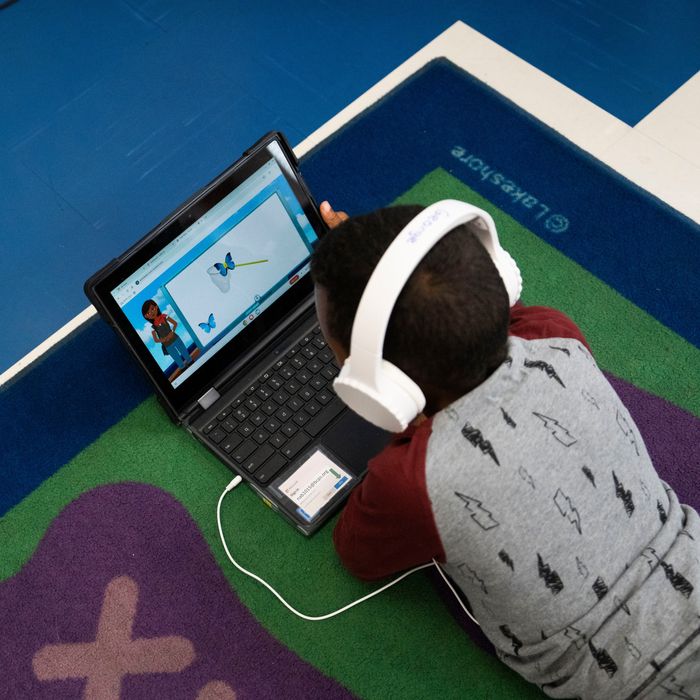
Photo: Kaitlin Newman/The Baltimore Banner
Amira is listening to the kindergarteners read aloud. Her flowy purple hair and her big green scarf frame her face as she teaches the children to read full sentences. A classroom full of 5-year-olds is a hectic place, so kids are advised to speak up — all the better to hear, and correct, their pronunciation mistakes. But Amira is not your average teacher. She is the eponymous avatar of an AI reading app, Amira, that uses the “synergy of AI and neuroscience” to teach kids to read — sort of like Duolingo but for a first language. Since 2024, New York City Schools has implemented the program in around 150 schools across the city. There are now thousands of kids in the city who learn to read in school from an AI-enabled iPad app.
I first learned about the AI incursion into public-school kindergartens from Kevin Dugan, my former colleague. He mentioned that the AI-enabled iPads in his daughter’s classroom in Brooklyn were infuriating parents. There is the continued annoyance of more screen time for kids. But the fact that the app takes recordings of their voices so that it can teach itself how to teach — with the app listening at scale — has taken complaints to a new level. Dugan is one of many parents in the city who feel trapped as their schools go all in on AI. “You’re just teaching children how to use consumer products,” he told me, “not to use their imagination or develop social skills, especially at the level of kindergarten.” (In a statement a spokesperson for Amira said that the app “supports teachers rather than replaces them” and “helps differentiate instruction based on each child’s needs.”)
Earlier this year, Dugan and his wife, Rachel Pelz, learned that they could take their daughter out of AI reading (because Amira collects biometric data, kids’ voices, its use requires parental consent). But the couple couldn’t avoid all AI, they soon discovered. Their daughter was learning to count, in part, from a program called ST Math, another gamified, AI-enabled learning app in use in five schools in New York City. In the ST Math app, kids follow JiJi, a penguin with a green backpack, through a series of point-and-click math games to “improve focus and fine motor skills,” according to the app’s promotional materials. (If a student really loves JiJi, they can buy a stuffed-animal version of their AI math teacher for $20.) The app’s parent company, MIND Education, says that it mines “vast amounts” of data from kids’ interactions to improve its teaching process.
“I don’t think my kid should be drilling multiplication tables, but I think that one of the really important things is learning how to interact with other people and not to get sucked into a screen,” Dugan told me. His daughter appears to enjoying the onscreen AI math games almost too much: “She’s already said to us, ‘You know I love iPad math, but regular math is boring.’”
Dugan is among a growing cohort of New York City public-school parents who view AI use in the classroom as parasitic — siphoning their children’s intellectual curiosity, capacity for boredom, and data in order to make money. “These companies are literally mandated by their corporate charters to maximize profits in any way possible,” said Bridget Kessler, a mom of elementary-school-age children in Flatlands who also serves on her local community-education council. “So how can I trust that they have the best interests of my kids in mind?”
Jessica, a kindergarten parent in Brooklyn who preferred to stay anonymous, says there are also immediate problems when schools off-load teaching to a tablet. “Half the class would get an iPad and they would be learning ST Math, while the other half has the teacher’s attention,” she said. Or at least some of their attention: The teacher was running around helping kids set up their iPads. “When I try to ask about how ST Math is going, my kindergartner spends a lot of time talking about the log-in process,” she said. “Our teachers’ jobs are becoming more about managing these devices versus actually teaching the kids.”
Across the country, many public schools are embracing AI — like the iPad before it — arguing that the technology can level the field for students and ease the burden for overwhelmed teachers. In March, First Lady Melania Trump made the case at the White House for personalized education with AI. It backfired when she debuted a faceless automaton as the future of teaching and talked about “humanoids that deliver utility” in the classroom. But the jokes about the robotic First Lady and her robot friend aren’t stopping a real push in the U.S. toward AI education. In April, President Donald Trump signed an executive order that aims to integrate “AI literacy” beginning in kindergarten and launch a task force in “Artificial Intelligence Education” to boost public-private partnerships to get AI in schools.
Though phones are banned in classrooms across the state, New York City Schools has embraced AI for years. Three years ago, Google partnered with the AI-focused investment firm Global Silicon Valley Ventures to “advance technology” in education — through programs like Amira, which GSV Ventures has a stake in. Top education administrators have joined the Google GSV Education Innovation Fellowship, including superintendent of Manhattan high schools Gary Beidleman and chief academic officer Miatheresa Pate, who is responsible for the city’s AI guidelines. In a policy document from the fellowship, Beidleman advises educators on how to get parents and teachers to accept AI: Find “early adopters and key messengers” to convert skeptics and achieve a “cultural shift” from within. The fellowship’s director declined to comment on the efficacy of AI in schools. But the fellowship document on the importance of AI adoption is riddled with spelling errors: a city in Ohio called “Colubmus,” a discussion of an AI “framjework,” and a headline about “AI literacty.”
“Are they taking over? Yeah, they’re taking over,” Lauren Monaco, a pre-K teacher in Brooklyn, said of AI. A mother of three, Monaco was formerly a kindergarten teacher before the encroachment of ed tech, iPads, and a more strict curriculum meant that “play was almost practically eliminated.” She was part of a petition last month calling for New York City schools chancellor Kamar Samuels and Mayor Zohran Mamdani to enact a two-year moratorium on AI in schools. The petition cited evidence that AI in schools can “undermine” students’ privacy, creativity, and critical thinking. “I think a lot of these principals and superintendents really believed that doing the best for kids meant putting them at the forefront of knowing technology,” she said. “Unfortunately, now we know better. And when you know better, you need to do better.”
Listening to parents of kids in kindergarten, it became clear to me that schools’ growing reliance on AI is a final insult in the yearslong advance of education tech in the classroom. It’s not just that the AI is listening to their kids. It’s that they’re playing gamified math programs that experts say don’t work as they scroll on the same screens that parents are trying to cut down on at home. The pushback is particularly strong at the kindergarten level for an obvious reason: Why would children need an iPad game to learn how to count when tools like building blocks — and other proven methods of tactile learning — are right there? (Many tech executives, and New Yorkers who can afford private school, seem to agree, prioritizing what they call a “low-tech” education for their own kids.)
This cohort of parents may also be particularly incensed because, unlike for the parents subjected to the trials of remote school during the pandemic, the onslaught of classroom iPads has come as a surprise. “I’m the elder parent now, and I see my daughter’s kindergarten friends whose parents, it’s their first kid,” explained Kessler, the parent from Flatlands. “They’re like, ‘Wait, this is not what I’m signing up for. This is not what I want to see my kid doing in school all day.’”
School administrators now have to listen to the parents who are upset about the iPads listening to their kids, too. On April 27, Chancellor Samuels announced that the city would suspend the opening of the AI-focused Next Generation Technology High School amid a wave of criticism and open mockery. Two days later, Samuels and other administrators listened directly to parents at a policy hearing, sitting onstage for over six hours as parents chewed them out in the white-walled auditorium at M.S. 131. (For nonparents, that’s the Guggenheim-looking building in Chinatown next to Time Again.) According to a New York City Schools spokesperson, the hearing was part of a 45-day public-feedback window “to gather meaningful input” from parents before the city decides on a new framework for AI in the classroom. “We remain grounded in a core principle: AI can never replace the care, love, and dedication that defines exceptional teaching,” they added.
When Pelz, Dugan’s wife, came to the microphone, she had her young son in her arms and her kindergarten-age daughter at her feet. “You are experimenting on our children,” she told Chancellor Samuels. School administrators are telling parents “that AI is inevitable,” she said, but when Pelz asked about specifics, no one had answers. How are AI-based learning programs learning from her children? What do the programs really help her kid learn? “If it is so good for my children, why is it a secret?” she asked. Every few sentences, she shifted her son, now sucking his thumb, back onto her hip. She warned of a “groundswell” of rage from public-school parents as the city stocks classrooms with AI-enabled screens: “My kindergartener has been given an iPad. It came home in her backpack. Shame!”
Parents clapped for everyone who pushed back on the inevitability of AI in the classroom. The loudest round of applause was for Dina, a 6-year-old in a pink dress who walked up to the mic but froze and turned to hide her face in her dad’s sweater when it was her turn to speak. After a moment of terror, she gained the confidence to give her message about AI-enabled iPads during indoor recess.
“We look at screens all day, so it’s not actually good for our brains,” she said. “So I think with indoor recess we could do something more fun.” She was gaining momentum, and the crowd cheered her on. “You could play with a friend, you could bring toys,” she said. “Or you even could read.”
Related