
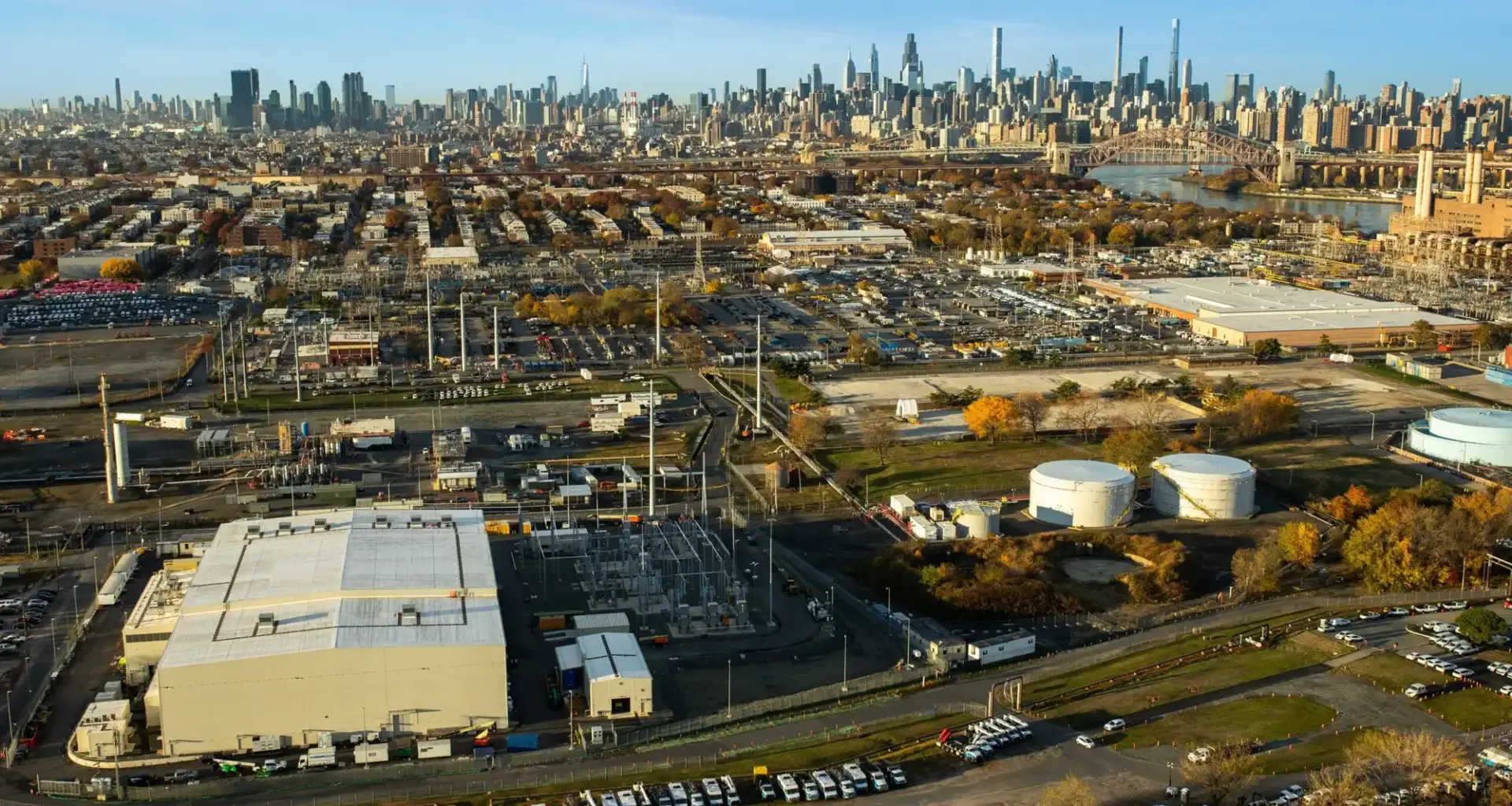
Bob Harrison pushes open the door to a 70-foot tall industrial building in Astoria, Queens near the East River, revealing an array of electrical equipment spread out across a massive room. But what Harrison really wants to point out is a pair of black cables sticking out of the ground at one end of the space.
“Those are the cables that come from Quebec,” he says.
To get them to this room, Harrison’s team designed special barges to drop the cables to the bottom of Lake Champlain. They buried them at the bottom of the Hudson River, and along roadways and railroad tracks in upstate New York. They drilled a hole from either side of the East River to meet in the middle, “and we were off by about an inch, which is pretty spectacular,” Harrison said.
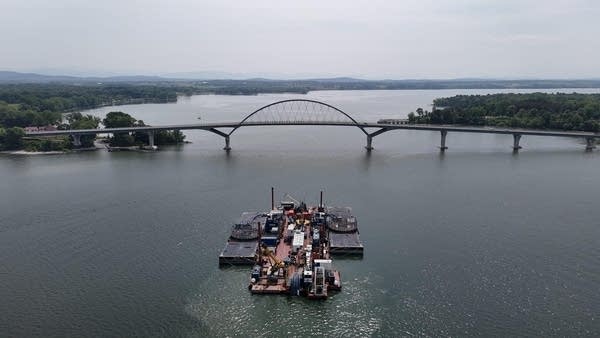
The developers of the Champlain Hudson Power Express (CHPE) built special barges to install power cables at the bottom of Lake Champlain, seen here near Crown Point, NY
All that, to bring electricity over 330 miles from Quebec to New York City. The new power line is called the Champlain Hudson Power Express, and soon it will provide enough electricity — primarily generated by hydroelectric dams — to power 1 million New York City homes. Harrison has been working on the line for over 11 years.
“If you look at me, I’m an old, gray haired guy,” he said. “ I have spent 25% of my professional career trying to get this project across the finish line.”
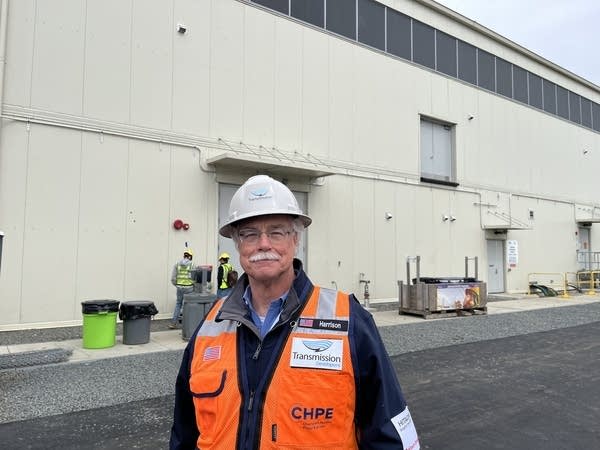
Bob Harrison, head engineer of the Champlain Hudson Power Express, has been working on the project for 11 years.
Henry Epp/Marketplace
When it officially switches on, likely in June, CHPE will be the second of two transmission lines connecting the northeast to Quebec’s grid to start delivering electricity in 2026. A line to Massachusetts powered up in January. Both lines have been in the works for over a decade. But in the years since they were proposed, the dynamics in the energy market of the northeast of North America have changed.
A decade ago, however, the connections made perfect sense.
At that time, Hydro Quebec, the government-owned utility north of the border that operates massive, decades-old dams in the north of the province, had plenty of energy to spare.
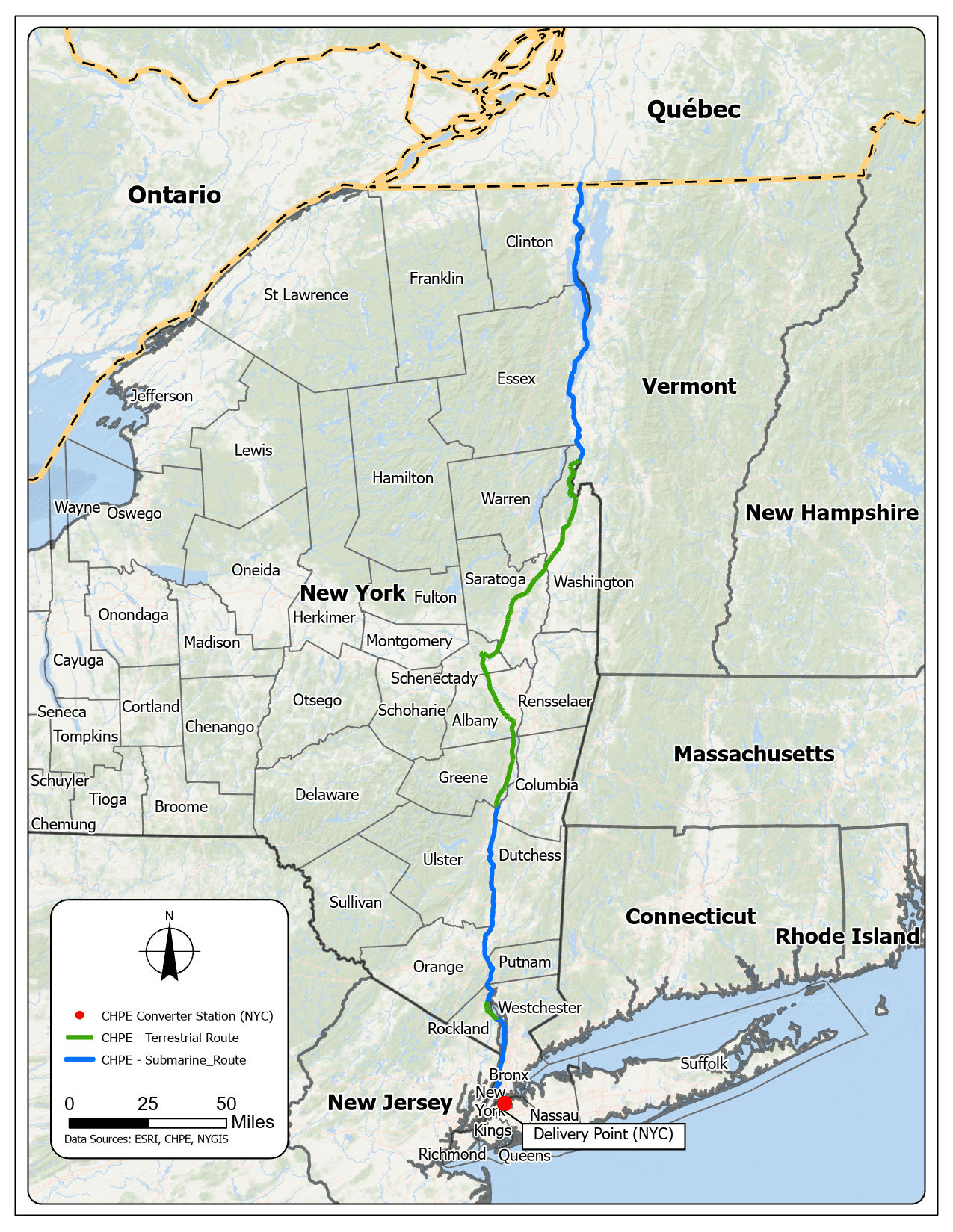
The new Champlain Hudson Power Express (CHPE) line runs from Quebec down to New York City, including stretches beneath Lake Champlain and the Hudson River.
Courtesy TDI CHPExpress
“We had almost 15 years of above average water inflows in terms of rain coming into the reservoir of Hydro Quebec,” said Pierre-Olivier Pineau, a professor of energy sector management at the business school HEC Montreal. “It gave an illusion of plentiness and abundance of hydropower.”
So, the government of Quebec sought to sell off some of that perceived abundance to the northeastern U.S., where states, like New York and Massachusetts, were looking to get away from fossil fuels.
“We export relatively cheap hydro to the U.S., they pay us, and they decarbonize,” Pineau explained. “So, everyone wins.”
But 11 years later, now that the lines are finally installed after years of construction and local pushback, Quebec’s energy surplus is not what it used to be.
Much of the province has been in a drought for three years, so there’s less water the utility can pass through its dams. Meanwhile, there are new industries and data centers north of the border that also want cheap hydropower, Pineau said. Plus, Quebec has decarbonization goals of its own.
“So now, these lines are not seen as such good deals, because people are starting to think, ‘Well, we actually need the electricity in Quebec to decarbonize,’” Pineau said.
While Hydro Quebec is meeting all that domestic demand, it also needs to fulfill its contracts to send power to the south for the next 20-plus years.
Despite the run of dry years, Serge Abergel, COO of Hydro Quebec’s U.S. arm, said the utility is in a good position to manage its power supply.
“We always manage it in a way to make sure that we have enough power to meet our firm commitments,” he said. The company is also planning to invest billions in new hydro, wind, and solar generation over the next decade.
Meanwhile, New York and Massachusetts are counting on ample power supplies from the north.
“This is going to meet 20% of the region’s electric needs. That’s very substantial for a single project,” said Erin Smith, clean grid director at the Environmental League of Massachusetts.
The new transmission line to Massachusetts, called the New England Clean Energy Connect, will take a huge bite out of the state’s mandate to cut carbon emissions from the electric sector. But it can’t do the whole job by itself.
“It’s a piece of the bigger clean energy portfolio,” Smith said.
The rest of that portfolio, however, isn’t developing as smoothly or as quickly as policymakers had hoped. In particular, offshore wind.
Without more of that source of electricity, the new transmission lines are, for now, even more important to the region, said Marc Montalvo, head of the energy consultancy Daymark Energy Advisors.
“They were going to be two parts of a much bigger set of things, and now they look like they’re the things,” Montalvo said.
The new CHPE line in New York, built by a subsidiary of the asset management company Blackstone, will allow the city government to claim progress towards a looming deadline: Cut or offset its carbon emissions by 50% by 2030.
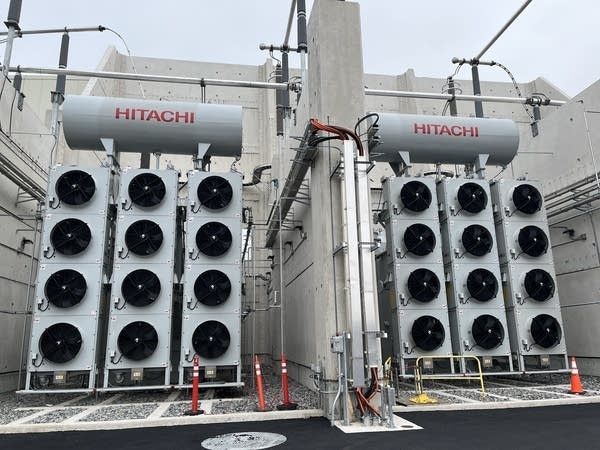
The CHPE converter site includes several transformers used to step down electricity to the voltage used on New York City’s grid.
Henry Epp/Marketplace
“This project, CHPE, is going to be instrumental in helping us meet our 50% mandate ahead of schedule,” said Sana Barakat, New York City’s deputy commissioner for energy management.
It expects to meet that requirement by next year. That’s because the state has set up a system allowing the city to buy up to $6 billion worth of renewable energy credits over the next 25 years, generated by the new power from Canada.
That money, in turn, will pay off the cost of building the CHPE line, Barakat said.
Beyond cutting carbon, the project could also address other problems in New York’s energy market: High prices and a lack of diverse resources.
“At the moment, New York City, in the power market, is like a small town with one grocery store,” said Robert McCullough, an energy industry consultant. “The prices are phenomenally high. The best way to solve high prices is to bring more sellers into the market and that’s what the new line does.”
Hydro Quebec is under contract to sell to the New York market for the next quarter century at rates that rise about 2% per year.
“This is the beauty for New York of a contract like this: It brings you stability and predictability for the next 25 years,” said Hydro Quebec’s Serge Abergel.
Over time, the Canadian power could end up being a lot cheaper than other energy sources, he said, especially on days when lots of residents turn on their air conditioners.
“On those hot summer days, you’re going to get this supply of power at a much lower cost than where the market is at,” Abergel said, which could put downward pressure on electricity prices in the New York market as a whole.
Hydro Quebec, and the developers of CHPE, are already looking beyond the two-decade contracts with the states. For now, both lines will only deliver power from north to south. Over twenty years from now, however, once those contracts expire, the power lines could wind up running in the opposite direction.
If New York and Massachusetts manage to build out more wind and solar by that time, it might be the U.S. that occasionally has surpluses of power. States could send those surpluses north, especially in the winter when Quebec typically uses the most electricity, said CHPE’s head engineer Bob Harrison. That would allow Hydro Quebec to hold back more water, which it could release later when the states are in need.
“So there’s a thought that in the winter, you could send power north, and in the summer, send power south, but that’s way in the future,” Harrison said.
By then, it’ll be a different engineer’s job to sort out the details.
Related Topics