
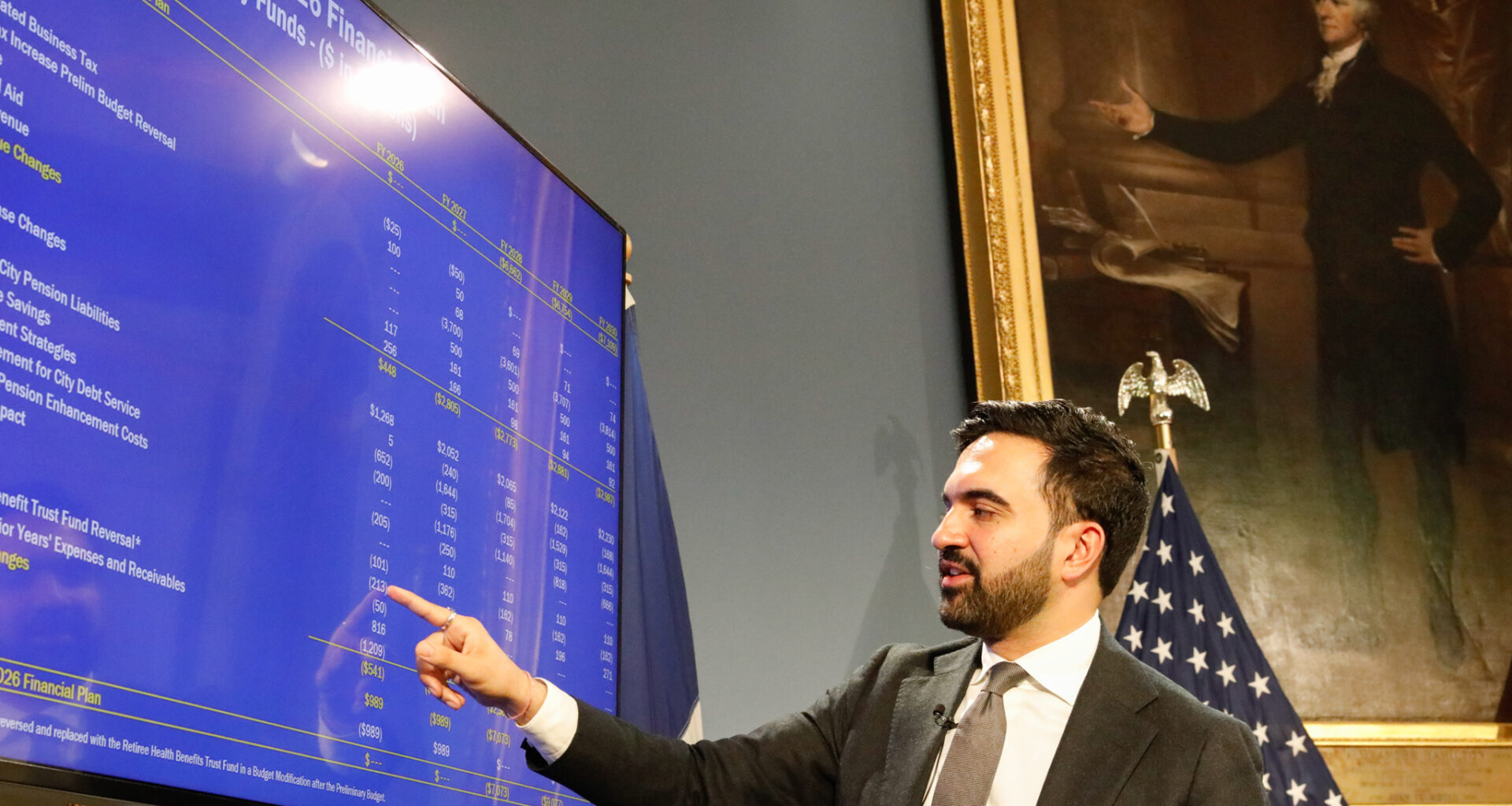
Mayor Zohran Mamdani dropped his threat to hike property taxes as a way to close the budget gap after Gov. Kathy Hochul promised additional aid for his $124.5 billion spending plan.
The city budget includes an additional $4 billion in support to close the gap, totaling nearly $8 billion over two years.
That money is through $352 million in direct aid, $3.2 billion from programs that require state authorization and $500 million in new revenue — enough to close the $12 billion budget gap for the next two fiscal years that Mamdani inherited from his predecessor.
“I am proud to announce that we have closed the gap entirely, down to zero,” the mayor said at a press conference Tuesday.
“It hasn’t been easy but we have balanced the budget and we have done so without placing the burden on the backs of working New Yorkers.”
The mayor thanked Hochul, State Senate Leader Andrea Stewart-Cousins, State Assembly Majority Carl Heastie and Council Speaker Julie Menin for their help and partnership, along with “the movement that carried us to City Hall.”
The budget, he said, “is evidence of a new era of government in our city, one that can balance both ambition and fiscal responsibility.”
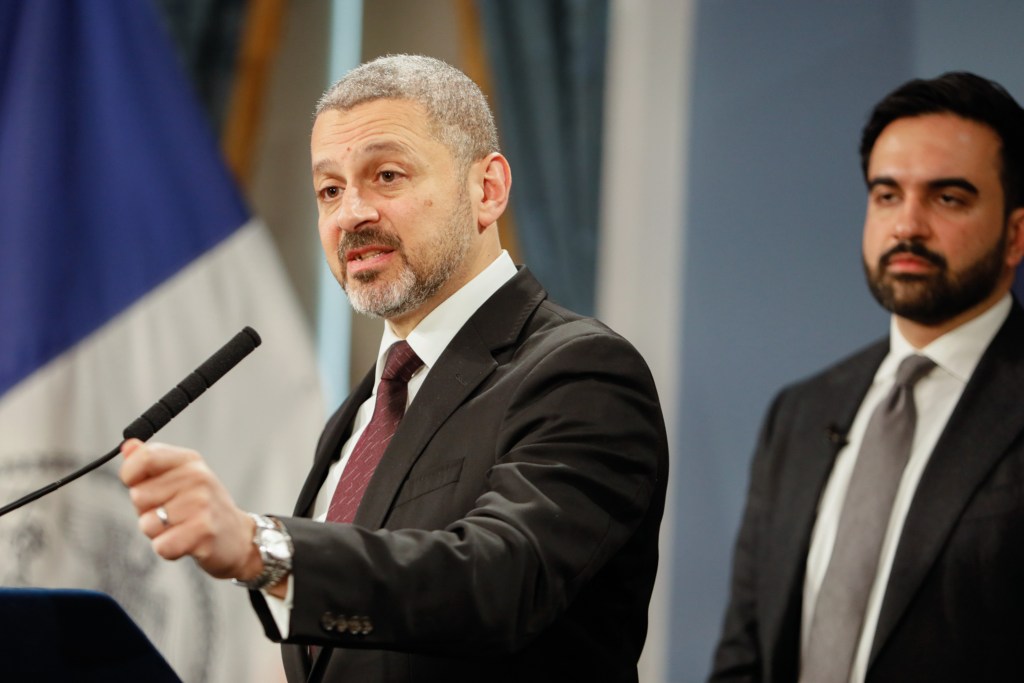 Mayoral Budget Director Sherif Soliman discuses the executive budget at City Hall, May 12, 2026. Credit: Alex Krales/THE CITY
The mayor’s budget manages to close a $5.6 billion shortfall for this fiscal year and an estimated $7 billion gap for next year without new income taxes for the wealthy and for corporations that he had demanded from Albany, and without raiding the city’s financial reserves.
Jabs at the Wealthy
But Mamdani said they are taxing the rich through other changes, like a pied-à-terre tax on luxury second homes that is estimated to bring in $500 million in new revenue.
There is also a proposal to reduce the Unincorporated Business Tax credit, known as UBT, which he noted mostly benefits millionaires. Reducing the tax credit will bring in an estimated $68 million, according to the mayor.
“These are common sense measures,” he said. “Working New Yorkers cannot be asked to sacrifice as we sit in the wealthiest city in the wealthiest country in the history of the world.”
Pension Moves
Other revenue and savings comes from the state taking over expenses that shifted to the city years ago, like line of duty death benefits for families of first responders killed on the job, saving the city $202 million. There’s also an additional $600 million in youth programming and $300 million to restore money for sales tax intercepts.
The city will also seek state approval for pension amortization, which could save more than $2 billion by restructuring some payments over the next two years, which Mamdani assured wouldn’t affect benefits for current or retired city workers.
“I think there’s a logic to smoothing out payments,” city Comptroller Mark Levine said Tuesday morning after a budget briefing with the mayor and his team.
“I think it’s easier to plan for the long term when you have a smooth payment schedule.”
 Council Speaker Julie Menin and Mayor Zohran Mamdani speak at City Hall about reaching a deal on a budget extension, April 28, 2026. Credit: Alex Krales/THE CITY
More than $1 billion in savings comes through a delay in the state’s mandated cap on class sizes which would require hiring more teachers and administrators. Last year, the city approved hiring 3,700 more teachers and 100 more assistant principals.
Mamdani added more money to hire 1,000 additional teachers and $1.5 billion to the $7.6 billion existing budget for the School Construction Authority’s five-year capital plan.
The mayor is also working to rein in spending on some students whose private school tuition is paid for by the city when it’s found they can’t receive the same special education services at public schools.
The cost of what’s known as “Carter” and “Connors” cases – depending on how the money is paid out – has increased 300% over the last decade, according to data obtained by Chalkbeat. Tuition costs can go as high as $144,000 per student.
To address this rising number of students, the Department of Education will invest more money in special education needs, like speech and occupational therapy, the mayor said.
Another major rising cost to the city’s budget is housing vouchers, specifically through the City Fighting Homelessness and Eviction Prevention Supplement, or FHEPS, program.
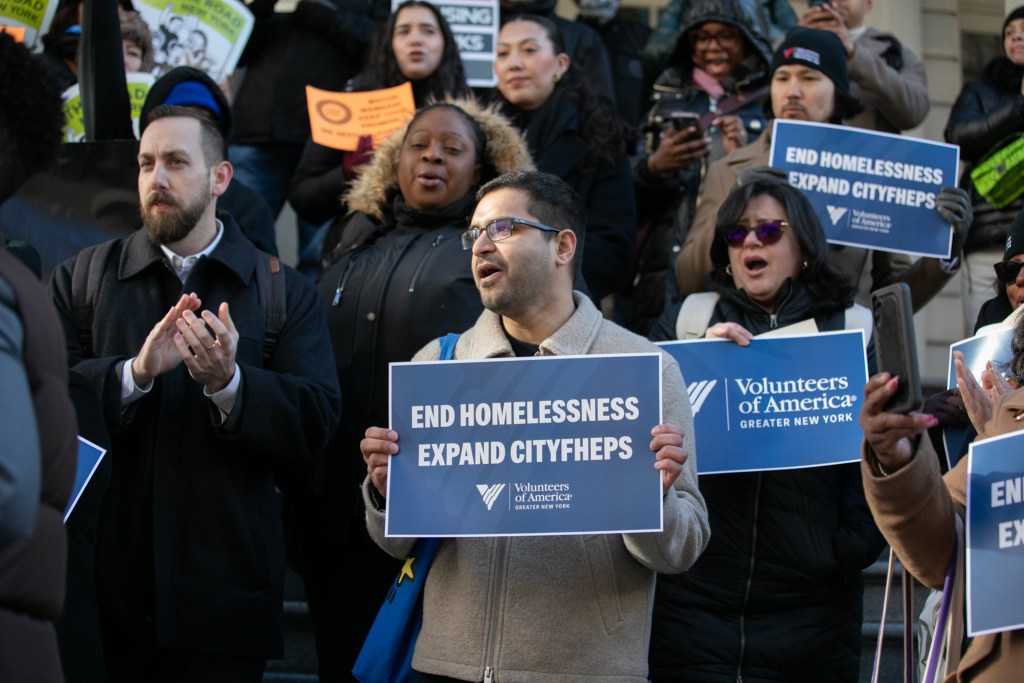 Anti-homelessness advocates rally at City Hall in favor of funding for the CityFHEPS rental voucher program, March 17, 2026. Credit: Ben Fractenberg/THE CITY
The mayor is fighting a legal battle against implementing a package of laws the City Council passed in 2023 to expand eligibility for the vouchers. He promised to put the laws into effect as a candidate, but reversed once he took office due to budget pressures.
Around 68,000 households rely on CityFHEPS vouchers, while another 47,000 could end up depending on the program if it’s expanded.
Mamdani plans to save $519 million within CityFHEPS, mostly through administrative changes, he said.
The mayor announced new spending in his budget, including $40 million for the Office of Community Safety and $26 million towards hate crime prevention.
‘Conservative’ on New Spending
Levine, the comptroller, said there was a lot of “good news in this budget” but he was still cautious.
“We are entering into very uncertain economic times because of the threat of a recession and the impact of AI, and I want us to build a very strong fiscal foundation that grows reserves,” he said.
“There still is a reliance on a number of one-shot measures, and those are tools that are then going to be off the table next year. And we are looking at about a $7 billion shortfall for the following fiscal year.”
Levine did praise the mayor for his “pretty modest” additional spending.
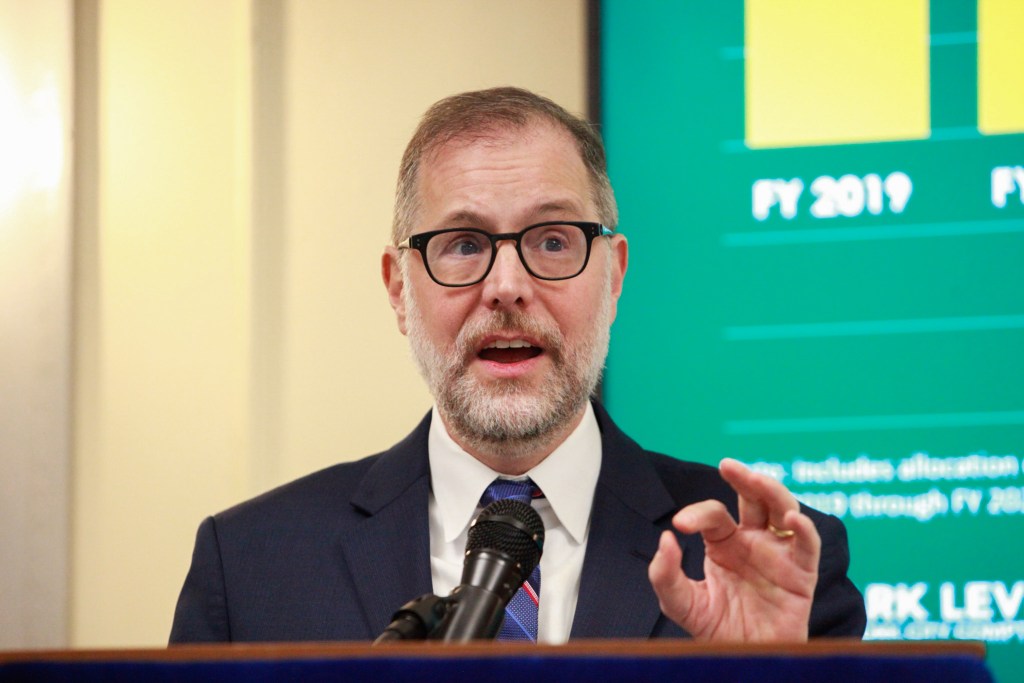 Comptroller Mark Levine speaks at the Municipal Building about the budget, Jan. 16, 2026. Credit: Alex Krales/THE CITY
Some of the additional money includes $31.7 million to the three library systems, $15 million to the Parks Department, $10 million to cultural organizations and $15 million to the City University of New York.
“It’s been a while since we’ve seen a mayor be this conservative on new spending,” Levine said about the spending. “It reflects why we’re in a better place today than we were in February.”
Mamdani had floated a property tax increase as a last-resort option to raise money to fill the gap, as Gov. Hochul continued to resist raising taxes.
Raising the property tax rate, which has not been done since Mayor Michael Bloomberg, is one of the few levers the mayor has to raise revenue. It was met with immediate backlash and was unlikely to pass in the Council.
Hochul’s help to the city benefits the whole state, she said at an unrelated event Monday.
“He inherited a pretty significant financial mess,” Hochul said.
Public Advocate Jumaane Williams took a cautious approach to the promised state aid.
“I think until that budget is passed, you don’t know if all that money is real,” he said following his briefing.
Related