
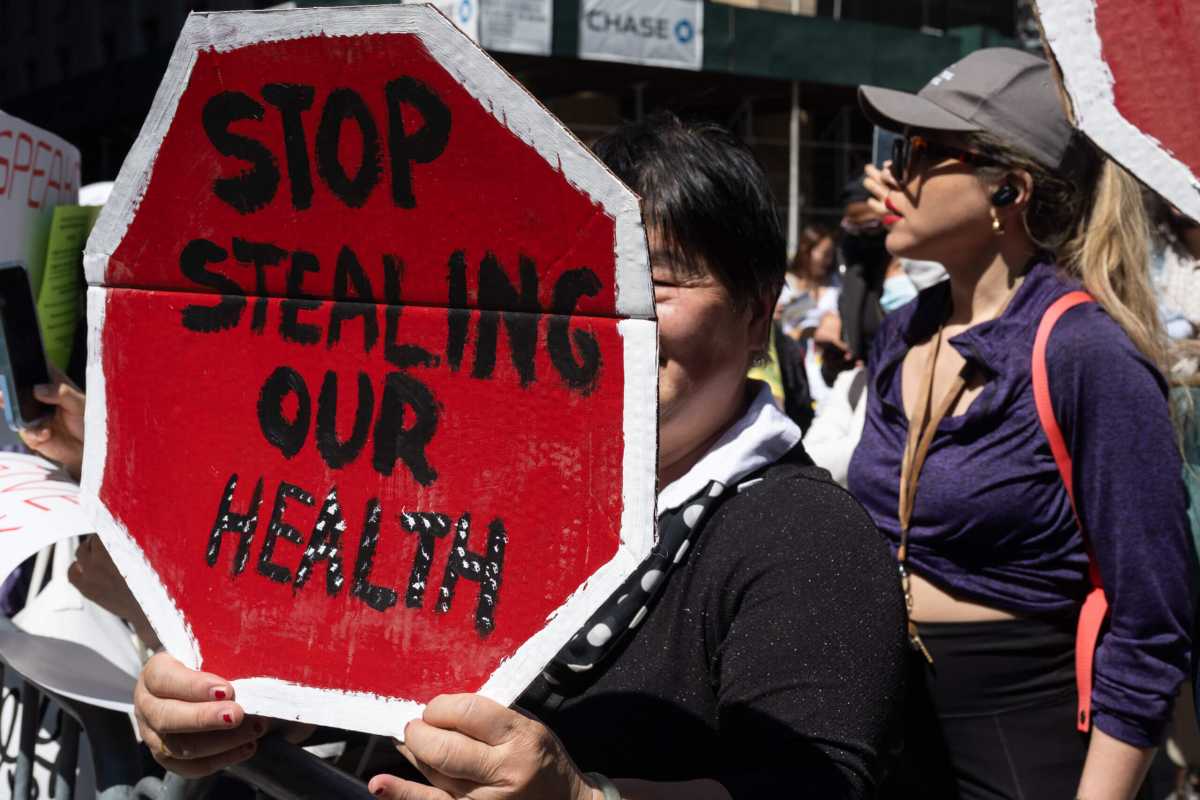
Two more New York City Council members withdrew their support this week for Intro. 303, the “No More 24” bill that would ban 24-hour workdays for home healthcare workers, bringing the number of co-sponsors who have abandoned the bill up to five since April.
Council Member Elsie Encarnacion (D-Bronx) pulled her support for the bill on Monday, while her colleague in the chamber, Ty Hankerson (D-Queens), formally withdrew his support on Tuesday evening.
The legislative exodus stems from concerns about the language and financial realities of the bill in its current form. Intro. 303 wrestles with the needs of two vulnerable groups of New Yorkers: home health workers who are often low-income, immigrant women, and people who require round-the-clock healthcare, often the elderly or people with disabilities.
Under a state law known as the 13-hour rule, employers are allowed to pay workers for only 13 of a 24-hour home health shift, with the other 11 hours accounting for rest and meal breaks, given that a certain number of hours are interrupted periods of rest.
Added to the broader economic pressures facing both workers and care recipients alike, and the debate over the bill has become increasingly contentious.
The bill’s supporters said that failing to pass “No More 24” enables wage theft, puts care workers at risk of deteriorating health, and leaves thousands of workers trapped in a cruel system that devalues their work.
But opponents of the bill, such as The Legal Aid Society, argue that the bill, as currently constituted, puts those in care at risk. The group applauded Encarnacion and Hankerson for being the latest to pull their support.
“Their decision to withdraw support for the bill reflects a growing understanding that, as currently drafted, Intro. 303 could jeopardize access to essential home care services for older adults and New Yorkers with disabilities while failing to provide a workable solution for workers,” The Legal Aid Society said in a statement.
Since Hankerson’s exit from the list of co-sponsors, a spokesman for the Legal Aid Society also emphasized that the bill now lacks any council support representing the Committee on Civil Service and Labor, the committee which stalled the bill following a hearing in February.
Hankerson and Encarnacion’s withdrawals from the bill followed Council Members Farah Louis, Shahana Hanif, and Sandy Nurse pulling their support from the bill in recent weeks. Hankerson reportedly told The City last week that he would pull his support for the bill if it wasn’t altered to include an amendment which allowed some workers to get a waiver allowing them to work 24 hours.
But Hankerson told amNewYork Wednesday that his decision to formally drop out as a cosponsor didn’t hinge on one specific thing.
“The fundamental problems with this bill run much deeper,” Hankerson said. “The City Council does not have the power to make these changes unilaterally.”
He reiterated a chorus of concerns which noted that funding for home care workers is issued largely through insurance companies and funded with state Medicaid dollars.
Estimates put the cost of splitting each 24-hour shift into two 12 hour shifts at $460 million, according to SEIU.
“This bill would force agencies into an impossible position: either stop providing care to nearly 14,000 vulnerable New Yorkers who depend on it, or violate the law,” Hankerson said. “It simply would not be right to pit workers against care recipients and pray that the state would come in and fix the funding gap we created when both deserve better.”
Many workers serving vulnerable New Yorkers, however, have thrown their weight behind the bill, waging weeks-long protests and even hunger strikes to draw eyes and hearts to their cause. Their sustained efforts were realized back in March following a protest, when Council Speaker Julie Menin all but promised that the bill would be put to a vote in April.
Yet, increasing skittishness around No More 24 have put advocates’ hope on hold. For home health workers advocates at Chinese Staff & Workers’ Association (CSWA), a leading voice in support for the bill, arguments over funding amounted to excuses. Zishun Ning, an organizer with CSWA told amNewYork that workers cannot bear the physical or financial toll of working 24-hour shifts any longer.
“ Many of these workers become disabled themselves by working these shifts so that the insurance companies and home care agencies continue to make a huge profit by stealing the wages from the workers,” Ning said.
Multiple lawsuits appear to support Ning’s claims. Despite state laws that require a certain number of uninterrupted hours of rest for 24-hour shifts, the Legal Aid Society won a $600,000 settlement in 2021 against a home health care services agency for six workers who worked more than the legally allowed hours in their 24-hour shift, but were not paid accordingly.
Again in 2023, the New York State Department of Labor won settlements totaling over $113,000 on behalf of two home health aides in Brooklyn and Staten Island who were “denied adequate sleep time” and underpaid as a result.
“ Sleep deprivation is a form of torture and what they’re [workers] experiencing, the consequences they suffer from these 24-hour shifts—it is torture,” Ning said. “So that’s got to end. That’s why there’s so much urgency. And I think that reflects on the hypocrisy and the shamefulness of all this opposition.”