
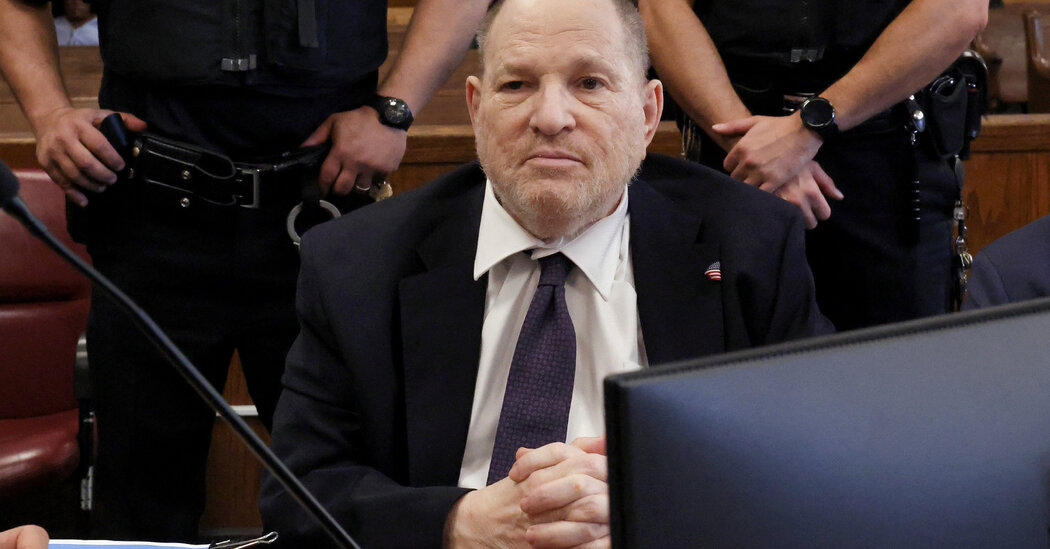
A Manhattan jury on Wednesday began deliberating whether Harvey Weinstein raped an aspiring actress in a hotel room over a decade ago — the third time a jury in New York is considering the case.
Mr. Weinstein, the disgraced Hollywood producer, was convicted of the rape of Jessica Mann, the aspiring actress, in 2020 during his first trial in New York, but the verdict was overturned. Following the second trial last year, the jury was deadlocked on that count, and the judge ordered a new trial.
This week, after a monthlong trial and testimony from nearly 20 witnesses, a lawyer for Mr. Weinstein, 74, and a prosecutor with the Manhattan district attorney’s office delivered their closing statements.
Mr. Weinstein — who his lawyers have said is battling a host of medical issues — has insisted that he never sexually assaulted any of the women who have accused him. He has told the judge overseeing his latest trial that his situation “feels like a slow march to my death.”
Earlier this year, Mr. Weinstein hired a new legal team from a firm that has defended other high-profile people, including Sean Combs, the fallen hip-hop mogul, and one of the Alexander brothers, who were convicted of engaging in a conspiracy to traffic women for sex.
In his closing statements to the jurors on Tuesday, one of the lawyers, Marc Agnifilo, said Mr. Weinstein and Ms. Mann had a consensual relationship, where she asked him for help and he “helped her in every conceivable way” for years. The couple was on-and-off again, he said, and Ms. Mann felt conflicted throughout.
But when news broke in the fall of 2017 that Mr. Weinstein had been accused of assaulting other women, Ms. Mann was going through her own crisis, he said. As she saw the reports, Ms. Mann decided to say that she was also assaulted, Mr. Agnifilo told the jurors.
“Is she lying? Yeah, maybe,” Mr. Agnifilo said, adding “but there’s affirmative evidence that it did not happen.”
But as Mr. Agnifilo spoke, a male juror in the front row rarely looked at him. At one point, Mr. Agnifilo said he did not know any woman who believed that “giving a man a massage will de-escalate the situation.” The juror visibly reacted, leaning back in his chair. He rolled his eyes toward the ceiling, a motion he repeated throughout Mr. Agnifilo’s statements.
Mr. Weinstein’s downfall was seen as a critical moment in the #MeToo movement, which demanded accountability for sexual harassment and assault in the workplace. His return to court in New York marks the most recent development in a legal drama that has taken many turns as it has unfolded over the better part of a decade.
But the public and media attention around his case has diminished as Mr. Weinstein has repeatedly returned to courthouses in New York and California.
He has been in jail or prison since his conviction in New York in 2020, including during a trial in California, where he was convicted of sexual assault in 2022 and sentenced to 16 years. He is appealing that verdict.
In New York, he was convicted on a single count of criminal sexual act last year, and the judge overseeing that case, Justice Curtis Farber, is awaiting the conclusion of Ms. Mann’s case to sentence Mr. Weinstein.
Just before a lunch break on Tuesday, Nicole Blumberg, an assistant district attorney, began making her closing statements. The Manhattan district attorney, Alvin L. Bragg, sat in the back of the courtroom watching.
Throughout the afternoon, Ms. Blumberg pushed back at Mr. Agnifilo’s characterization of what happened between Ms. Mann and Mr. Weinstein. Because Ms. Mann had a relationship with the former producer that was at times consensual, that does not mean she was not raped, she said.
“Whether you’re in a hotel room with somebody or not, you have the right to say no,” Ms. Blumberg said. “Jessica Mann said no over and over and over again.”
The defense’s arguments, Ms. Blumberg said, were “ultimate victim blaming.”
For the third time, Ms. Mann testified about the day in 2013 when she says Mr. Weinstein raped her.
Ms. Mann testified that she first met Mr. Weinstein when she was about 27, after moving to Los Angeles to pursue a career in acting. Shortly after, she said, he pressured her into giving him a massage.
In 2013, she was visiting New York and had planned a morning meal with friends and the producer. He arrived early and got a hotel room despite her objections, Ms. Mann testified.
Nonetheless, she went with him to the room, where he injected his penis with medication that produced an erection and then raped her, she said. She tried to fight, she said, but eventually “I just gave up. I wanted to get out.”
The testimony and evidence in this trial has been similar to the past two times Ms. Mann’s case has been presented. But this time, in an effort to discredit her testimony, Mr. Weinstein’s lawyers introduced a note she wrote on her phone labeled “Thoughts; Violation of emotions,” which had not been presented at either of the previous trials.
In the note, written two days after Ms. Mann says she was assaulted in the Manhattan hotel room, she said that she “let myself become emotionally attached to someone” and “the actions vs. how I feel towards this one person has conflict in my life.” Ms. Mann did not mention rape or name Mr. Weinstein in the note, but she did not dispute during cross-examination that it had been written about him.
The note was never meant to be seen, Mr. Agnifilo said on Tuesday. She was writing about how she was falling in love with Mr. Weinstein, he said, and her conflicted feelings over the relationship.
“God forbid, if she had been raped, she couldn’t possibly write this,” Mr. Agnifilo told the jurors.
During her testimony, Ms. Mann said that the note reflected that she “struggled with some of the decisions that I was making that were different than what I was raised with.”
Her testimony remained consistent over the three Manhattan trials, including her description of a complicated relationship with Mr. Weinstein in the years that followed the hotel room meeting. Their interactions included friendly email exchanges, phone calls and several consensual sexual encounters, she said.
In her testimony, she called it a “dance” in which she tried to keep him both happy and at a distance. At one point, Ms. Mann said, she decided to enter a romantic relationship with him.
Throughout her five days of testimony, Ms. Mann took breaks and at times cried on the stand.
Ms. Blumberg, in her closing, pointed to the toll she said testifying had taken on Ms. Mann. Ms. Mann had “absolutely no motive to lie in this case,” she told the jurors.
“All it did was cost her,” Ms. Blumberg said.