
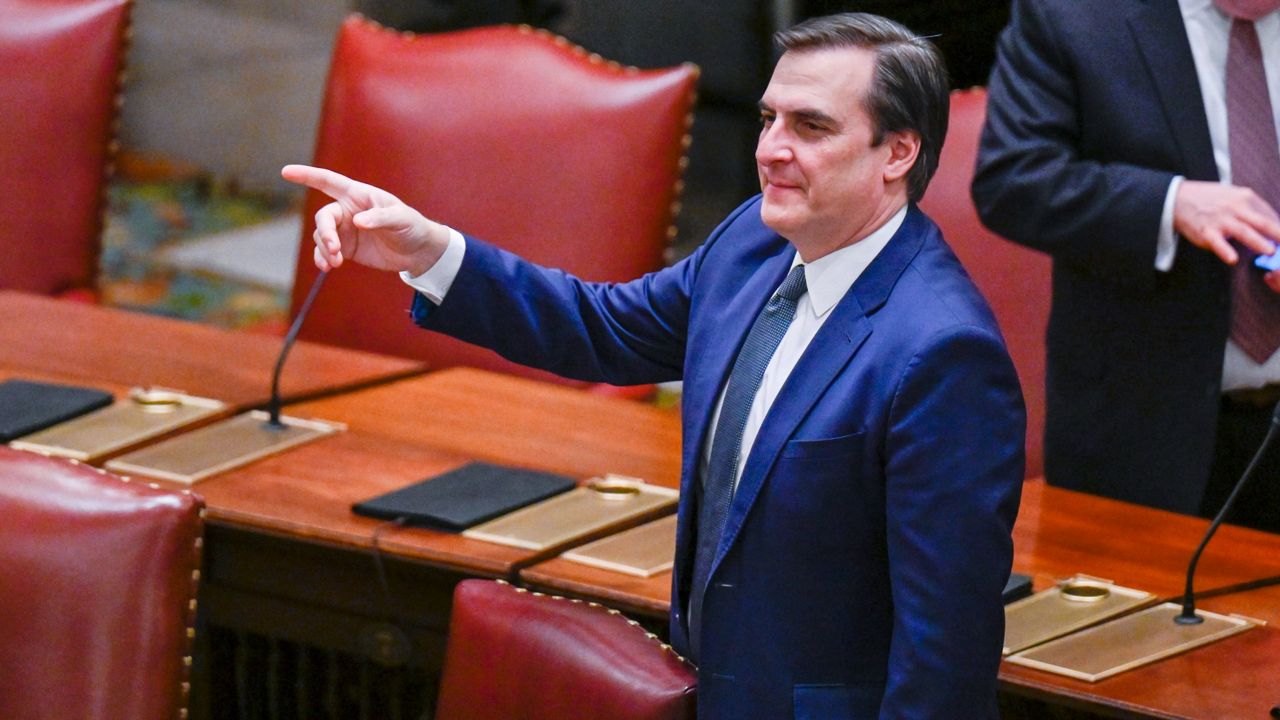
After New York state lawmakers in the Democrat-led Legislature passed a 12th budget extender, punting the deadline for a state spending plan to Monday, Deputy State Senate Majority Leader Mike Gianaris told reporters that widespread hopes of finalizing the process by next week appeared to be evaporating.
“Very slim,” he said when asked what he felt the chances were that the budget could be wrapped up by the end of next week. “I hope we start voting on bills next week, but that’s not certain.”
The budget was due April 1 and is New York’s fifth straight late budget, and the latest since 2010. That budget, passed under former Gov. David Paterson in the aftermath of the Great Recession, was the last in a string of chronically late budgets that characterized the period between the mid-1980s and the early 2000s, with a few brief interruptions.
The stubborn toughness of this budget fight has perplexed lawmakers, given the absence of the type of hot-button criminal justice policy fights that have colored Democratic Gov. Kathy Hochul’s late budgets in recent years. Instead, negotiations have focused on Hochul’s policy proposals around car insurance rates, loosening environmental quality review standards and rolling back the state’s climate law — with a battle over an immigrant protection package folded in after it stalled earlier in the legislative session.
With that, many key lawmakers predicted an easier negotiating process this year — some even going as far as to say the budget would be on time. Gianaris, for his part, has consistently batted away suggestions in recent weeks that this year’s budget process is turning out to be meaningfully more problematic than last year, when Hochul signed the budget into law on May 9.
“Oh no, it is. I think I was more optimistic when I said that,” he said.
The prolonged slog is threatening to eat up nearly every moment of budget-free time the Legislature has left to work with in a way not seen in years, but both Gianaris and Assembly Speaker Carl Heastie told reporters that the delay will not stop the state from taking up a long-anticipated constitutional amendment to potentially allow mid-decade redistricting and potentially change parameters around the state’s Independent Redistricting Commission.
The anticipated first passage of the amendment this year has been billed as a response to President Donald Trump’s pressure campaign for Republican-led legislatures to redraw maps to favor the GOP ahead of the midterms.
“Oh, we’re definitely doing redistricting,” Heastie said.
Gianaris said that because the remainder of the session is so compressed, the two components of the amendment — which would not have an impact until 2028 if approved by voters after a second passage next year — may move forward as a menu of options. Hochul and legislative leaders are working together with Democrats in Congress on the effort.
“I think we’ll have something before the session is out,” he said. “Because our time is so short, there is some school of thought that maybe we pass multiple versions to create the options for second passage next year, but that’s still under consideration.”
Republicans in the state Legislature, including Senate Minority Leader Rob Ortt, have resisted the attempt, despite its roots in Trump’s push.
“The voters have spoken on this. The voters want independent redistricting. They have voted to not have the Legislature pass redistricting,” he said, adding that the sequence of events that led to legal chaos around New York’s maps in 2022 and 2024 suggests Democrats are insincere in their crusade against Trump’s initiatives.
Gianaris defended New York Democrats’ venture into the redistricting fight Thursday.
“We have elections in this state like everywhere,” he said. “The people have chosen to provide substantial Democratic majorities in both houses of the Legislature and the governor’s office, which means our actions and our judgment are representing the people who elected these bodies.”
When it comes to when the budget process will wrap up and allow legislative resources to focus on such issues uninhibited, Heastie was a bit more optimistic.
“I’m hoping we can get this wrapped up and actually be passing bills by the middle to end of next week,” he said.
While the conventional wisdom in Albany is that once policy debates are settled, fiscal discussions move quickly, there is still much left to be done one week after Hochul announced a “general agreement” on those major policy issues, leading to a public spat with Heastie over policy in the budget and the timing of her announcement.
“I was very specific when I came out and said there is still a lot of details to be worked out,” she said this week.
Moving the needle, Hochul on Thursday unveiled key details around her proposal for a tax on second luxury homes in New York City as it became clear that the budget will also likely include a new tax on cash real estate transactions in the city and possibly elsewhere in the state. The announcement came as the full picture of how the state plans to bail out New York City as it struggles to rein in its deficit became clearer this week.
Among the financial issues apparently not fully resolved, according to Heastie, is Tier 6 pension reform.
“I don’t know if that’s final. It’s kind of being left to them to work this out in a $500 million window, give or take,” he said.
The state’s most recent pension tier, established in 2012, has drawn criticism for lackluster benefits and has been blamed for recruiting problems. Opponents of reform dispute that recruiting issues are as significant as unions insist they are and say the $500 million price tag — down from the unions’ original $1.5 billion ask — is astronomical and will hurt local governments.
The most recent offer on the table this week would pare the request down by giving a little to everyone. For teachers, it would drop the retirement age from 63 to 58 after 30 years of service. For other public employees, it would lower their contribution rates, and for law enforcement, it would change how overtime pay factors into pensions. Details of the plan are evolving and are still not finalized.
Both Heastie and Gianaris confirmed that a bill by state Sen. Chris Ryan to delay the state’s all-electric school bus mandate, set to kick into its first stage next year, by five years will make the final budget package.
Hochul’s office has said more details on these final issues like modifying the electric school bus mandate will become clear as budget bills head to the Senate and Assembly floors.
“Governor Hochul announced a general agreement with the State Legislature on many of the major elements of the FY2027 budget, and final budget bills will be printed in the coming days that will provide additional details,” a spokesperson said.
When it comes to questions surrounding the state’s Essential Plan, and what to do about thousands of New Yorkers who could lose coverage in July, Heastie told reporters that there is a desire to do something to help, but he questioned whether the state could afford to pick up the entire tab.
The state was able to prevent a much larger loss of coverage for individuals who rely on the low-cost plan through a federal waiver, leaving about 450,000 at risk of losing coverage, though the state says around 300,000 of those individuals could likely find coverage through other means.
Gianaris indicated there is significant support for a resolution among members of the state Senate.
“We hope so,” he said. “This time is coming quickly and we need to do something to preserve coverage for all of these people,” adding, “It is a great cost, but it’s also a great cost to leave all of these people uninsured.”
Ortt accused Democrats of advocating to provide coverage for immigrants in the country illegally, though the Essential Plan requires individuals who rely on it, many of whom are immigrants, to be “lawfully present.”
“Do I want people to lose health coverage? No. Was it entirely preventable from my perspective? Yes,” he said.
Ortt and other Republicans came out swinging over the late budget Thursday. If voting on budget bills moves forward late next week as Heastie suggested, Ortt urged leadership not to allow floor activity to continue into Memorial Day weekend.
“I have no interest in passing a $270 billion bloated budget that will do nothing to address the issues that need to be addressed when we should be home honoring those … if we waited this long, we can wait another.”