
by Olivia Young
Along Stevenson Place in Van Cortlandt Village, trimmed shrubs line the street and lush greenery towers overhead. As a soft breeze rustles the leaves, with it comes the foul odor of sewage water.
Van Cortlandt Village is a historic neighborhood that sits between the south end of Van Cortlandt Park and above the Jerome Park Reservoir. The 15-block community is known for its small homes, brick apartment buildings, including the 99-year-old Amalgamated Housing Cooperative, and being a quiet, verdant section of the Bronx — something residents say has changed amid recent development.
The stench of sewage has lingered since early April, at times bubbling up or appearing as a green sludge, residents said. Its source: a “plumber’s line,” or a temporary connecting pipe installed by a private contractor when the block was first developed, according to the New York City Department of Environmental Protection. Over time, as more people started moving in and bigger buildings were constructed, the pipe couldn’t keep up with the amount of water and waste, the department said.
Debra Travis, a resident of the apartment building across from the leak, explained the water tends to spread a couple of feet along the road’s surface, and glides to the curb underneath tenants’ parked cars. Some days it follows the natural slope of the road down to Sedgwick Avenue and toward the commercial corridor. When the weather warms, the smell becomes more putrid, she added.
Longtime tenant Michael Stoller described the smell as sometimes nauseating. He said living in an area with a fair amount of construction, noise comes with the territory, but typically sewage does not.
A spokesperson for the department of environmental protection told The Press it plans to install a new sewer on the block, and will reconnect any pipes they find in the process. A contractor was hired, but a start date has not been scheduled.
In the meantime, Stevenson Place tenants said the sewage is the result of a much larger issue — the sharp rise of development in Van Cortlandt Village.
Two properties are connected to the sewer line, according to Bronx Community Board 8. One is the historic Denishawn House, a former dance studio founded nearly 100 years ago by two pioneers of modern dance, Ruth St. Denis and Ted Shawn. The other is a four-story home that was converted in 2024 to a 10-unit apartment building, or a micro-apartment.
Units in a micro-apartment are usually under 400 square feet, low-cost, and intended for a single person. In Van Cortlandt Village, there are at least four other recently converted micro-apartments — ranging from 10 units to 17 units — according to city building records.
The manager listed in city property records for the Stevenson Place micro-apartment could not be reached for comment.
The Denishawn House is owned by Van Cortlandt Jewish Center, and is part of a lot that is under contract as of June 2025 to be sold to Barone Management, a real-estate development and construction firm based in Roslyn, New York, according to city property records. Residents’ concern with the Denishawn house stems from fear a building with cultural significance will be converted or demolished.
The center’s president, Stuart Harris, and vice president, Jack Spiegel, said the deal has not gone through yet. The lot includes a synagogue, so it must be approved for sale by the Office of the New York State Attorney General. Harris and Spiegel said they don’t know what Barone will do with the property, and Barone could not be reached for comment.
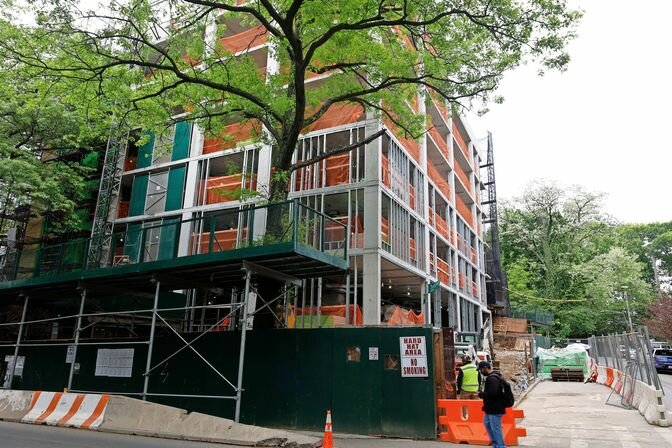
In between Stevenson Place and Sedgwick Avenue is an active construction site, where the whir of machinery is heard often. It is set to be a seven-story building, following the erection of another seven-story building on Sedgwick, called The Rowan, which is described on StreetEasy as “refined luxury living.” The company associated with these properties, Innovative Development & Construction, declined to comment.
Sandwiched between these properties is Patricia Klarl, who has lived in her family’s stone house for more than 20 years. She expressed disappointment for the houses that were torn down to make room for new development.
“We all understand in the neighborhood the need for housing,” Klarl said, noting the size of the new buildings. “It just changes the characteristics of the neighborhood … But you can’t stop progress.”
The recent rise in development is due to a few factors, according to Charles Moerdler, a former city buildings commissioner and chair of the Bronx Community Board 8 Land Use Committee. It goes back to moves by former mayors Bill de Blasio and Eric Adams — especially Adams’ landmark City of Yes initiative — that aimed to address the city’s housing shortage through zoning reform and other measures. In the last mayoral election, there were also three proposals on the ballot that looked to fast-track affordable housing by limiting the number of parties needed to approve a building site, which critics said took away community input. Van Cortlandt Village is also zoned in a way that lets developers build taller buildings.
In the last few months, Van Cortlandt Village residents have mobilized over concerns about rapid development. Natalya Girshman, who lives in Park Reservoir, wrote a letter along with neighbors to Bronx Community Board 8 and the New York City Planning Commission April 14, expressing strong opposition to the development trajectory. It cited narrowing streets and rising traffic, aging sewage infrastructure, a perceived increase in crime, and alleged harassment of homeowners to sell their properties.
“The rapid replacement of single-family homes with multi-story, high-density units is not development” the letter reads. “It is the destruction of our community’s character and safety … Our neighborhood is turning into a city within a city, and we deserve a say in our future.”
The letter proposed a temporary suspension of development until a comprehensive study could be done to address neighbors’ concerns. It was sent with 150 signatures.
The city’s planning commission told The Press it would review the letter with sister agencies, and keep lines of communication open with the community. It also said that as the city faces an unprecedented housing shortage, it’s vital every neighborhood does its part.
Van Cortlandt Village has built less than 300 new homes since 2010, the commission said, and greater Riverdale has generated a net gain of 2,336 homes in that time, which is the third lowest in the borough.
Residents emphasized opposition to the “Not in My Backyard” phenomenon, when individuals are against development in their neighborhood due to the proximity. Instead, they stressed the importance of housing, but with more input from the community. The sewer may be the most potent side effect of development cited by concerned neighbors, but it is certainly not the first for community members who say they have been sounding the alarm for years.
“How about a little planning? How about a little insight from the people who already live there?” Stoller said. “It’s not a NIMBY thing.”
Keywords
Van Cortlandt Village,
Bronx development,
sewage leak,
Stevenson Place,
Bronx housing development,
infrastructure concerns,
Bronx Community Board 8,
City of Yes