
New York’s top prosecutors want better access to mental health courts to connect people charged with nonviolent crimes to treatment.
District attorneys and lawmakers are pushing Gov. Kathy Hochul to sign a bill into law that would allow people with a mental illness who are charged with a nonviolent crime to have their case transferred to a neighboring county with a mental health court if one isn’t available in their home county.
“Maybe they have a clinician that isn’t in the county where they offended, but could be accessed if we were in a different county,” said Mary Pat Donnelly, president of the District Attorneys Association of the State of New York. “…Find those offenders who are offending simply because they have a mental health issue.”
New York has about 40 mental health courts in 26 of its 62 counties — meaning about two-thirds of the state doesn’t have one.
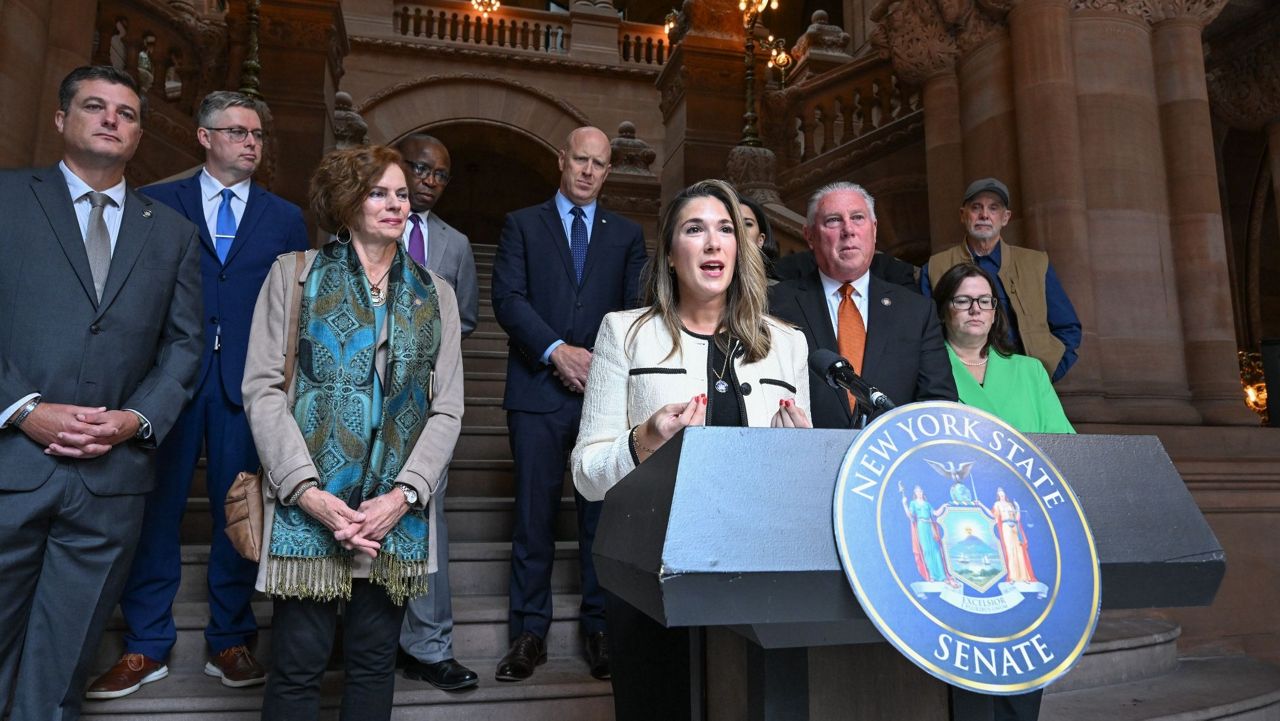
District attorneys joined lawmakers in Albany on Wednesday pushing Hochul to sign the measure to allow a nearby county’s mental health court to take the case if the court, defense and both DAs agree. The legislation passed unanimously at the end of session.
Donnelly, a Democrat who serves as Rensselaer County’s district attorney, said expanded access to mental health treatment would reduce recidivism for low-level, nonviolent crimes.
“We can come right out of the box and say that’s what’s needed in a particular case, but figuring out how to get from A to B is very difficult,” she said.
Ulster County doesn’t have a mental health court, which Ulster DA Manny Nneji said often forces judges to dismiss a case where people with mental health issues are charged with a misdemeanor. That person typically falls through the system’s cracks until they re-offend, he added.
“When you make the determination that the person suffers from mental disease or defect, and then the case is dismissed, the person goes into a black hole until they re-offend,” Nneji said. “You cannot do anything with them until they commit a violent felony or a homicide or something more serious that brings them to the felony level.”
Hochul must sign or veto the measure by the end of the year. Bill sponsor state Sen. Michelle Hinchey said it was a top priority this session.
Hinchey, a Kingston Democrat, represents the 41st Senate District, which has one mental health court across four counties and 56 towns.
“Not only is that not serving our region, it’s not getting the services we need,” she said. “…I’m very excited for the governor to sign this bill. This will immediately provide more services to epoepl across our state and that’s what we’re here to do.”
Albany County District Attorney Lee Kindlon said mental health courts serve as a one-stop shop for nonviolent defendants to get the help they need.
He told Spectrum News 1 that Albany County is prepared to take cases from other counties, and bridge the gap with alternatives to incarceration.
“I think everyone understands that whatever resources are necessary, it’s worth it,” Kindlon said Thursday. “Because I tell you, we’re going to spend far less money getting people into mental health court, getting them treated and sending them on their way than we would just incarcerating somebody. Because we know that’s not always the answer.”
Kindlon and lawmakers both said costs to counties would be negligible to implement.
DAs said it may be more cost effective for counties to share mental health courts as a consortium than smaller, less densely populated counties operating a specialized court on their own.
The state Unified Court System supports the legislation.
“We understand that incarceration and punishment is not necessarily the way to go,” Kindlon said. “And if the courts, the prosecutors, the defense attorneys all get together and agree that maybe the root cause of the criminal behavior is a mental health problem, mental health court is there to help work through this problem.”