

Broadway has always had weak seasons. Not every year produces a “Hamilton,” “The Book of Mormon,” or “Hadestown.” But even mediocre seasons usually produce at least one genuinely exciting new musical, one show that reminds audiences why the form still matters.
This season never found that show.
Only six new musicals opened on Broadway this year, an astonishingly small number compared to last season, which featured 14 new musicals. The resulting Best Musical lineup of “The Lost Boys,” “Schmigadoon!,” “Titaníque,” and “Two Strangers (Carry a Cake Across New York)” feels less like a showcase of Broadway’s best than the byproduct of an industry retreating into survival mode after years of financial disappointment.
This contraction did not happen in a vacuum. Recent seasons were flooded with ambitious new musicals carrying capitalization costs exceeding $20 million, only for many of them to collapse commercially within months. Last season alone offered cautionary examples in “Smash” and “Boop! The Musical,” two expensive productions that opened with significant hype and quickly ran into financial trouble.
Those failures appear to have fundamentally changed Broadway’s appetite for risk. Investors have become far more cautious about financing expensive new musicals, making it increasingly difficult for productions to reach Broadway at all. The result is far fewer opportunities for something extraordinary to emerge.
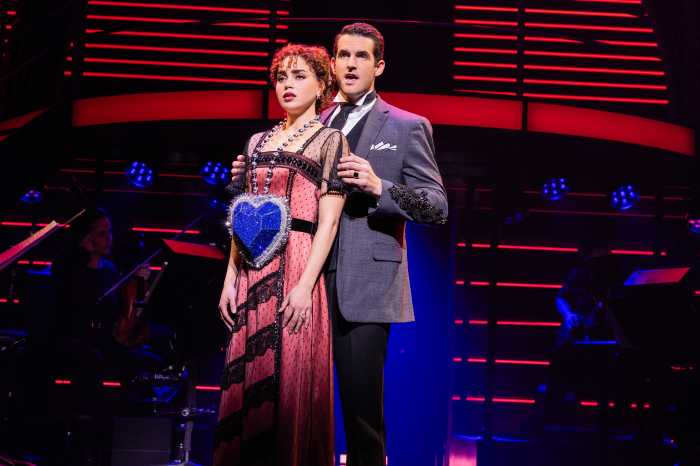 Melissa Barrera as Rose and John Riddle as Cal in “Titanique.”Photo by Evan Zimmerman for MurphyMade
That diminished pipeline is reflected in this year’s Tony race, which became dominated by musicals that often feel artistically thin or simply misguided. What ultimately wins Best Musical feels unusually difficult to predict, largely because none of the nominees has emerged as either a major critical triumph or a genuine commercial hit. Each show has its defenders and devoted fans, but none has established the kind of overwhelming momentum typically associated with a Best Musical winner.
“The Lost Boys” buries shallow characterization and forgettable songs beneath effects-heavy spectacle. “Schmigadoon!” stretches an affectionate parody premise far beyond its limits. “Titaníque” functions more as an extended camp sketch than a fully realized musical. “Two Strangers (Carry a Cake Across New York)” is a sappy two-hander so slight that it barely leaves an impression.
Ironically, “Dead Outlaw,” the darkly offbeat musical about outlaw Elmer McCurdy’s corpse becoming a traveling attraction, might easily have won Best Musical had it waited one more year to reach Broadway. After premiering Off-Broadway in 2024, the show transferred last season but struggled commercially amid a much stronger and more crowded field. Against this year’s competition, its eccentric originality would likely have seemed comparatively daring and substantial.
In stronger years, none of this season’s nominees likely would have been nominated for Best Musical.
The New York Drama Critics’ Circle decision not to give an award for Best Musical this year quietly acknowledged something awards culture rarely admits openly: not all Broadway seasons are equal. Some years produce classics. Others simply produce winners by default.
To Broadway’s credit, the musical revival season was considerably stronger. “Ragtime,” “The Rocky Horror Show,” and “Cats: The Jellicle Ball” demonstrated that audiences still crave ambitious, imaginative musical theater. And for most theatergoers, the distinction between a “new” musical and a revival matters less than whether the experience feels fresh and exciting. “Cats: The Jellicle Ball” reinvented familiar material so radically that it practically functions as a new musical.
But revivals cannot sustain the art form indefinitely. The long-term vitality of Broadway depends on creating new musicals that future generations might someday want to revive themselves. That is what makes this season feel less like a temporary slump than a warning sign.
Broadway still has extraordinary artists and audiences eager for compelling musical theater. The troubling question is whether the industry can realistically make producing new musicals economically feasible again on a meaningful scale. If costs remain this high and investors remain this cautious, fewer new musicals will continue reaching Broadway, and seasons like this may become less of an anomaly and more of the new normal.