
ROCHESTER, N.Y. — More than half of the people jailed in New York state wind up back in jail within three years of their release, according to the NYS Division of Criminal Justice Services. One jail has started a pilot program using music to help inmates break that cycle.
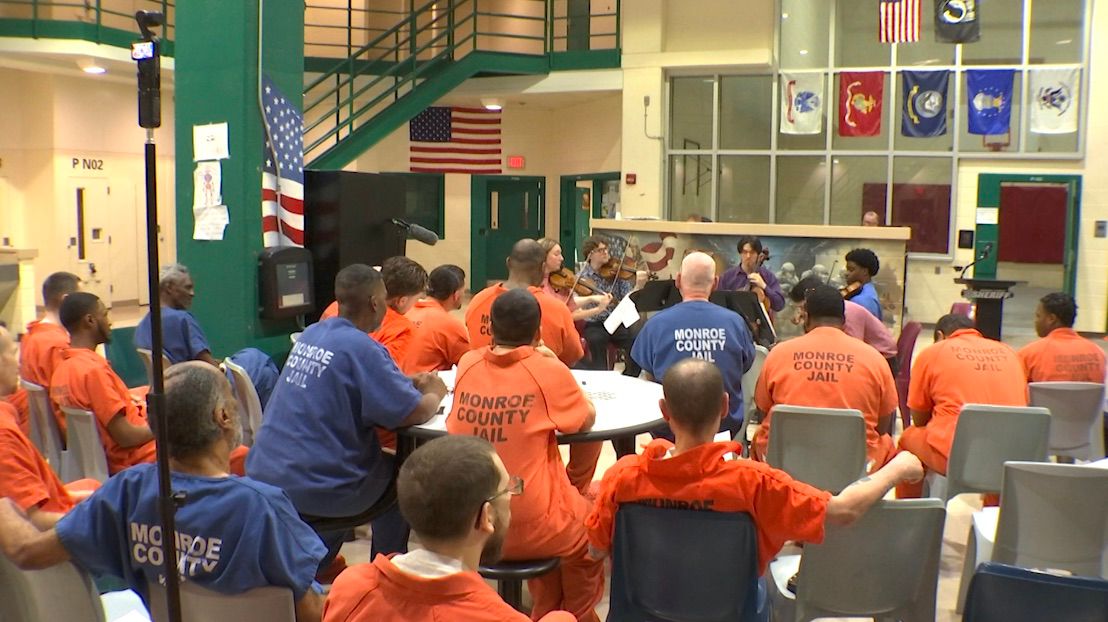
Musicians from the Eastman School of Music recently played a concert that was certainly unique to them. The Monroe County Jail inmates in the audience are part of a jail drug rehabilitation program.
“When you [commit a] crime, you get locked up,” said inmate Frank Cremaldi. “The last imprint that people have of you is the negative thing you were doing.”
Cremaldi is awaiting transfer to state prison, where he will serve a two- to four-year sentence. He has been locked up several times and says he’s battled addiction for two decades.
He is one of a half dozen inmates who are not just listening to the songs – they composed the music using a computer software tool, working side-by-side with students from Eastman.
”Being in addiction, I mean, it’s hard to start something and finish it,” said Cremaldi. “This just gives me an opportunity to start something, to finish something, to be proud of something, which, at the end of the day, it just motivates me to do better knowing that I can do that.”
Musicians visited the jail several times, using a computer software called Hyperscore to help the students compose their own mini-symphonies, which they played at the concert.
“I’m generally not of the belief that punishment should be for the sake of punishment,” said musician Aiden Hughes. “It should be for the sake of rehabilitation. Always. And I thought this program was really brilliant.”
Music therapy is part of a pilot program at the jail, helping those who are here to change their ways.
“I think the most beautiful thing about this project is, it’s really not about the music,” said Elinor Freer, Eastman associate professor of piano and chamber music. “The music is the tool, but what it really is about is learning skills, life skills, making decisions, working as a team, working collaboratively.”
Drug counselors work closely with jail inmates to try and get to the root of their addiction, and oftentimes, family members are also involved in the process.
“This was a very courageous thing for them to do,” said Joel Yager, MCSO director of drug rehabilitation. “Our success, it’s hard to give a number, but we have a lot of people who have not been back.“
It’s been said that idle hands do the devil’s work.
“Yeah, they do,” said Cremaldi. “From experience, I can tell you that.”
The program’s success is measured by how many can stay out of jail.
“I think I speak for all of the guys who are involved, how grateful we are for the opportunity,” said Cremaldi.