
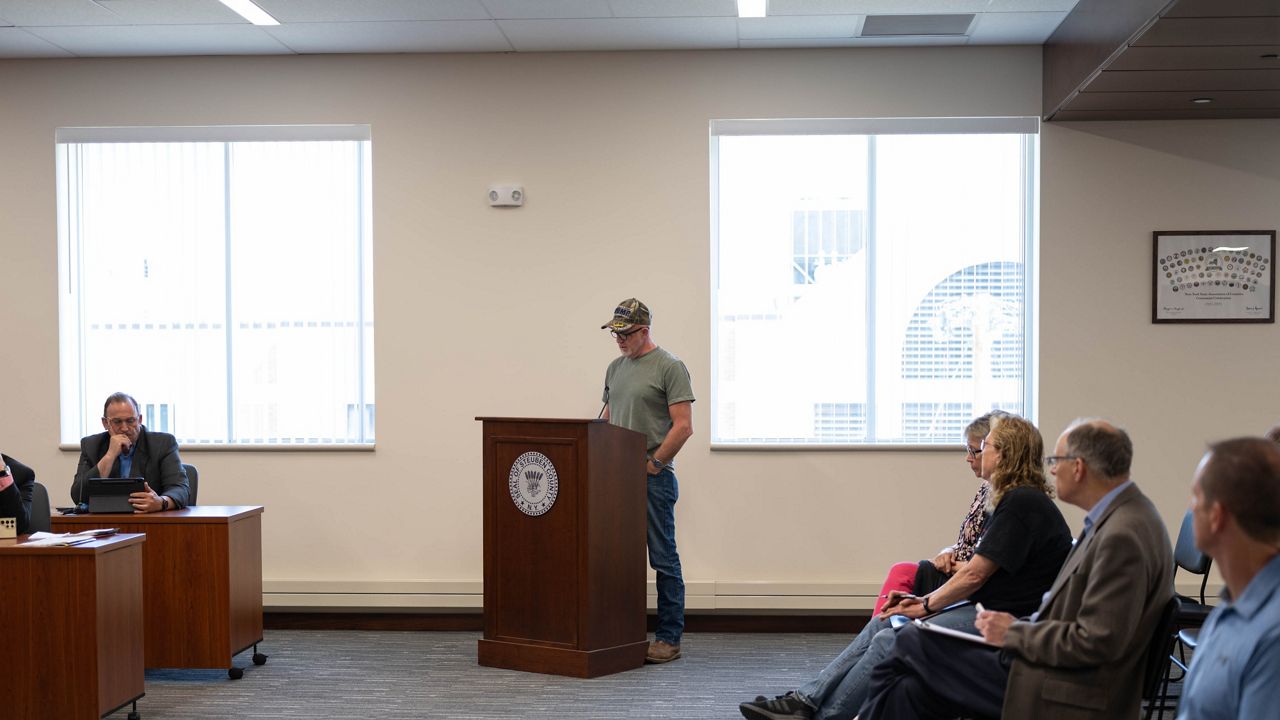
Steuben County legislators unanimously passed a six-month moratorium on issuing new permits to spread sewage sludge, which can contaminate the water supply with dangerous forever chemicals.
Residents in the area have asked the county to take action for decades.
“It’s better late than never, but I think that it’s a very good step if it can be followed through with something meaningful,” said Wayne Wells, who has been attending the county legislature meetings for 40 years to discuss the issue.
The moratorium would prohibit anyone in the county to get a new permit to spread sewage sludge on farmland, but it wouldn’t impact the two permits that have already been issued in the county. One permit is issued to Casella Bonny Hill Organics in Thurston and the other is for the city of Hornell, which land applies its biosolids.
“I think the economic pressure to maintain these permits is going to be pretty powerful,” Wells said.
Wells and his neighbors believe the farm, which now belongs to Casella Bonny Hill Organics, is responsible for contaminating streams, ponds and drinking wells with per- and polyfluoroalkyl substances due to spreading sludge for decades.
“I live near where sludge spreading has been, and now I live with contaminated wells, ponds, streams and soil. Don’t let this happen to other farmland in our beautiful county,” said Eva Turner prior to the vote.
Turner lives near the Bonny Hill property, and her stream is contaminated with high levels of PFAS.
Tim and Lisa Hargrave also live near the property and have a stream contaminated by PFAS. That led the Hargraves to discontinue raising beef cattle on the property. Following the passing of the moratorium, Tim Hargrave said he still wants to see more action against spreading sewage sludge, but this is a step forward.
“The snowball is going to start getting bigger. I am going to start reaching out to some more of the towns and try to get some more of the towns within Steuben County to start adopting these moratoriums,” Hargrave said.
Michael Volino, Thurston town supervisor, led the charge in creating a local law for Thurston, and now, as a county legislator, has worked to get this moratorium passed.
“I think it’s a great first step that Steuben County has followed Albany County and Schoharie County in passing a moratorium,” Volino said. “It’s really great to see.”
Volino said that they are hoping the state would pass its own five-year moratorium, which is why they only issued the moratorium for six months. Last year, the bill passed the state Senate but did not get a vote in the Assembly. This session, the bill is in committee for both.
“Looking at the makeup of our state legislators, talking to our local representative, it’s clear that nothing is going to happen at the state level, and unfortunately, we have a governor who refuses to lead on this issue. As a result, it falls on counties and the towns,” Volino said.
The New York Department of Environmental Conservation is currently reevaluating their regulations around the use of sewage sludge. However, in the past, the agency cited source control as the primary solution to sewage sludge contamination.
“We’ve really been focused at the department and working with the legislature and others to really make sure that we’re trying to reduce the amount of emerging contaminants that go into the waste stream because that’s really the single-most important thing we can do,” said Commissioner Amanda Lefton in an interview last year.