
The Bayonne City Council officially introduced their municipal budget for 2026, totaling nearly $173 million with a 2.3 percent tax increase at last week’s meeting.
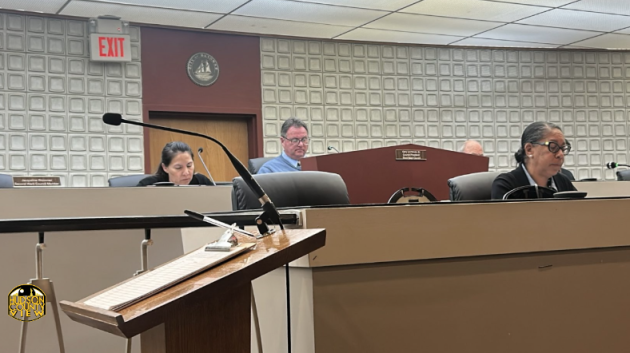 File photo.
By Dan Israel/Hudson County View
The governing body voted unanimously (5-0) to introduce the 2026 spending plan of $172,988,250.89. However, there was no presentation of the budget by any official at the meeting.
According to city spokesman Joe Ryan, Chief Financial Officer (CF) Donna Mauer said the budget comes with a $105,889,178 tax levy, which marks a 2.3 percent increase from last year’s $103,476,875.07.
The tax levy consists of $100,365,530.37 to be raised for municipal purposes, $1,731,610.45 for the school district, and $3,792,037.56 for the library.
This equates to roughly a $123 annual increase on the average assessed property of $400,000, according to Mauer.
Looking into the budget itself, HCV found that the revenues consist, in addition to the over $105 million tax levy, of $12,100,000 from the surplus and $350,000 from delinquent taxes.
On the surplus side, this is increased substantially by $5,350,000 from $6,750,000 last year while delinquent taxes are down slightly from $400,000 last year.
In addition, the appropriations include $54,649,072.51 in miscellaneous revenues, which are down significantly by $8,157,391.90 from $62,806,464.41 last year.
According to the introduced budget, the miscellaneous revenues include $26,535,950.88 in local revenue largely from payment in lieu of taxes (PILOT) agreements, up by $2,451,650.71 from $24,084,300.17 last year.
State aid remained flat from last year at $8,935,091, as did revenue from shared services agreements at $627,453.
Private revenues remaining from last year that are present in this budget, including various grants and opioid settlement funds, totaling $1,327,172.45.
This marks a stark decrease by $7,462,603.9 from $8,789,776.35 last year.
Special revenue this year totals is $17,223,405.18, declining slightly by $3,146,438.49 from $20,369,843.67 last year.
This includes funds from: Port Authority Land Payment at $5,000,000; the Royal Caribbean Cruise Port at $2,416,140, the sale of municipal assets at $2,100,000, Spectra Energy at $1,651,494, and the parking tax at $1,599,403, among others.
Of the $172,988,250.89 in expenditures, $139,857,280.07 is for municipal purposes, up by $10,560,680 from $129,296,600.05 last year.
The bulk of that is for operations tallying $117,666,760, $9,323,347 from $108,343,413 last year.
Of the over $117 million for operations, the biggest line items were salaries and wages totaling $68,803,285, up by $4,187,285 from $64,616,000 last year.
Specifically, this included for $25,858,460 for police salaries, up slightly from $23,495,000 last year, and firefighter salaries at $21,431,025, also up by slightly from $20,030,000 last year.
Outside of operations, other big operating costs include employee group health insurance at $27,196,000, up by $3,787,020 from $23,408,980 last year.
The rest of that over $139 million for municipal purposes, the other $22,190,520.07 is for deferred charges and statutory expenses, up slightly from $20,953,187.05 last year.
The biggest item under that category is the Police and Fireman’s Retirement System of NJ at $17,196,843, up a bit from $15,850,343 last year.
In addition, the budget includes $9,245,077.78 for operations excluded from the municipal budget cap, decreasing dramatically by $8,029,317.95 from $17,274,395.73 last year.
This includes: $7,375,407.56 in other operations, up slightly from $6,354,429.69 last year; $3,792,037.56 for the maintenance of the library, up slightly from $3,613,409.69 last year; $332,000 for shared services agreements, flat from last year, and $1,537,670.20 in public and private programs offset by revenues, down dramatically by $9,050,295.84 from $10,587,966.04 last year.
On top of that, $19,663,248.80 is for municipal debt service, down slightly from $20,627,124.01 last year.
While total deferred charges increased a bit from $800,000 to $1,400,000 this year, the amount raised for the school district decreased substantially by $3,597,323.06 from $5,328,933.51 last year to $1,731,610.45 in 2026.
Rounding out expenses, there is $1,091,033.81 including in the budget for reserve for uncollected taxes, down slightly from $1,134,478.18 last year.
If the introduced budget is amended by the council, these numbers could change.
This roughly lines up with what Business Administrator Mary Jane Desmond, also the Bayonne board of education president and a recent mayoral candidate, said at a BOE meeting last month.
At the time, she said the council would introduce the budget in May before the municipal elections on May 12th, but that didn’t happen.
Nonetheless, her estimates of a $170 million budget with a 2.2 tax increase and a $124 average annual impact on taxpayers lines up with the introduced budget.
The Bayonne BOE introduced a tentative $233 million 2026-2027 scholastic year budget that comes with a 12 percent tax increase at the end of April, as HCV first reported.
The council is set to hold a public hearing and final vote at their next meeting on June 17 at 6 p.m. in the council chambers at City Hall at 630 Avenue C.