
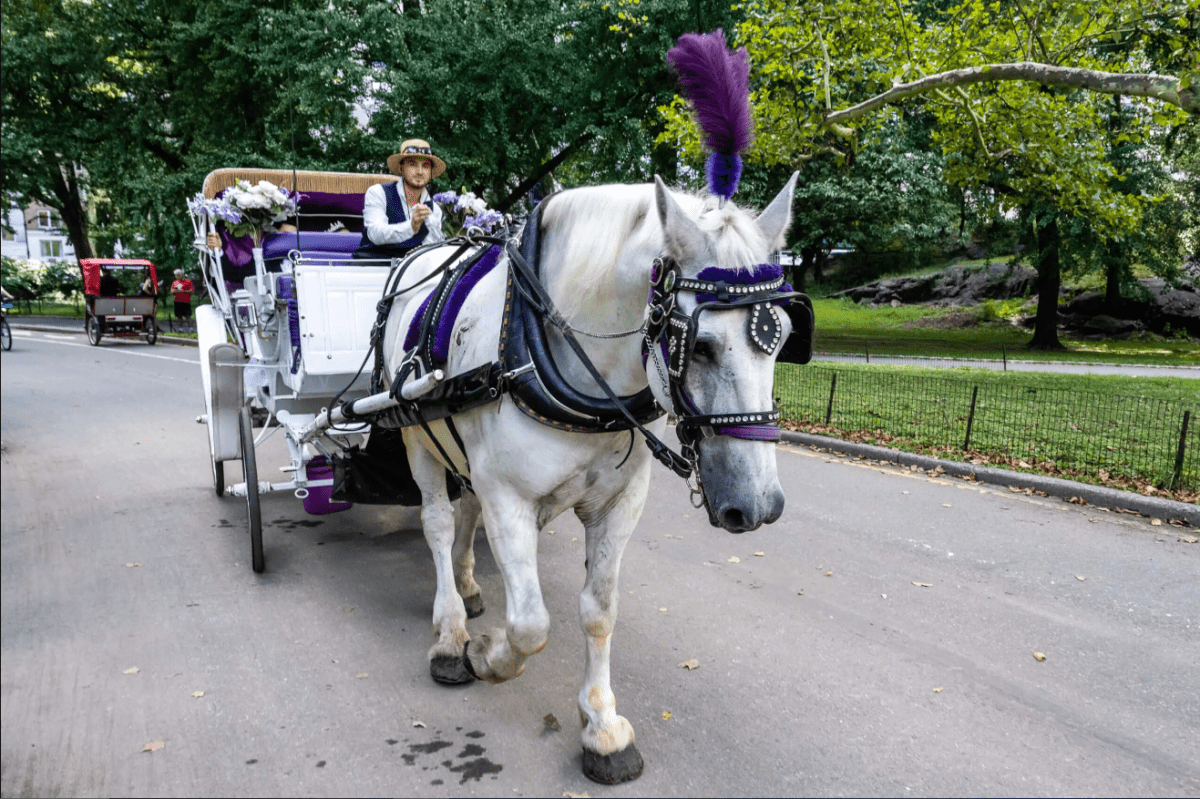
A horse-drawn carriage that toppled in Central Park on Monday is reigniting the debate between transit union members and animal welfare activists —- groups with concerns for both animal and public safety, as well as the livelihoods for carriage drivers in NYC.
The incident at the center of the controversy occurred when two horse carriages were parked, one behind the other, at W. 59th and West Drive in Manhattan on May 18, just before 4 p.m, the NYPD said.
Officers from the Central Park Precinct responded to a 911 call of a person in need of help. When they arrived, officers were informed that a carriage horse became startled due to an “abrupt movement,” authorities said, causing the carriage to overturn.
The 44-year-old coachman fell to the ground as a result of the topple; EMS brought him to NewYork-Presbyterian Weill Cornell Medical Center in stable condition.
The horse sustained no injuries; there were no passengers in the carriage at the time of the incident.
Following the jaw-dropping incident, the Central Park Conservancy immediately called for a ban on horse-drawn carriages in the iconic park and around the city.
“This incident is a stark reminder of the dangers that horse-drawn carriages pose in an increasingly crowded Central Park, not only to the park’s millions of visitors, but very often to the drivers themselves,” a spokesperson for the organization said.
In a historic move last year, the conservancy called for the city to end the horse-drawn carriage industry in the park, marking the first time it took a side in the ongoing controversy.
“The Central Park Conservancy renews its call to ban carriages in Central Park as a matter of public safety and public health,” the spokesperson added. “New York should join the growing number of major cities around the world that have already banned horse-drawn carriages before yet another accident is allowed to happen.”
Horse-drawn rides are ‘part of what makes Central Park special’
Meanwhile, a spokesperson for TWU Local 100, the union that represents the city’s carriage drivers, refuted accounts that say yesterday’s incident started from a startled horse. Rather, the animal reacted after two carriages crossed wheels, she said.
“Carriage-horse rides and the horses are a popular attraction, part of what makes Central Park so special, and are an important source of jobs for an overwhelmingly immigrant group of New Yorkers,” the union spokesperson said.
The union has also maintained that the horse-drawn carriage fight is less about animal welfare than it is about vying for coveted real estate where the stable is located on Manhattan’s far West Side in Hell’s Kitchen.
“The stables are on valuable property that real estate interests would love to see vacant so they can be snatched up to build expensive high-rises,” the union spokesperson said. “This so-called debate has always at its core been about real estate, not animal welfare.”
Legislation to ban the industry
Edita Birnkrant, executive director of NYCLASS (New Yorkers for Clean Livable and Safe Streets), who is often at odds with TWU reps, told amNewYork that the NYC Council should reintroduce Ryder’s Law, legislation that would phase out horse-drawn carriages and replace them with electric alternatives.
“NYCLASS urgently calls on Speaker Menin and the City Council to quickly reintroduce and fast-track Ryder’s Law before more drivers, members of the public, or horses are seriously injured or killed,” Birnkrant said. “Yesterday, another violent and entirely foreseeable carriage horse crash unfolded in Midtown, underscoring that the continued operation of horse carriages amounts to reckless endangerment of horses, drivers, and the public.”
She said she and others who witnessed the incident were concerned about the driver, as well as the horse working in the sun during a heat advisory.
“These incidents keep happening because horses are skittish prey animals who do not belong in chaotic Midtown traffic,” Birnkrnat said. “78% of polled New York voters support passing Ryder’s Law, along with the Mayor, the Central Park Conservancy, and countless horse experts. The City Council must act now before the next tragedy occurs.”
But horse-carriage drivers maintain that their animals are loved and cared for.
“Every equine veterinarian who has examined the NYC carriage horses has remarked on their good health and care. The American Veterinary Medical Association, the American Association of Equine Practitioners, and the New York State Veterinary Medical Society have all endorsed horse-carriage rides in New York City,” the union’s website states.
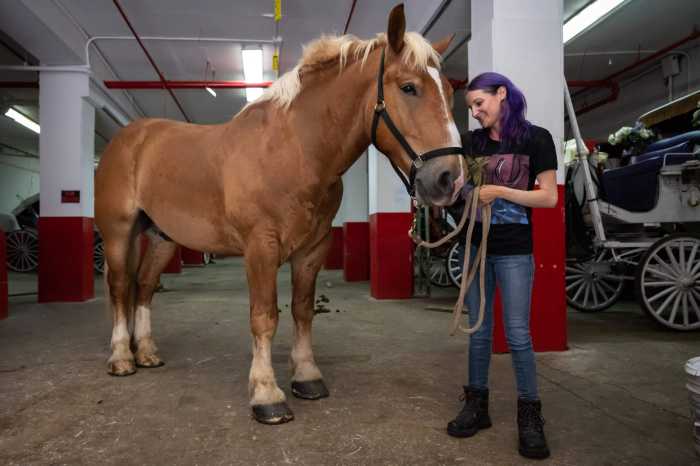 Horse carriage driver Jill and her horse Scout, a new arrrival, wait for an exam. Photo by Gabriele Holtermann
Ashley Byrne, director of PETA, agreed with Birnkrant that the City Council should pass Ryder’s Law.
“It’s past time for the New York City Council to pass Ryder’s Law and end this dangerous, archaic industry before the next carriage overturns, the next horse collapses, or the next person gets seriously hurt or killed,” she said. “PETA notes that Ryder’s Law—named after a horse who collapsed on Ninth Avenue and later died—would ban horse-drawn carriages. Horses forced to haul carriages are subjected to exhaust fumes, extreme weather, and the constant threat of traffic accidents.”
Last year, former Mayor Eric Adams said he supported ending the horse-drawn carriage industry in Central Park. On Sept. 17, 2025, he signed an Executive Order “preparing for the cessation of horse-drawn carriages in New York City.”
Mayor Zohran Mamdani, who erased all of Adams’ Executive Orders made after he was in federally indicted on Sept. 24, 2024, said before he took office that he supports banning the horse-drawn carriage industry in Central Park.
Meanwhile, the NYPD said Monday’s carriage incident investigation remains ongoing.